A crew of NASA-selected research volunteers are undergoing a simulated journey to Mars, and Florida Tech doctoral candidate Anderson Wilder got a front row seat to the mission. He was one of two alternates picked for the latest Human Exploration Research Analog (HERA) mission from Johnson Space Center.
Wilder trained with the crew for weeks, preparing to move into NASA’s 650-square-foot closed simulation habitat if needed. The habitat acts as an analog for isolated, confined and remote conditions in various exploration scenarios; in this case, that’s a trip to Mars.
Wilder is the second psychologist to be selected for the program, as well the first HERA selectee to be educated by a former HERA member: Wilder’s advisor, associate professor of psychology Richard Addante, was the first psychologist to be selected for the program when he was chosen in 2017.
The four prime crew members taking part in the mission are Erin Anderson, a structural engineer at NASA Langley; aerospace engineer Sergii Iakymov; Brandon Kent, a medical director in the pharmaceutical industry; and Sarah Elizabeth McCandless, a navigation engineer for NASA’s Jet Propulsion Laboratory. They are staying in the habitat for 45 days while performing various scientific and operational tasks.
Jason Staggs, a cybersecurity researcher and computer science professor, was an alternate crew member with Wilder.
“There aren’t a lot of people who get selected and then even fewer actually get to go into the habitat,” Wilder said. “I’m honored to even be a backup.”
Wilder is pursuing a Ph.D. in industrial-organizational psychology at Florida Tech, and recently completed a master’s degree in aviation human factors. He researches team resiliency and human-machine interactions, along with how spaceflight contributes to astronaut neurobehavioral changes.
According to NASA, participants on the latest HERA mission (Mission XXVIII) prepared to complete tasks such as “harvesting plants from a hydroponic garden, growing shrimp, deploying a small, cube-shaped satellite to simulate gathering virtual data for analysis, ‘walking’ on the surface of Mars using virtual reality goggles and flying simulated drones on the simulated Mars surface.”
The crew will also deal with communication delays of up to five minutes long during their simulated approach to Mars.
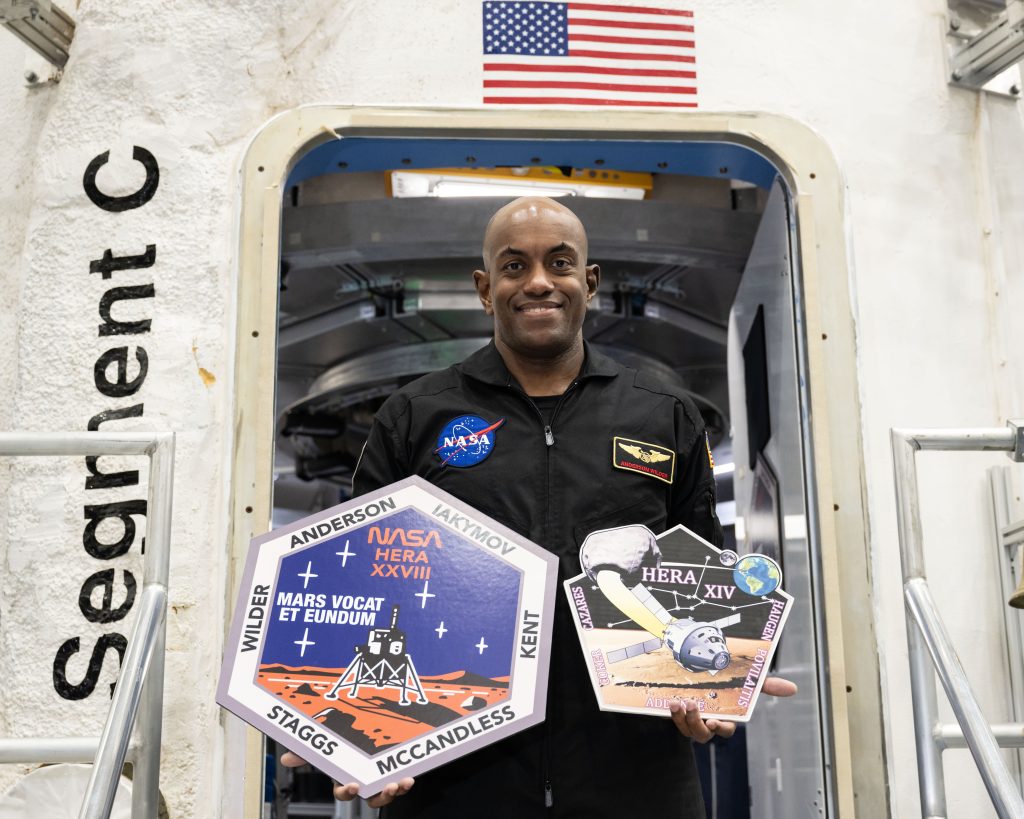
Addante was also originally chosen as an alternate but was promoted to the prime crew four days before HERA Mission XIV began.
According to Addante, alternates complete the same training as the main crew and can help with the mission where needed. The selection criteria for crew members, whether entering the habitat or not, is the same.
“They need [Wilder] to be ready to completely replace someone within a moment’s notice,” Addante said. “That’s what happened to me on very, very short notice.”
NASA’s HERA missions examine how people respond to the deep space conditions experienced by astronauts, such as isolation, confinement, work and life demands, and remote exploration. Wilder’s education in psychology and human factors gives him a greater understanding of how teams work together, and why failures in cohesion happen.
Wilder works in Addante’s lab, which investigates the cognitive neuroscience of human memory, brain states for improving performance and metacognition. Recently, he was the lead graduate student in a study conducted on NASA’s NEEMO 23 mission. The study proposed a new way of measuring the psychomotor interactions of working memory cognition and motor activity deficits in explorers such as astronauts and aquanauts.
Wilder also dreams of becoming an astronaut himself and has previously applied for NASA’s astronaut program alongside his advisor.
“The same as every young kid, from the time I can remember, I’ve wanted to go to space,” Wilder said.
Outside the lab, Wilder is an instructor for Zero-G. He coaches passengers from all over the world to operate in reduced and microgravity environments.
Even though Wilder didn’t participate in the 45-day simulation himself, he’s glad to have helped advance the science of human spaceflight.
“My goal is always to be able to do research and help move forward human spaceflight,” Wilder said. “NASA is using the data they get from HERA to figure out how to better select astronauts and to assist them while they are up in space, when they eventually go back to the moon and on to Mars.”