Prime is a quantity.
Unique, a product unachievable by any two other numbers. 2, 3, 5 …
Prime is a quality.
Excellent, of the highest caliber. Outstanding, Choice, Top-Notch…
In both quantity and quality, this column features Prime Examples of what makes us Florida Tech.
To grow is to increase—in size or amount, but also in value, importance. Whether it’s a sprouting plant, a
maturing child, a developing idea or an expanding venture, growth requires nurturing. Care, support and persistence beget progress, evolution, transformation. Big or small, fast or slow—for better or worse, growth is change. And what you plant matters. Bury seeds, harvest flowers. Cultivate diligence, breed success. Foster values, gain trust, integrity, respect.
You reap what you sow—and at Florida Tech, we’re growing greatness.
Here are a few Prime Examples.
2 Campus Improvements
Crimson Crossing

The first phase of Crimson Crossing is well underway, with foundational work, utility infrastructure and vertical construction making strong progress. Over the next few months, crews will continue framing, and the building will rapidly take shape. We’re on track and moving steadily through the core construction phase, targeting readiness for student occupancy in fall 2026.
Project ASCEND

Exciting progress is being made on the second floor of Vertex Applied Innovation Hub, with construction in full swing for Project ASCEND, a 30,000-square-foot, state-of-the-art space dedicated to additive manufacturing, composites, electronics manufacturing and materials testing. Phase One, a lab designed to support hands-on innovation, prototyping and advanced research and development focused on drones and autonomous systems, is on track to be completed this semester. The space will house an array of top-of-the-line instruments and equipment, including the Bruker X4 POSEIDON Benchtop X-Ray microscope—making Vertex the first customer globally to acquire this groundbreaking system.
3 Experience Upgrades

AI Undergraduate Certificate
Beginning this fall, students can enroll in our new artificial intelligence undergraduate certificate program—a seven-course curriculum offering fundamental knowledge and practical skills in AI applications, ethical considerations and specialized AI topics.

Aviation Meteorology Minor
The College of Aeronautics (COA) has launched a new aviation meteorology minor developed to deepen students’ understanding of weather’s impact on aviation operations. The minor covers topics including meteorological codes, charts and aviation bulletins; identification of potentially hazardous in-flight weather conditions; basic prediction techniques for flight planning; seasonal weather patterns; and the principles of atmospheric circulation, stability, convection, moisture, air masses and fronts.

Steps to Success
As the university’s Quality Enhancement Plan (QEP), Steps to Success through Transformative Advising, heads into its second year, 19 professional advisors staff the Office of Student Advising to help students succeed and support them in their timely progression to graduation. Evans Library’s second-floor renovation into a new Student Advising Center is well underway—aiming to be completed this fall semester— and more face-to-face events, including a new Grad School Expo, are on deck as we continue to improve the university experience and increase mentoring opportunities for students.
5 “Growing” Research Ventures

Seagrass Cultivation
Since the Indian River Lagoon lost about 75% of its previously abundant seagrass coverage between 2009 and 2021, researchers, including assistant professor Austin Fox ’15 Ph.D., have been studying seagrass growth and its potential impediments, such as declining water quality and increased use of herbicides. In his recent paper, Fox investigated the effects of the herbicide glyphosate on local seagrass, concluding that when used at recommended application rates, glyphosate’s acute toxicity is less likely to harm seagrass growth than eutrophication, degraded water quality and harmful algal blooms.
Maturing Monkey
Remember Mateo? The spider monkey who was confiscated from Texas wildlife traffickers in 2020 was brought to Brevard Zoo, where Florida Tech researchers, including assistant professor Catherine Talbot and associate professor Darby Proctor, helped rehome and integrate him into the troop at the spider monkey complex. After some initial struggles, today, Mateo is not only fully integrated, but he has risen from refugee to alpha male of the spider monkey community—an unexpected twist that highlights both his resilience and the powerful impact of our partnership with Brevard Zoo in supporting victims of wildlife trafficking.
Martian Meals
Can we grow food on Mars? Student and faculty experts, including associate professors Andrew Palmer and Toufiq Reza, are researching ways to cultivate crops in regolith—the dusty, poisonous substance that covers the Martian surface. Take an in-depth look at their projects and more.
Tissue Repair and Regeneration
In his Functional Biomaterials and Tissue Engineering Lab, professor Vipuil Kishore and his students create biomaterial scaffolds that mimic the native tissue in terms of composition, mechanics and structure, then add cells to create a graft. Their goal is to develop different kinds of scaffolds to control and direct cell function for specific purposes, like replacing a diseased or damaged site in bone or repairing common injuries, such as a torn ACL.
Underwater Organisms
In her research, associate professor Kelli Hunsucker ’07 M.S., ’13 Ph.D., studies plant and animal growth on underwater surfaces—preventing it on certain spaces (biofouling) and promoting it on others (ecological engineering). The Office of Naval Research currently funds her research evaluating different ship hull coatings and ultraviolet light to test their efficacy in preventing biofouling accumulation. She also partners with local communities to create “living docks,” which promote the growth of filter-feeding organisms to aid in improving the Indian River Lagoon.
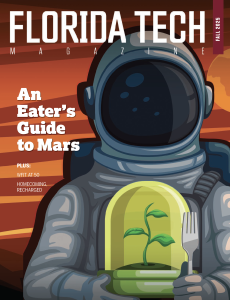
This piece was featured in the fall 2025 edition of Florida Tech Magazine.