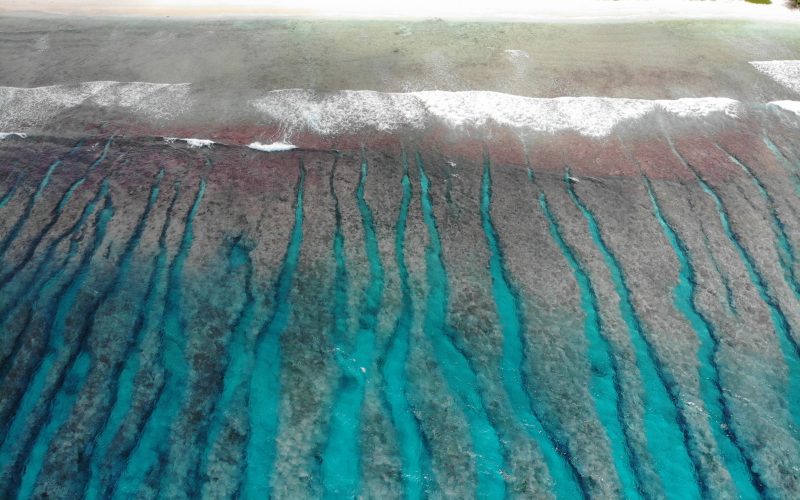
MELBOURNE, FLA. — Coral reefs over the past 12,000 years grew best when the ocean temperature was 77 degrees Fahrenheit (25 degrees Celsius), according to new research from Florida Tech.
Recent ocean warming and regional and local disturbances are reducing coral reefs’ capacity to keep pace with rates of sea level rise. This research is important because looking into the past helps us understand how reefs may respond in the future.
A global analysis of 1,890 geologic reef cores by Florida Tech Ph.D. candidate Tonya Macedo and professor Robert van Woesik, director of the Institute for Global Ecology at Florida Tech, found that coral reefs grew fastest when sea-surface temperatures were 75.2 –77 degrees Fahrenheit (24–25 degrees Celsius). Their findings were published in the PLoS One journal, “Growth on coral reefs peaked at 25 °C through the Holocene.”
“A global dataset of reef cores through the Holocene era (over the past 10,000 years) provides a unique opportunity to evaluate reef growth across regions over a long period of time. The results help us understand when and where reefs grew the fastest as well as how they previously responded to rising sea-surface temperatures and sea-levels,” Macedo said.
Reef growth peaked around ~77 degrees Fahrenheit (~25 degrees Celsius) when atmospheric carbon dioxide levels were 325 parts per million and at locations farther from the equator. When carbon dioxide concentrations increased, ocean temperatures rose, and reef growth declined.
Modern sea-surface temperatures are on average around 82.4 degrees Fahrenheit (28 degrees Celsius) in many regions of the world, suggesting that coral adaptation to warmer oceans has occurred over past millennia. However, contemporary ocean temperatures are at the upper limits of a reef’s adjustment capacity.
“There is concern for coral reefs as marine heatwaves cause mortality on present-day reefs. Intense and repeated marine heatwaves, high mortality rates, and slow recovery rates reduce the capacity for the reef to grow fast enough to keep up with a rising sea level,” van Woesik said.
Sea levels are predicted to rise in the coming decades as glaciers melt and ocean temperatures rise.
“Recent ocean warming, combined with local pollution, is eroding the ability of coral reefs to keep pace with sea levels,” Macedo said.
Coral reefs will only continue to grow and protect shorelines if they can keep up with sea level rise. Reducing local pressures on reefs highlights how individuals and local reef managers can help protect reefs from climate change.