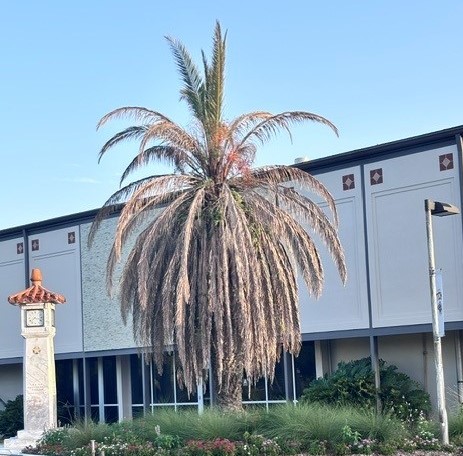
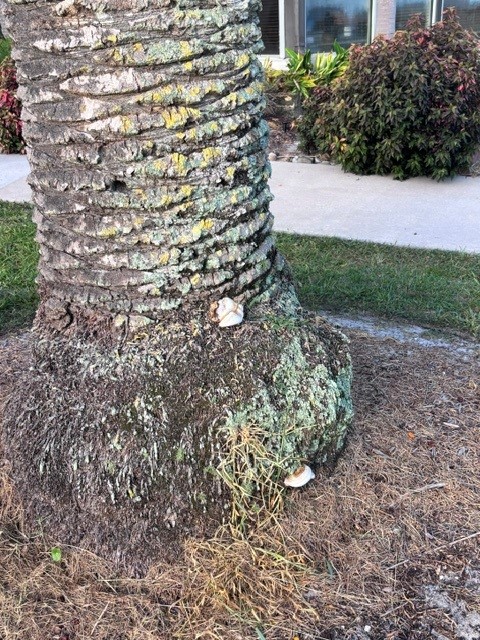
Several palm trees on the Florida Tech campus appear to be afflicted with a fatal, incurable fungal disease that renders their fronds wilted and sagging and their trunks dark and degraded and often riddled with growths.
Guided by the university’s commitment to campus safety and landscape management, Facilities staff actively monitors campus landscape and foliage for signs of disease and tree health concerns. It was during one of those inspections that the sickly palms were identified, said Lee Myers, associate vice president of facilities.
The presence of Ganoderma butt rot in a few trees, which will have to be removed in the coming weeks, does not indicate that all susceptible trees on campus are at risk, Myers said. There are also a few trees damaged by the early-year freeze that will have to be removed, which was the recent fate of the large Ficus tree that greeted visitors to the Gleason Performing Arts Center.
“Every year trees are being removed and replanted,” Myers said. “The freeze has increased that number higher than average with much larger trees being affected. Our outstanding and vigilant grounds team will evaluate and add more trees to campus whenever possible.”
The fungus Ganoderma zonatum causes the rotting disease. It has been found in 65 species of palms across Florida, and a related Ganoderma species has appeared in hardwood trees such as oaks, elms and ash.
Battling it is vexing for a few reasons, according to the University of Florida Institute of Food and Agricultural Sciences (UF/IFAS). One is that the conditions that lead to the disease are not known. Another is that, in many cases, infection cannot be confirmed until visible fungal growths known as conks appears on the trunk.
Yet even if there was a test, UF/IFAS notes that “there are currently no cultural or chemical controls for preventing the disease or for curing the disease once the palm is infected.”
Additionally, the fungus can remain in the soil and infected root material after removal, so rarely can the same species be replanted. Facilities follows industry best practices when performing tree maintenance and removals, with crews routinely cleaning and disinfecting equipment used for tree work, with additional precautions taken whenever work involves trees showing signs of decline or disease.
“Whenever the work involves a tree or plant showing visible signs of disease, the team increases the frequency of disinfection,” Myers said. “This proactive approach supports the long-term health and safety of the campus landscape.”