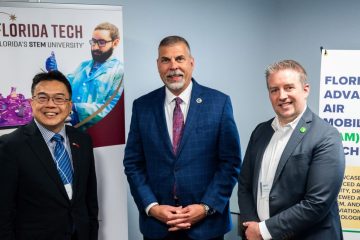
Florida Tech’s Madhur Tiwari and his students are working to build software architectures that will create 3D models from 2D images of unknown space objects. With a new $1.5 million grant from the U.S. Space Force and Air Force Research Lab, the assistant professor of aerospace engineering and director of the Autonomy Lab is ready to move this research into its second phase.
His lab is working in partnership with Creare, a New Hampshire-based innovator in the design and development of cryogenic components and systems, to design an algorithm that can produce 3D models of unknown objects using deep learning architectures. His algorithms will use machine learning to estimate 3D models of unknown objects – such as a spacecraft or debris – only using a few photos.
According to NASA, orbital debris includes nonfunctional spacecraft, abandoned launch vehicle stages, mission-related debris and fragmentation debris. They travel at speeds up to 17,500 mph, fast enough for even a small piece to damage a satellite or spacecraft.
Tiwari’s algorithms will aid in space exploration by helping construct 3D models of unknown objects in real-time, he said. It will bridge the information gap for someone who can see part of an object while the rest is hidden or obstructed.
“Let’s say a U.S. spacecraft is orbiting and we see an unknown spacecraft that we have never seen before. We can just take a couple of pictures and create a 3D model of it,” Tiwari explained. “That is the goal here.”
In 2023, Tiwari and Creare received a $150,000 grant from the Small Business Technology Transfer to kick off the project. Its first phase focused on feasibility: Is it possible for an algorithm to reconstruct a 3D model of an object with just few pictures?
Once that was proven possible, it was time to move into the next phase: solidify the algorithm while testing a simulated spacecraft under realistic space conditions. To do this, Tiwari is modeling the path of a spacecraft using accurate lighting, orbit and trajectory details. This is done in simulation and experimentally at the lab.
The algorithm is tested in simulation, where the researchers will collect the image data and use that to create a complete 3D model of a spacecraft or other debris.
Phase Two also includes determining the best algorithm for the job. It needs to be efficient enough to run from space, and it needs to be able to run on limited hardware, Tiwari said.
Once the algorithm is robust enough, it can be used to identify any kind of unknown debris or spacecraft in real time. Ideally, the technology should be ready for implementation on a real mission by the end of this phase, Tiwari said.
“We’re seeing an exponential increase in space debris. What drives me is that we are playing a part in delivering something towards that problem,” Tiwari said. “We can characterize this debris or space object and then eventually do something with it.