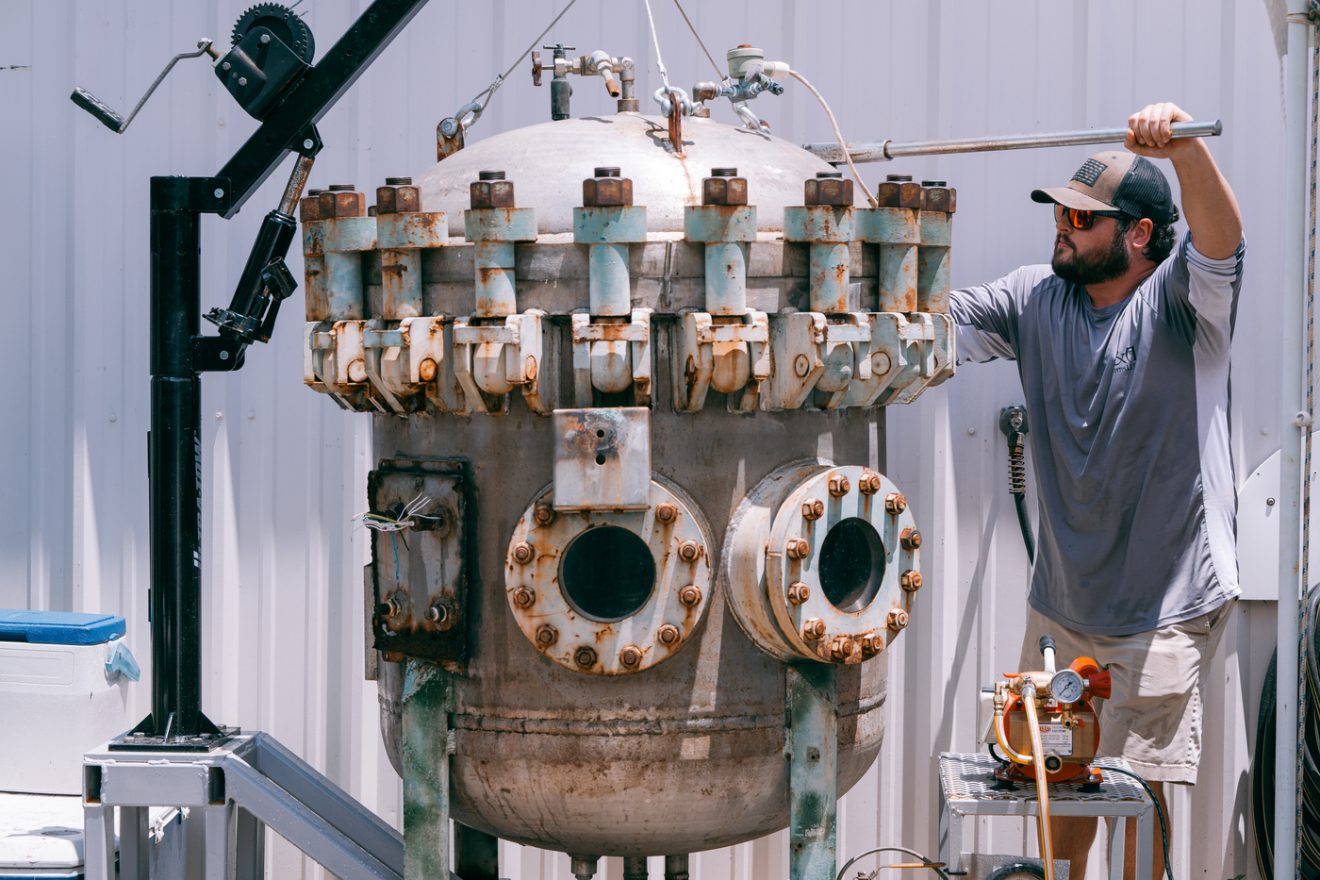
A group of Florida Tech researchers is working to understand how deep-sea water pressure affects biofilms and larger biofouling organisms by refurbishing a handy tool: a deep-water pressure chamber.
Biofouling is the growth of a bacterial film or larger marine life, such as barnacles, after an object’s surface is submerged in water. It can inhibit a ship’s functionality by slowing it down, which forces the ship to use more fuel and emit more greenhouse gases. All existing commercial antifouling paints and coatings were designed for use on surface vessels. The U.S. Navy is interested in how those materials are affected by hydrostatic pressure, and if repeated pressure cycling negatively impacts their ability to discourage or prevent biofouling.
The chamber was originally built by Edwin Link, the visionary inventor of the flight simulator, ally of Florida Tech founding president Jerome Keuper and co-founder of the Harbor Branch Oceanographic Institution. Link, whose name graces the Florida Tech building home to ocean engineering and marine sciences, donated the chamber to Florida Tech.
The chamber can simulate the pressure of up to 1,000 feet below the surface of the ocean. However, the chamber hasn’t been able to reach that depth due to a faulty pump.
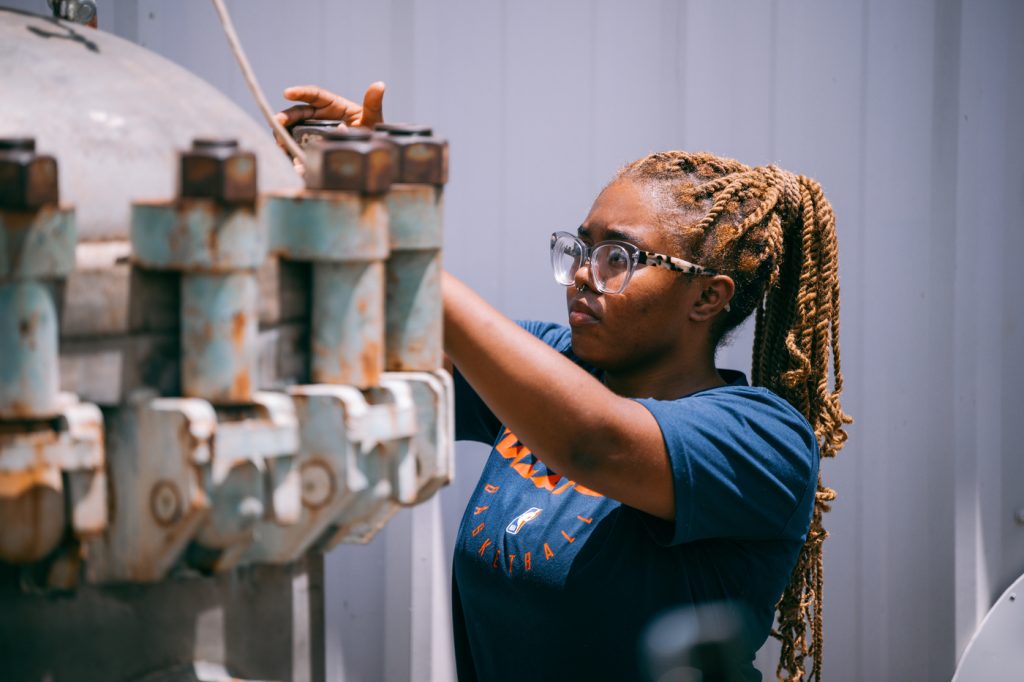
With recent funding from the Naval Undersea Warfare Center, assistant professor Kelli Hunsucker and Ph.D. candidate Geligne Franklin are conducting deep-sea biofouling research using the pressure chamber. Though the chamber functions, part of their funding supports refurbishing it to make it fully operational. This was done through Florida Tech’s machine shop and design center.
Their research investigates how biofilms colonize surfaces and how those biofilms are affected by changes in hydrostatic pressure (e.g., when a submarine or unmanned underwater vehicle dives). With the chamber, they are looking to see whether higher pressure will kill biofilm-forming organisms.
“Do we even need to worry about the biofilm that’s accruing on a submarine? That was kind of the main driver of this,” Hunsucker said. “If you have a biofilm that grew in shallow water when the vessel was docked, and then it was subjected to different pressures, is that biofilm going to die off?”
Hunsucker’s previous research investigated this growth on ship hulls and how to mitigate it.
Starting with the pressure chamber, the researchers will see if fouling is even an issue at greater depths. If the fouling is killed by the pressure, the next question is how long it needs to be at that level to die, Hunsucker said. However, if the biofilm is still there after being subjected to the pressure, different questions will follow.
“If [the surface] comes back and this biofilm is still there, the biofilm can thicken or be a precursor for the next fouling layer, like barnacles and weeds and other things that’ll grow on top of it,” Hunsucker said.
As for the chamber’s improvements, Hunsucker’s team added several new components, including a new pump and cart. With the functioning pump, they want to finally try pressurizing up to the chamber’s limit of 450 PSI (about 1,050 feet deep).
“[We’re] really trying to push some of these biofilms to the max,” Hunsucker said.
Their first phase of testing has involved growing a biofilm on surfaces in-house, then pressurizing the surfaces inside the chamber to see how they are affected. The second phase will take place in the Bahamas to compare the results of the chamber to pressure in an actual ocean environment.
“I’m really excited to see how [the results] all come together,” Franklin said.