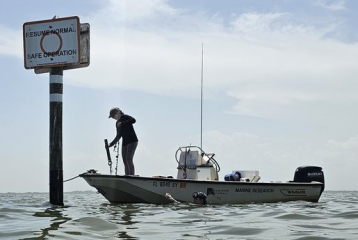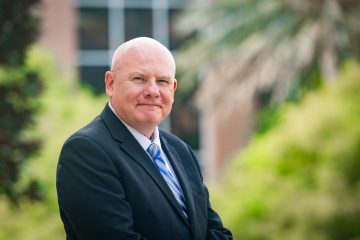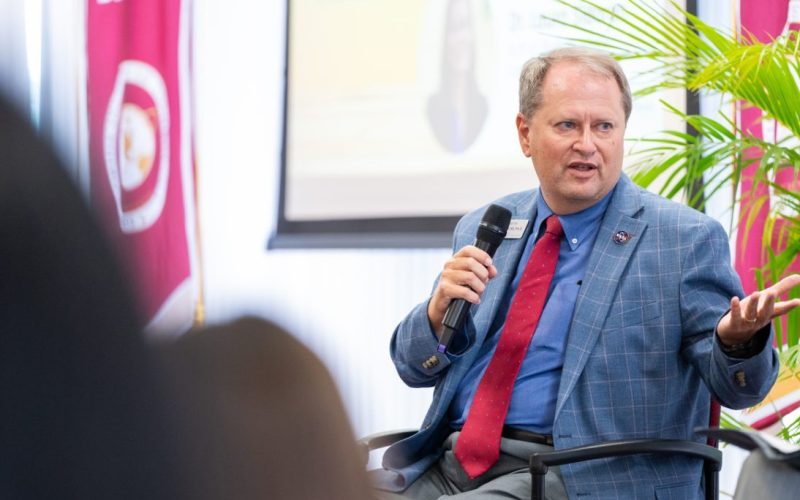
Over the last seven months, after extensive national searches, three academic positions have been filled that are essential to the success of Florida Tech and its students: the associate provost for research/chief research officer; and the deans of the school’s largest college, the College of Engineering and Science, and the College of Psychology and Liberal Arts.
They are scholars in biology (Amy Adamson), physics (Sambandamurthy Ganapathy) and psychology (Leslie Matuszewich), respectively, with the unique interests, academic backgrounds and research reflected in their varied fields.
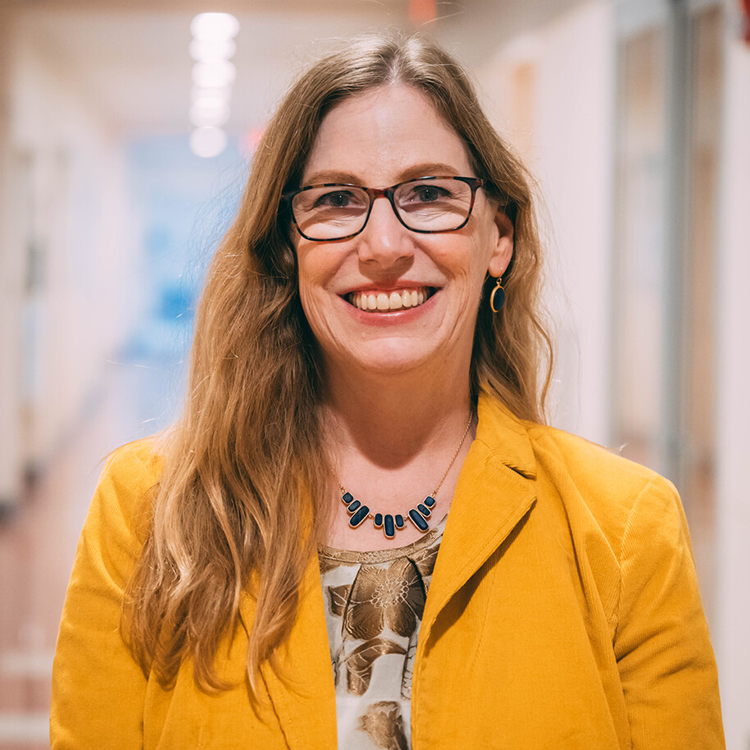
Adamson was associate dean for research for the College of Arts and Sciences at the University of North Carolina Greensboro, where she was a faculty member in the Biology Department since 2000 and associate dean for research since 2019. She earned her Ph.D. in biology from The Johns Hopkins University and a B.S. in biochemistry from the State University of New York at Geneseo. Adamson’s scholarly work has focused on the molecular interactions between Epstein-Barr virus and human cells, with a focus on how the virus initiates intracellular changes that can trigger metastasis.
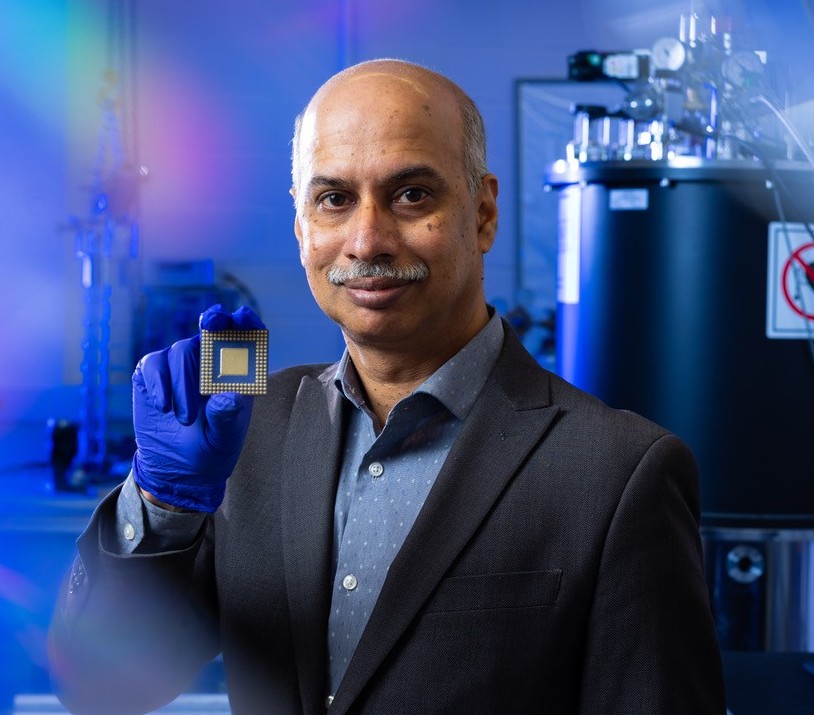
Ganapathy was associate dean for research in the College of Arts and Sciences and interim director of the Quantum Institute at the University at Buffalo (UB). He has been a faculty member in the Physics Department at UB since 2006 where he also served as chair of graduate recruitment, director of graduate studies and as department chair. He earned his Ph.D. in physics from the Indian Institute of Science. Ganapathy is an internationally recognized scientist working at the intersection of material science, quantum physics and interdisciplinary research.

Matuszewich was senior associate dean for research and graduate affairs in the College of Liberal Arts and Sciences at Northern Illinois University (NIU). As an associate professor in the Psychology Department at NIU, Matuszewich focused her research on the effect of stress on motivated behavior and dopaminergic systems in the brain. She has also served as department chair and director of undergraduate studies. She earned her master’s degree and Ph.D. in behavioral neuroscience of psychology at the State University of New York at Buffalo.
For the search committees that worked with the national firm, for the students, faculty and staff who attended candidate forums, and for Florida Tech Provost John Z. Kiss, who made final recommendations, the candidates boasted impressive CVs, extensive teaching and administrative experience and track records of strengthening the programs and departments they led.
But as the university’s top academic official, Kiss brought another layer of criteria to his evaluations as he looked beyond their accomplished scholarship and career successes. He talked about this in a recent interview. Answers are edited lightly for length and clarity.
QUESTION: First off, why are deans and top administrator positions such as chief research officer important to a university and its students? They aren’t usually in the classroom that much. So what is it they do to move their area or college and our students in the direction they think is best?
JOHN Z. KISS: Deans and senior leaders like the chief research officer matter because they shape the conditions that allow students, faculty and academic programs to thrive. Their work is mostly behind the scenes, yes, but it has a direct impact on the quality of education, the opportunities available to students, and the long‑term strength of the university.
QUESTION: Can you talk about what that impact is?
KISS: For instance, deans oversee departments and programs, making sure curricula stay current, rigorous and aligned with industry and research trends. They recruit strong faculty, mentor them, and ensure they have the resources to teach and conduct research effectively.
The Chief Research Officer focuses on the university’s research mission, which benefits students in ways that are not always obvious at first glance. For instance, the CRO helps secure grants, partnerships and infrastructure that allow students to participate in meaningful research.
In this role, Dr. Adamson will also support faculty scholarship, and when faculty have strong research support, they bring cutting-edge knowledge and real-world problems into the classroom. And raising the university’s profile, which exciting research can do, enhances the value of students’ degrees and attracts top faculty and collaborators.
QUESTION: Do you see a throughline in these three hires?
KISS: I do see a strong commonality among these three recent hires. First, all three subscribe to the teacher-scholar model for faculty. At its core, the teacher‑scholar model says that excellent teaching grows out of active scholarship, and active scholarship is strengthened by meaningful engagement with students. I have embraced this philosophy during my academic career, and I know all three new senior administrators see its merits, as well.
All three also have a strong record of collaboration and are real team players. As provost, I value my team, which includes deans, associate provosts and others, so I am very pleased to have a strong group that will be highly collaborative.
Finally, Drs. Adamson, Ganapathy and Matuszewich all have strong records in interdisciplinary collaborations. Working toward solutions of large-scale societal issues requires this approach as does providing a modern education to our students.
QUESTION: It must be rare that a provost has the opportunity to guide the hirings of multiple university deans and its top research officer, much less in relatively rapid succession.
There are committees and multiple voices offering their input, but have you yourself, faced with filling these positions, ever thought about them collectively? Do you think about any similarities or even differences that could be complementary?
KISS: Yes, I think the approach of these three senior leaders will be complementary. For example, as part of the “Programs Driven by Innovation” pillar of our strategic plan, I want to focus on building our research enterprise. Thus, the CRO must work closely with the two new deans on this endeavor. It turns out that Drs. Ganapathy and Matuszewich, as former associate deans for research, clearly have expertise and experience in this area. I also would like to foster interdisciplinary collaborations among our colleges, and the two deans and the CRO will play a role in these efforts.
QUESTION: As we conclude, what are your final thoughts about the newest members of your team?
KISS: We had a rigorous national search to find our three new leaders. I am very excited to have Dr. Ganapathy and Dr. Matuszewich join us in July and am pleased Dr. Adamson has already started in her new role. I consider myself fortunate to have this trio on my already strong team as we all work together to make Florida Tech the best it can be!