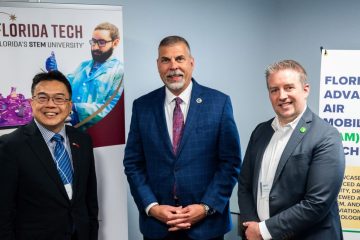
Florida Tech astrobiologist and assistant professor of aerospace, physics and space sciences Manasvi Lingam has been recognized with a 2024 Rosalind Franklin Society Award in Science for his paper exploring the likelihoods of life originating on Earth.
“A Bayesian Analysis of the Probability of the Origin of Life per Site Conducive to Abiogenesis” was declared the organization’s best astrobiology paper of 2024.
The RFS Awards recognize outstanding peer-reviewed research by women and underrepresented minorities in science, technology, engineering and math (STEM) featured across the 100 peer-reviewed journals from publisher Mary Ann Liebert, Inc. They also highlight the critical contributions of these researchers and the organization’s commitment to amplifying diverse voices in scientific discovery.
“The importance of this award for the department is that it recognizes such voices, as in Dr. Lingam’s case,” said Ratan Jha, head of the aerospace, physics and space sciences department.
To determine winners, the editors-in-chief and editorial board members across the journals nominate papers that demonstrate exceptional scientific contributions. They evaluate nominees based on scientific excellence and originality, potential impact on their fields and the rigor of methodology and research approach demonstrated.
Lingam’s paper was published Aug. 19 in the journal Astrobiology with help from Ruth Nichols ’24 and University of Rome astrobiologist Amedeo Balbi. They developed models that illustrate the relationship between hypotheses predicting varying numbers of potential sites on Earth for abiogenesis–the emergence of life from non-life–and the likelihood of life’s emergence at those sites.
“The origin of life–whether on Earth or elsewhere–remains one of the great unsolved fundamental questions of our age,” Lingam said. “How do we go from a soup of prebiotic chemicals to a complex living system–the first organisms?”
Lingam emphasized that this research does not claim to answer that question, but it instead illustrates how quantitative frameworks can be harnessed to place constraints on the probability of the origin of life in a conducive environment.
While the accolade is significant to Lingam, he believes the recognition should extend beyond him. He emphasized the role his community played in his pursuit of understanding.
“I do not consider the award important for my own sake, but rather as vindicating people that have supported and aided me: my parents and other close family, my close friends and my students,” Lingam said.
Each award recipient received a $1,000 cash prize and a certificate. In addition, all winning papers – including Lingam’s – are freely accessible for 90 days.