NASA is awarding two Florida Tech research efforts from engineering professor Hector Gutierrez for their roles in advancing space exploration as part of the agency’s $1.5 million initiative to fund a total of 24 projects designed to assist with future missions to the Moon and Mars.
Florida Tech’s submissions under NASA’s Dual-Use Technology Development Cooperative Agreement Notices (CANs) were a Contactless Magnetic Joint Actuator for space applications, which builds on previous NASA research, and spacecraft formation flight by a Smartphone Video Guidance Sensor (SVGS), which has been underway since 2017. Both are overseen by Gutierrez, a mechanical and aerospace engineering professor.

Florida Tech was one of just three grant recipients to receive funding for two projects. The others were University of Alabama and Northwestern University.
With the grants, Gutierrez’s projects will also get assistance from propulsion, space transportation and science experts at NASA’s Marshall Space Flight Center in Huntsville, Alabama.
“The NASA CAN program supports technology development of interest to NASA both at companies and universities. It fosters research, development and training outside of NASA while addressing specific NASA needs,” Gutierrez said. “It is a win-win program both for NASA and for those involved.”
Daniel O’Neil, manager of NASA Marshall’s Technology Development Dual-Use CAN Program, added, “Products from these cooperative agreements support the closure of identified technology gaps and enable the development of components and systems for NASA’s Moon to Mars architecture.”
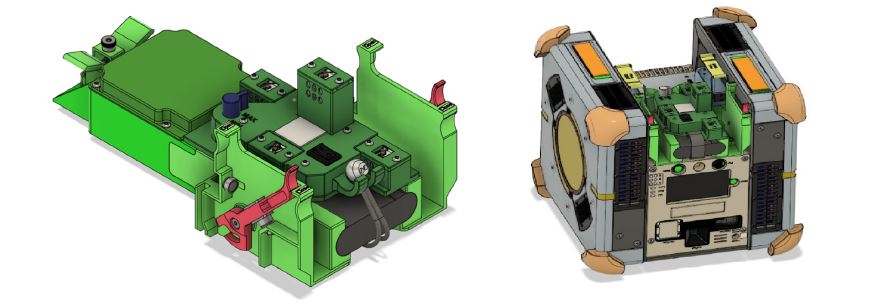
The SVGS is a vision-based sensor originally designed to run from an app on an Android cellphone. It allows for navigation and proximity operations by calculating the relative position and attitude of an illuminated beacon, relative to a coordinate system, attached to a camera on the host spacecraft. According to the proposal, its compact, low-cost hardware and small satellites allow for autonomous rendezvous, capture and formation flight.
The latest proposal supports a new SVGS demonstration through formation flight maneuvers using Astrobee, NASA’s free flying robots on the International Space Station (ISS). In 2022, the team deployed the SVGS using Astrobee four times; three maneuvers were successful, one was not, which Gutierrez said motivated significant technology improvements that led to the currently funded CAN award. Combined with existing navigation sensors, the new technology promises accuracy that’s not affected by occasional loss of sight during a maneuver or when faced with other environmental disturbances.
The Contactless Magnetic Joint Actuator is designed to benefit several space applications and builds on previous research at the Marshall Space Flight Center. The new proposal addresses three focus areas identified by NASA: dust mitigation with dust tolerant mechanisms and bearings; new sensors and controls for precision landing, surface navigation, hazard detection and avoidance to support spacecraft systems; and precision pointing subsystems for instruments to address the need for autonomous systems and robotics, according to the submission.
“The actuator project falls within an important area for development of dust tolerant mechanisms for long-term use in moon base operations,” Gutierrez said. “We are making good progress and are aiming to have a preliminary prototype operational by the end of the summer.”
The contract for the actuator started in September 2023.