Twenty feet below the ocean’s surface, just west of Florida’s Marquesas Keys, a mysterious box rests within an undocumented shipwreck. Senior Stephen Coster and his peers are clustered on the stern of the research vessel W.T. Hogarth with plans to take a closer look using a device called a side-scan sonar.
These students are on the second of three annual marine field project cruises this summer led by faculty in the university’s department of ocean engineering and marine sciences (OEMS). They are surveying the site where, a year earlier, the box was discovered on the Florida Tech fieldwork cruise.
Even underwater, it is difficult to lift. What could be so heavy? Professor of ocean engineering Stephen Wood, who led this summer’s first and third tours, posed that question to his students prior to departure. It could be lead, mercury or even gold, Wood says.
The immersive four-day trips, led by Wood and OEMS professors Robert Weaver and Austin Fox, involve discovery, as well as mystery, through surveying reefs and shipwreck sites near the remote Dry Tortugas National Park. Students get firsthand experience conducting fieldwork using scientific instruments while spending four days living aboard a research vessel, itself a powerful experience.
“You have all the challenges that come along with it: living on a boat, keeping yourself clean, making sure you don’t hurt yourself out there,” Coster says. “Then when problems arise, you’re dealing with them with all you have on the boat. Can’t get anything delivered to you. You just have to deal with it.”
In just a few days, the team of green undergraduate students evolve into practicing researchers. From the empowerment of learning a new field technique to the anticipation of seeing the mysterious box through their own testing, they learn what life could look like after graduating.
Troubleshooting on the fly
The W.T. Hogarth, a research vessel owned by the Florida Institute of Oceanography, sailed from St. Petersburg, Florida, to Key West, Florida, and on to Dry Tortugas National Park. It was home to 21 students studying ocean engineering (and one marine biology major) across the three tours this summer. The 78-foot boat came with satellite internet, cabin space to sleep 10 guests and a lab full of instruments.
About an hour after the second cruise departed, the team pulled out the first instrument: a conductivity, temperature and depth (CTD) rosette. The tool measures water stratification by finding the salinity and temperature of samples at different depths. The CTD is attached to a rosette, which is a metal frame that holds multiple sample bottles and often other sensors.
Due to an issue with a communication cable, however, part of the machine couldn’t function. Ready to troubleshoot, the students wasted no time in developing an on-the-spot solution. They strapped on hard hats and built a temporary system using the materials available on board, then watched as their handiwork was submerged twice.
It worked! They collected enough data samples to see the stratification while gaining confidence in their abilities to think on the fly, Fox says.
“When you come into a lab, everything’s set up, and we’ve made sure it’s working,” Fox says. “Often, getting to see that not everything works all the time when you go through that troubleshooting process is pretty cool.”
The mysterious box
The ocean engineers and their students first discovered the undocumented shipwreck and submerged box in 2023. Wood says the wreck was detected when he and Weaver ran a side-scan sonar over a reef and spotted a ship’s mast.
Weaver descended to the site with a student and remembers spotting the box. After struggling to lift it, he couldn’t help thinking that it could be treasure.
“When I went to move it, I realized right then that this is significant. Like, there’s something dense inside this,” Weaver says. After brushing off some of the fouling, Weaver says he found a lead terminal. He speculated it could be a ship’s battery, but that was never confirmed.
This year, Weaver and Wood returned to the shipwreck site to give more students a look.
Fox, Weaver and graduate student Jolie Elliott, all of whom had the necessary science diver certifications, descended to the wreck. Coster stood watch on the Hogarth’s stern, ready to jump in if necessary.
“Scientists are learning how engineers can help, and engineers are learning how they can apply their stuff to the sciences.”
Austin Fox, OEMS faculty leader
The remainder of the students snorkeled, watching the divers. When the divers resurfaced, they were met with eager eyes. Was the mystery box still there?
It was, and the students could try to find it for themselves by deploying the sonar for the first time on this trip.
Deploying the ‘fish’
As the sun began to set, Weaver instructed his students to exchange flip-flops for sneakers and towels for life jackets. The side-scan sonar sat ready to visit the wreck.

Half of the students were in the ship’s lab, where they made key operational decisions and watched the sonar’s imaging. Everyone else was stationed on the back deck, where they were responsible for handling the instrument. That meant listening closely to radio calls—if they were directed to lift the instrument 3 meters, they needed to quickly abide, or else they risked damaging equipment.
As the boat motored up and down the wreck, both teams hustled to prepare the instrument for deployment. Senior William Lochte stood on the edge of the deck, anticipating the signal to throw the expensive sonar into the ocean. It was his first time on a research vessel, and he wanted to take good care of the device.
“I didn’t want to let anything touch the deck of the boat because I didn’t want it to get scratched or anything,” Lochte says. “They were like, ‘You have to be careful when you’re pulling it out.’ But how do we put it in? ‘See how far back you can throw it.’”
“Clear to deploy,” the captain called over the handheld radio.
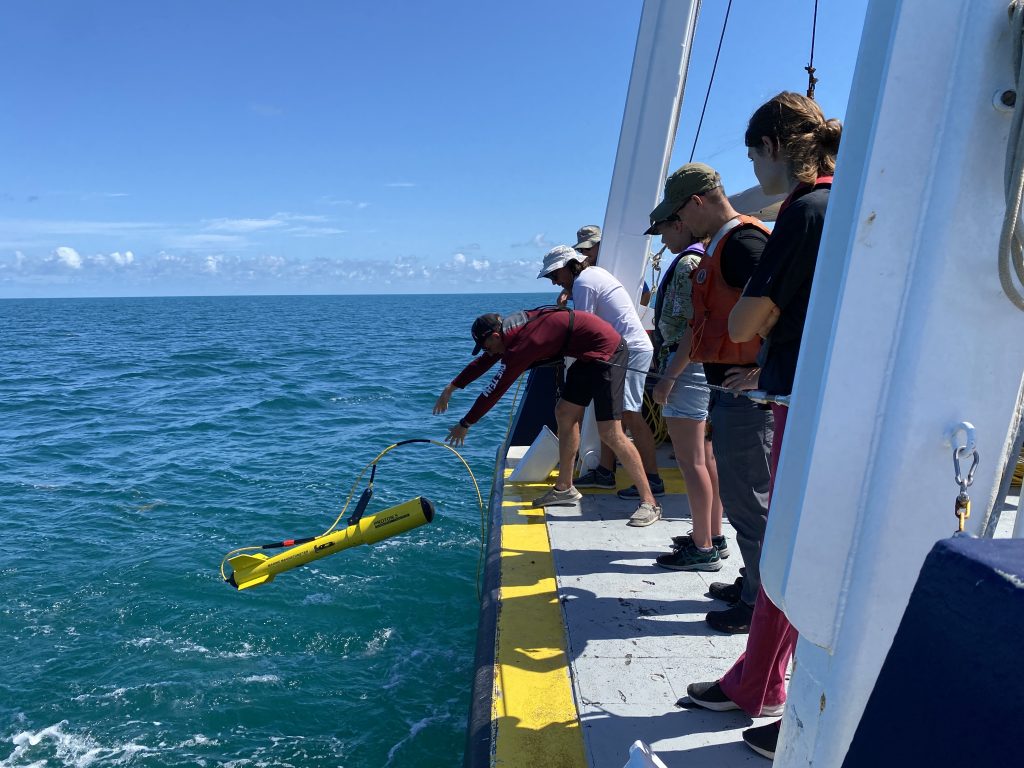
“Deploying the fish,” Coster responded, referring to the sonar. It was time for Lochte to throw it in.
With his classmates and Weaver handling the sonar’s cable, Lochte tossed the device successfully into the ocean. In the lab, students watched acoustic images of the seascape produced by the sonar. All eyes were on the screen when a crisp image of the wreck appeared, thanks to the students’ own survey.
“They’re out there putting all that work in … then, to be able to see the technology and what the technology enables you to see is pretty cool,” Weaver says.
Mixing the disciplines
While that concluded the treasure hunt for the second cruise, students continued to get their hands on new instruments. On the third day, the Hogarth arrived at the wreck of the 80-year-old Naval destroyer USS Amesbury for more underwater surveying.
There, they deployed the side-scan sonar, plus a magnetometer, to search for trace metals, a sub-bottom profiler to see the different layers of sediment below the ocean floor and a remotely operated vehicle (ROV) named Koda to get a close-up look at the wreck through its camera lens.
Everyone rotated between the lab, the deck and the bridge, where they learned the captain’s role in relaying important information about the water ahead to researchers. The hourslong day of testing included a simultaneous—ultimately unsuccessful—effort to spot SpaceX’s Starship, which launched from southern Texas in the middle of the day, in flight. (They ended up watching the livestream.)
As images from beneath the surface came in, Natalie Spohn, a marine biology junior, noticed something missing from the process: interpretation. Some of the data demanded more expertise than those on board had, Spohn says. While interpretation goes beyond the cruise’s main goals, she says it highlights the importance of collaboration between engineers and scientists in the field.
“That’s where science people come in,” Spohn says. “I think that’s why we need a combination. You need people who understand how [the instrument] works and how to get it to work and what it’s doing, and then, people to actually interpret the results.”
Scientists are often the people who deploy the instruments and interpret the results, Fox says. It’s why he and Wood encourage more majors within their department to get involved: Everyone would benefit from the learning experience.
The cruise also creates an environment for students from different disciplines to share ideas. Fox says it’s an icebreaker, enabling them to mix.
“You’re living with them for 24 hours a day for a few days … building those relationships,” Fox says. “Scientists are learning how engineers can help, and engineers are learning how they can apply their stuff to the sciences.”
There’s also some personal growth from the students while at sea, Weaver says. In many cases, it’s in their self-esteem.
“Yeah, they’re learning a lot, but there’s almost a little bit of maturity,” Weaver says. “There’s this evolution.”
The cruise pushes students out of their comfort zones. Someone afraid of making a mistake could be responsible for handling an instrument. Or, as Lochte explains, they could be tasked with delivering messages on the radio—a daunting task for many.
“I didn’t want to mess with the captain and the crew because they’re doing something very important. … If they mess up, everything messes up, and I don’t want to interfere with what they’re doing,” Lochte says.
With Weaver’s encouragement, Lochte says, each radio call got easier.
“It helped, most likely, a good number of us get a little bit out of our shell,” Lochte says of using the radio. “Since we were on this boat doing stuff, even our word is valid to the captain.”
“It’s great spending time with the professors. We have a good laugh. We have a lot of fun.”
Stephen Coster, senior.
Time for fun
The students also learned that there’s always time for a little fun, from fishing off the boat to plunging into the water from a rope swing to spotting constellations and Starlink satellites after dark. Students saw their professors as real people.

“When we’re in class, we’re serious. We’re teaching,” Fox says. “[But] we have fun, too. We enjoy jumping off the boat, too. We enjoy goofing off.”
The professors even led an excursion to Fort Jefferson at Dry Tortugas National Park, a destination only accessible by boat.
“It’s great spending time with the professors, you know? We have a good laugh. We have a lot of fun,” Coster says.
The marine field project cruise builds teamwork, collaboration and confidence. It’s the kind of learning that can only come from a hands-on, immersive experience.
Lochte, for one, left his first time aboard a research vessel ready to get back on the water.
“It definitely cemented that I wanted to work out in the field,” Lochte says. “I’m not sure exactly what I want to do, but I would love to help out with research.”
And, as for that mysterious box?
“The mystery is still there,” Weaver confirms.
“I think it will forever remain a mystery box,” Fox says. “I think I know what it is, but sometimes, we need mystery in our lives.”
Scuba in research
The roots of scuba diving lie in exploration. Though scuba is a popular recreational pastime, researchers continue to use it as a tool for discovery, whether as the main mode of data collection or to maintain oceanographic research tools.
In an age when advanced instruments can drive research, too, why not stay dry on land?
Stephen Wood, professor of ocean engineering, argues that no existing tools have the full capability of a human. He says the ability to grab items or quickly turn one’s head are difficult to replicate in a remotely operated vehicle (ROV).
He also argues that while robots can collect and send data, the ability to assess and interpret an environment through a human lens is essential.
“The human cannot leave [the research],” Wood says.
Robert van Woesik, professor of marine sciences, studies the dynamics of coral reefs around the world. He and his students analyze big datasets and scuba dive to examine and photograph coral assemblages, then return with information they can use to predict recovery from disturbances and future growth.

The ability to personally identify different species underwater is crucial to the understanding of coral reef dynamics, and van Woesik says that skill takes training.
“I think it’s still worthwhile knowing the species composition of a reef underwater instead of just saying, ‘Okay, we don’t need scuba divers anymore. We just need photographs and ROVs,’” van Woesik says.
He says he learns the most when he’s able to descend to a reef and see the seascape himself.
“I think there’s something to be said to just go in the water and ask some questions,” van Woesik says. “That’s the valuable part of being able to scuba dive, getting amongst it to experience the reef, in tandem with analyzing photographs from around the world on the computer.”
Austin Fox, assistant professor of marine sciences, often uses scuba for maintenance. In his study of the Indian River Lagoon, diving is essential for operating instruments and finding lost equipment.
“We spend a lot of time trying to figure out ways to do this stuff without diving…but there’s just no replacement for it,” Fox says. “We’re collecting data with other tools, but the only way to use those other tools is by scuba diving.”
Florida Tech scientific divers must attain a Science Diver certification through the American Academy of Underwater Sciences (AAUS). Any diver who plans to use compressed air or air blends, for activity involving teaching or research, must be in accordance with AAUS — that includes use of surface-supplied air.
The benefits of scuba extend beyond the water — it’s especially valuable for space exploration. Rick Addante, associate professor of psychology and biomedical engineering, studied astronaut cognition on the NASA Extreme Environment Mission Operations (NEEMO) 23 and NASA Neoteric eXploration Technologies (NXT) missions. Divers on the NEEMO 23 mission completed extravehicular activities 100 feet below water, mimicking a spacewalk, while living undersea for 10 days. The aquanauts worked for five hours at a time while breathing surface-supplied air and were supported by teams of scuba divers, Addante says.
Scuba allows astronauts to simulate outer space scenarios on Earth in operational conditions that are analogous to the extremes of space, he says, namely, being under water. Understanding changing pressurization levels, managing risks to life and learning to stay calm in crisis are just a few core lessons in both scuba diving and space travel.
“You don’t have another ‘space’ to practice in, so you have to find other ways to practice,” Addante says. “Scuba has provided the space program an excellent analog to prepare for success.”
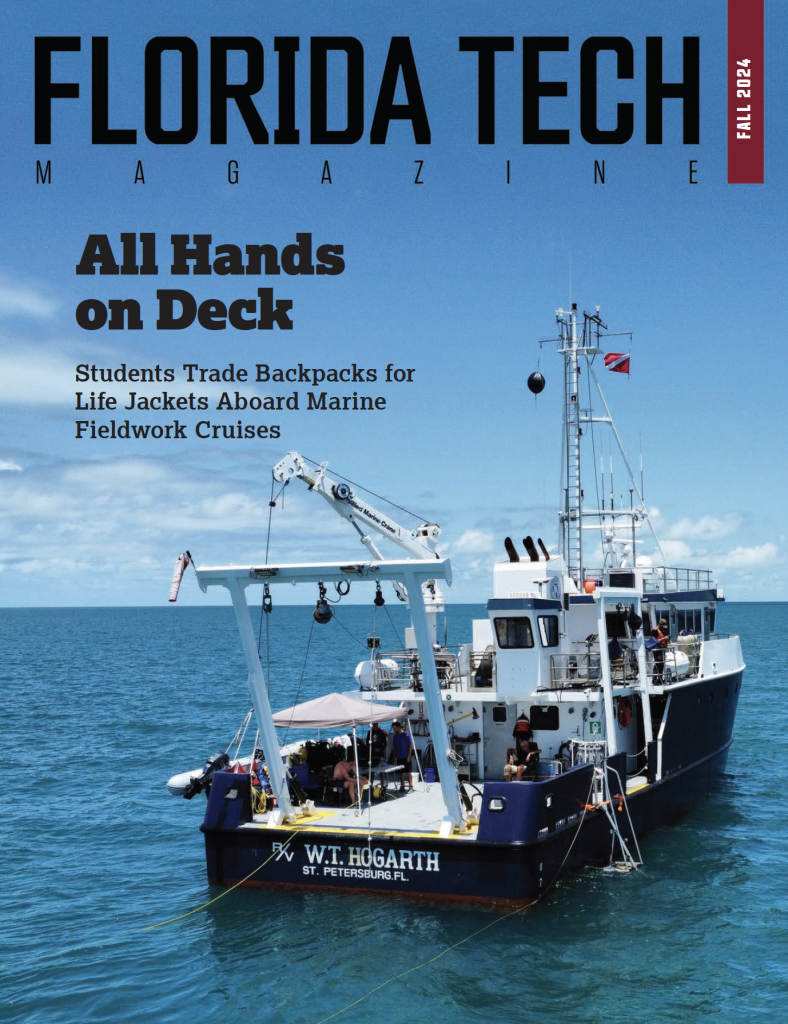
This piece was featured in the fall 2024 edition of Florida Tech Magazine.