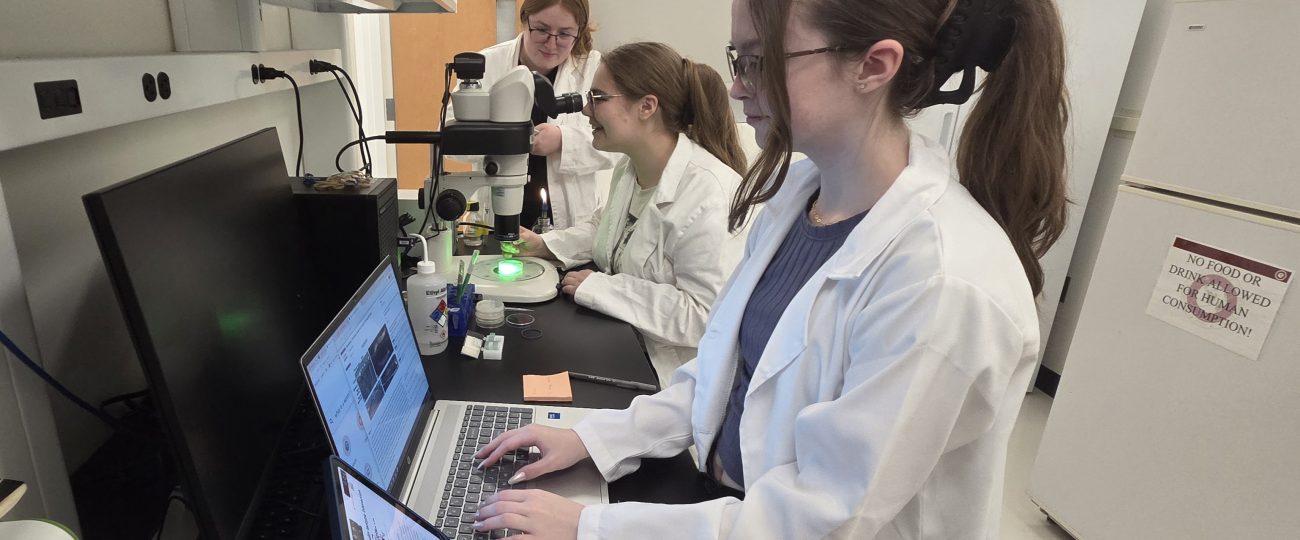
Florida Tech is moving into its second season of the Student Spaceflight Experiments Program (SSEP). Leading the way is this year’s winning project: “Effects of Microgravity on Neurodegeneration using Tauopathy Model,” by sophomores Cordelia Case and Kayla Conklin and juniors Alexis Hopper and Jessica Watkins. The experiment, which will explore the effect of microgravity on the rate of neurodegeneration found in diseases such as Alzheimer’s, is set for testing aboard the International Space Station (ISS) this year.
Their project is one of 20 proposals from universities across the United States and Canada selected to fly in SSEP Mission 21. It was also one of three Florida Tech finalists, selected by an internal selection committee featuring Provost John Z. Kiss, Andrew Palmer, Kunal Mitra and Brooke Wheeler.
The winning proposal investigates tauopathy-related diseases, which are characterized by the clustering of tau: a protein found to play a role in the degeneration of neurons. In these diseases, abnormal aggregation of this protein disrupts the structural integrity and function of neurons in the brain, leading to degradation. It’s established that microgravity can alter gene expression, but its effects on this specific type of neurodegeneration have yet to be researched, the students wrote in their proposal.
The students will compare the rate of neurodegeneration in microgravity by running identical tests in microgravity and on Earth. If successful, they will better understand whether microgravity accelerates or mediates tau-associated degeneration, providing insight for developing neuroprotective strategies in space and furthering scientists’ understanding of neurodegeneration, the proposal reads.
Florida Tech’s two runners up projects were: “How Does Microgravity Affect Protein Degradation in Metabolism” by Kaden Block, Brooke Mortillo, Olivia Weaver, and Conner Cadenhead, which would study the effects of microgravity on metabolic processes; and “PRISMAA: Prebiotic RNA Inclusion Study in Microgravity for Asteroidal Analogs” by Emilio Lugo and Allona Yehiav, which would explore the possibility of RNA transfer via asteroid.
Florida Tech’s inaugural SSEP season is simultaneously underway. Last year’s winning project, “Hydrogel-Radiation shielding viability under the influence of microgravity,” is almost ready for testing aboard Mission 20. The team is actively preparing their experiment for takeoff, currently set for August.