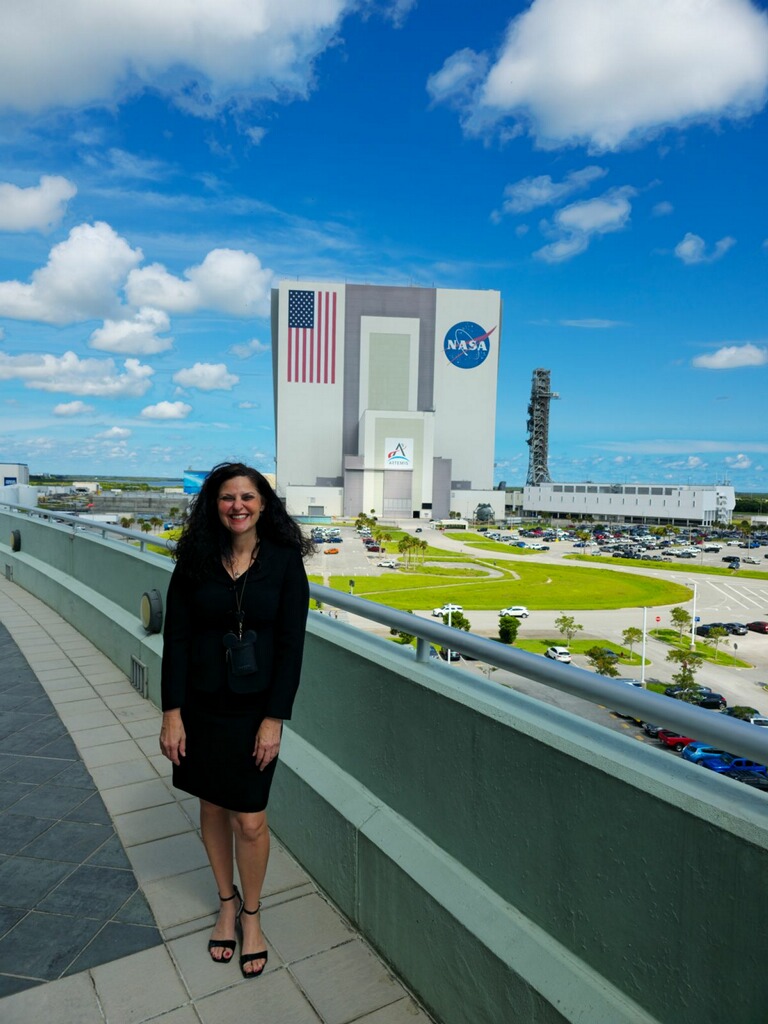
Florida Tech professor Debbie Carstens ’96 MBA spent four months on sabbatical at NASA’s Kennedy Space Center (KSC), conducting research and gaining valuable industry experience. During her time there, Carstens contributed to two key projects.
For the first project, she interviewed control room operators for the In-Situ Resource Utilization (ISRU) Pilot Excavator (IPEx), a rover designed to dig up lunar soil, known as regolith, and transport it across the Moon’s surface. The rover is designed to enable the extraction of vital resources, such as hydrogen, oxygen and water, which are essential for life support systems.
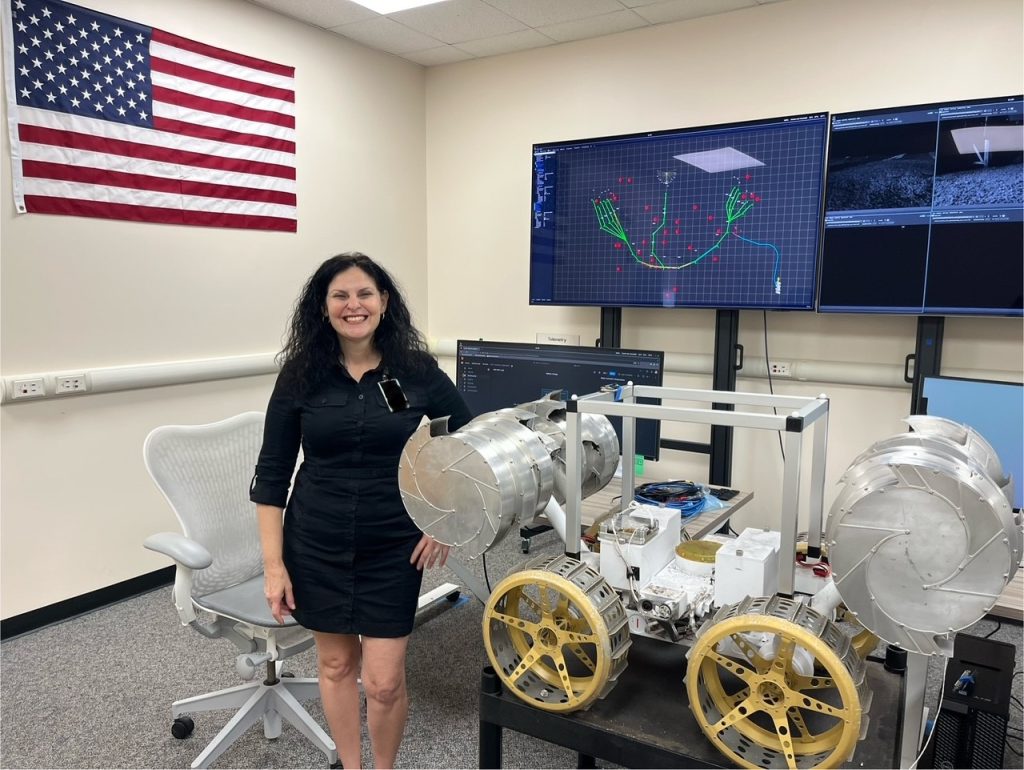
Carstens identified over 50 human factors recommendations for designing the Next Generation IPEx control room and facility. These recommendations included potential enhancements to screen displays, room layout, individual desk layout, lighting, shift work, shift changeover, control room employee interaction, control room environment, workload, rest area and food area.
In the second project, Carstens developed a human factors assessment tool and evaluated the Lunar Electrostatics and Dust Mitigation (LEDM) prototype, a device designed to remove static and dust from lunar spacesuits. She also created a second assessment tool to ensure future versions of the prototype meet human factors requirements for flight readiness.
“Witnessing the rockets and the collective dedication to safe crewed missions has been truly inspiring,” Carstens said. “I want to thank Florida Tech and NASA-KSC for allowing me this amazing opportunity.”
It was also a homecoming for Carstens, who previously worked as a civil servant in project management and human factors engineering research at KSC for 11 years. She started as a co-op while an undergraduate at the University of Central Florida until 2003, when she joined Florida Tech as a faculty member. She reconnected with many former colleagues during her sabbatical.
Carstens also currently serves as the graduate program chair for the College of Aeronautics, director of the Human Factors: Aeronautics, Safety, Sociability, Interfaces, Sustainability, & Training (HF ASSIST) Lab and site director for the FAA Partnership to Enhance General Aviation Safety, Accessibility and Sustainability (PEGASAS) Center of Excellence.