Graduation often marks the end of one story and the beginning of another. But for some Florida Tech students, the next chapter begins right where the last one ended.
By continuing from undergraduate study into a graduate program at Florida Tech, these students build on the momentum they have already established. The setting may stay the same, but the plot thickens: faculty relationships evolve into invaluable mentorships; coursework gives way to advanced research; and interests sharpen into research passions and professional focus.
Staying at Florida Tech for graduate school offers clear benefits for students pursuing multiple degrees, allowing them to move forward with confidence, supported by research continuity, trusted academic programs and a community invested in their success.
These are the stories of four students who chose to keep turning the pages—finding new purpose in familiar places and continuing their education at Florida Tech for the sequel.
Continuity in Research
For Andy Walker ’21, the pull to stay at Florida Tech for graduate school was the work itself and a mentor who knew how to guide without gripping too tightly.

After exploring several labs, Walker found his fit studying coral reef ecosystems and conservation in the lab of Robert van Woesik, professor and director of the Institute for Global Ecology.
“I became fascinated by the larger-scale analysis of coral reef ecosystems,” Walker says. “I always imagined myself out in the field—scuba diving and working directly with marine life—but then, I realized this lab was the perfect fit for me. Getting my hands on that data, mapping it and uncovering those patters was the moment I realized this is where I want to continue going.”
What began as a student-mentor relationship became a genuine research partnership.
“As an undergraduate, I looked up to Dr. van Woesik as a mentor—and I still do. But now, it feels more like I’m walking alongside him rather than following him,” Walker says. “He does a great job of grounding you, offering meaningful advice and gently guiding you forward.”
When it comes to Walker’s talent, van Woesik doesn’t mince words.
“Andy quickly transitioned from being a star undergraduate student to a major league player, writing papers with me in high-caliber international journals,” van Woesik says. “Andy is very creative but also scientifically rigorous, which are the perfect characteristics for success.”
Now pursuing his Ph.D. in biological sciences, Walker says staying accelerated his development.
“I’m confident that staying at Florida Tech was the right decision,” he says. “I have no doubt that if I weren’t at Florida Tech, I wouldn’t have been able to achieve this much so quickly.”
He credits the people around him.
“The only reason I’ve been able to do so well in graduate school—and stay sane—is because of the people I work with,” he says. “None of what I’ve accomplished so far would have been possible without them.”
For Walker, staying at Florida Tech meant carrying forward the research he’d already invested in and giving himself the space to see how far he could progress.
Tried-and-True Quality Education
For Ralph Rocco ’24, staying for graduate school wasn’t a gamble—it was a continuation of an academic experience he already trusted.
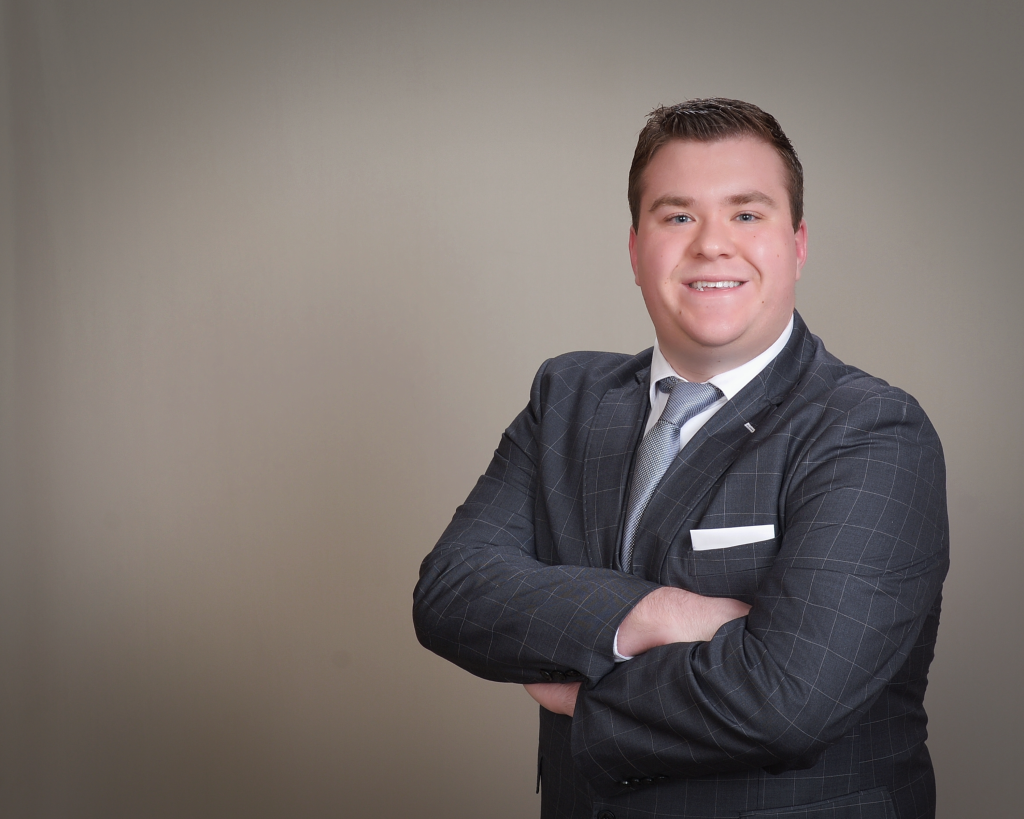
As an undergraduate, Rocco experienced firsthand what set the College of Aeronautics (COA) apart: faculty with deep industry experience, aviation-specific coursework and an environment designed to prepare students for the realities of the field. By the time he graduated, he already trusted the college’s quality—and that trust shaped his next step: pursuing his master’s in applied aviation safety.
“I already knew the quality of the education here—it’s a strong program, and I knew exactly what I was getting,” Rocco says. “I already knew my professors were not only experts in aviation but also genuinely cared about their students’ success and made sure we were equipped with the skills needed to make a positive impact in the aviation industry.”
A major influence was Rian Mehta ’13, ’15 MSA, ’17 Ph.D., COA associate dean, who helped Rocco understand how a master’s degree would build directly on the foundation he already had built.
“Dr. Mehta took the time to discuss the opportunities and value of continuing into graduate school at Florida Tech,” he says. “He really emphasized that continuing your education isn’t just about earning another degree but about deepening your expertise and professional readiness. That conversation was a key moment in my decision to stay.”
Mehta saw in Rocco the qualities needed to thrive.
“[Rocco] really stood out as an exceptional student and was always incredibly hardworking and inquisitive,” Mehta says. “This is exactly the mindset needed to be successful in graduate school, and I have no doubt he will go on to do great things in his career.”
Graduate school also brought Rocco closer to Debbie Carstens ’96 MBA, COA professor and graduate program chair, whose course and guidance pushed him into deeper research and industry-level problem-solving.
“Dr. Carstens has been incredibly helpful in guiding me through the graduate program—from selecting classes to identifying which skills would be most beneficial to add to my portfolio,” Rocco says.
His coursework reinforced that choice, connecting every lesson to the demands of the field.
“Staying at Florida Tech has prepared me not only by expanding my aviation knowledge, but also by allowing me to develop a well-rounded understanding of my field—deepening my understanding of safety—an area I now feel much more confident in.”
Rocco knew exactly what he would get at Florida Tech: a rigorous, reliable education. For him, that assurance made staying at Florida Tech an easy choice that has proven to be the right one.
Mentorship That Lasts
For Natalie Shah ’18, ’22 MBA, a biomedical engineering undergraduate alumna, the plan once involved a white coat, not a business suit. But a year working in a hospital changed how she imagined making an impact.
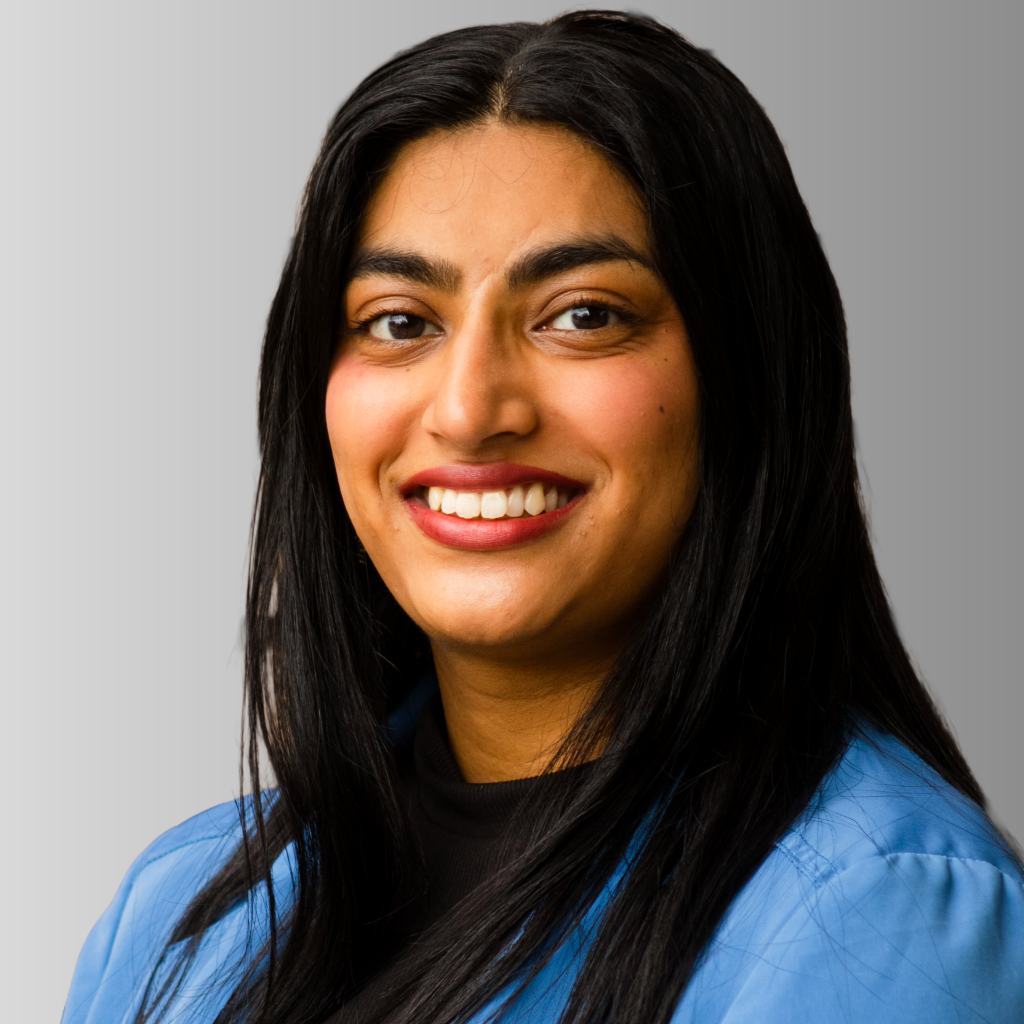
“Working in the hospital helped me see how clinical care and organizational strategy work hand in hand,” Shah says. “It was fascinating to see that the people making the biggest systemic impact weren’t necessarily the physicians—it was the business side, analyzing the data, making strategic decisions and implementing organizational ideas, that shape how care is delivered.”
She traded the medical track for an MBA—a shift that introduced her to the mentor who would ultimately define her graduate experience: Abram Walton, professor and Center for Innovation Management and Business Analytics (CIMBA) executive director.
As Shah’s interests shifted, so did her work with Walton. She began working in CIMBA, becoming a research scientist, gaining hands-on experience in innovation, strategy, artificial intelligence, human–autonomous teams and leadership. She co-authored papers, worked with industry partners and presented at the HR Florida State Conference—the largest HR conference in the state.
When Shah began exploring doctoral programs, Walton assured her he would mentor and work with her wherever she went, going as far as connecting her with faculty at other universities so she could hear directly about their programs and experiences.
Through those conversations, Shah said she learned a valuable piece of advice: Choosing a doctoral path isn’t about the name of the institution—it’s about the research you pursue, the purpose behind your work and the community that supports it.
“I had already been enjoying my collaboration with Dr. Walton, and I thought, ‘Imagine how much more we could accomplish if I stayed—more projects, more topics, more opportunities to grow,’” she says.
Walton sees in Shah the same potential she sees in herself.
“Through her work with CIMBA, Natalie has built a portfolio that is on par with the nation’s most accomplished graduate scholars—publishing original research, presenting at international conferences and leading major instructional design initiatives with confidence and skill,” he says.
Now pursuing her DBA, Shah says the decision to stay for graduate school—twice—was the right one.
“Florida Tech’s DBA program gave me the perfect balance—the ability to continue my research with Dr. Walton while also gaining pragmatic, industry-relevant experience,” she says. “I don’t think I would’ve found that balance anywhere else.”
Mentorship plays a role in every student’s story, but for Shah, it was the guiding force that made graduate school at Florida Tech the most impactful next step.
A Community That Cares
For Lillianna Vitale ’23, a clinical psychology doctoral student, returning to campus felt both familiar and new.

“It feels pretty surreal,” she says. “I really enjoy seeing the same faces—it all feels pretty natural to me—but it’s strange coming back and filling a different role.”
That role—researcher, clinician-in-training, mentor—was shaped by two faculty members who helped define her path: Julie Costopoulos, professor and head of the School of Psychology, and Marshall Jones, assistant professor and director of the Center for Applied Criminal Case Analysis (CACCA).
She worked with Costopoulos on her Forensic Clinical Research team, writing analytical summaries on mental health courts and exaggerated psychiatric symptoms, and even assisting in a sanity evaluation, an experience that solidified her path.
“It was honestly the best experience,” Vitale says. “Seeing it all firsthand gave me a glimpse of what my future will be like—everything just clicked.”
Vitale says Costopoulos modeled the kind of clinician she hopes to become—compassionate, empathetic and ethical.
“Her approach to forensic work combines precision and humanity—and that’s what you need when you go into the legal system,” she says. “I want to be her in the future.”
Costopoulos says Vitale’s focus sets her apart.
“Lillianna has always been clear on her focus and what she wanted to accomplish,” she says. “She is a go-getter. She takes advantage of all the opportunities in psychology—working with multiple faculty members on research, actively participating as an expert witness in mock trials, presenting at conferences and more.”
Vitale’s time in Jones’ CACCA, where she analyzed juvenile recidivism, shaped her as a researcher and encouraged her to stay for her Psy.D.
“Dr. Jones fostered a sense of community within our research team that made it incredibly difficult to imagine leaving,” she says.
Jones saw her curiosity from the start.
“Lillianna seized the opportunities to learn outside of the classroom,” Jones says. “When students adopt a mindset of curiosity and engagement outside the classroom, they can do amazing things.”
Now, Vitale serves as a graduate student assistant and project manager for CACCA, leading the same team on which she’d started.
“That full-circle moment has been incredibly meaningful for me,” she says.
Presenting her research at the Academy of Criminal Justice Sciences conference, she adds, “felt like the continuation of everything I’d been working toward, and seeing that work come to life in a professional setting was incredibly rewarding.”
Vitale’s message to undergrads:
“Florida Tech has been the place where passion turns into purpose—where I discovered not just what I love to do, but who I want to be,” she says. “If you already feel at home here, then stay. You’ll feel supported, cared for and encouraged by your mentors, who genuinely want to see you succeed.”
Her community had become integral to her growth, and for Vitale, those relationships made staying at Florida Tech feel not just natural but right.
The Next Chapter Starts Here
Four students. Four disciplines. Four reasons for choosing Florida Tech—again.
With the foundation that shaped their success already built—research, programs, mentors, community—they now devote more time to progressing toward their futures.
For them, staying at Florida Tech wasn’t about comfort; it was about growth. Their undergraduate years gave them roots; graduate school helped them bloom, as they embark on their next chapters—right where their stories began.

This piece was featured in the winter 2026 edition of Florida Tech Magazine.