By Caeley Looney
From a curious child watching tiny clams disappear beneath the waves to a dedicated marine science student making waves of her own, McKaylyn Merritt ’25 is a testament to where curiosity and courage can lead. As a senior at Florida Tech studying marine biology, Merritt has turned those childhood questions about the sea into a focused pursuit of research, conservation and animal welfare.
A Curiosity Sparked by the Sea
Merritt says she “dove headfirst into the world of STEM at a young age.” Growing up in the middle of Georgia without easy access to the ocean turned family trips to the Florida coast into a world of wonder.
“I can still remember crouching in the sand, watching tine coquina clams vanish back into the surf and wondering how they knew the waves were coming,” Merritt reminisces.
Like many future scientists, that curiosity led to a never-ending stream of questions that evolved into an early passion for marine science.
She didn’t waste a second, jumping right into any class her high school offered that was relevant to STEM, including Advanced Placement Environmental Science. Her ambition soon went beyond the classroom—she joined the National Science Honor Society and Junior ROTC, which gave her the confidence and leadership skills she needed to propel her into college studies.
As her search for the right university commenced, she was immediately attracted to Florida Tech.
“After touring several schools, I was drawn back to Florida Tech, and it was an amazing decision I have never regretted,” Merritt says.
Her journey came full circle, with her enrollment at a school just a few miles from the very same beaches where her excitement for marine biology first sparked.
Turning Passion Into Purpose
Once Merritt arrived on campus, “that same sense of wonder and curiosity that I felt as a child only grew to be stronger,” she says. She remembers being granted the opportunity to get involved with undergraduate research during her freshman year, allowing her to gain valuable hands-on experience, engaging directly with wildlife and conversation before most students even feel settled on campus.
In her final semester at Florida Tech, she enrolled in specialized courses, including a marine science seminar and a comparative vertebrate anatomy course. When she’s not in the classroom, she remains heavily involved with several on-campus clubs and organizations, including the Marine Biological Society and the Society for Women in Marine Science.
“I have been a part of the executive boards for both of these organizations … as a graduating senior, it has been heartwarming to be able to pass the torch to others to come after me,” Merritt says.
Merritt’s experience goes well beyond campus, however. Through a partnership Florida Tech established with the Brevard Zoo, she became an undergraduate researcher at the Animal Cognitive Research Center. Through this program, Merritt studied the complex social behaviors and overall well-being of the black-handed spider monkey troop that resides at the zoo. This invaluable experience diversified her résumé, helping her land her next opportunity.
Learning to Keep Wildlife Wild
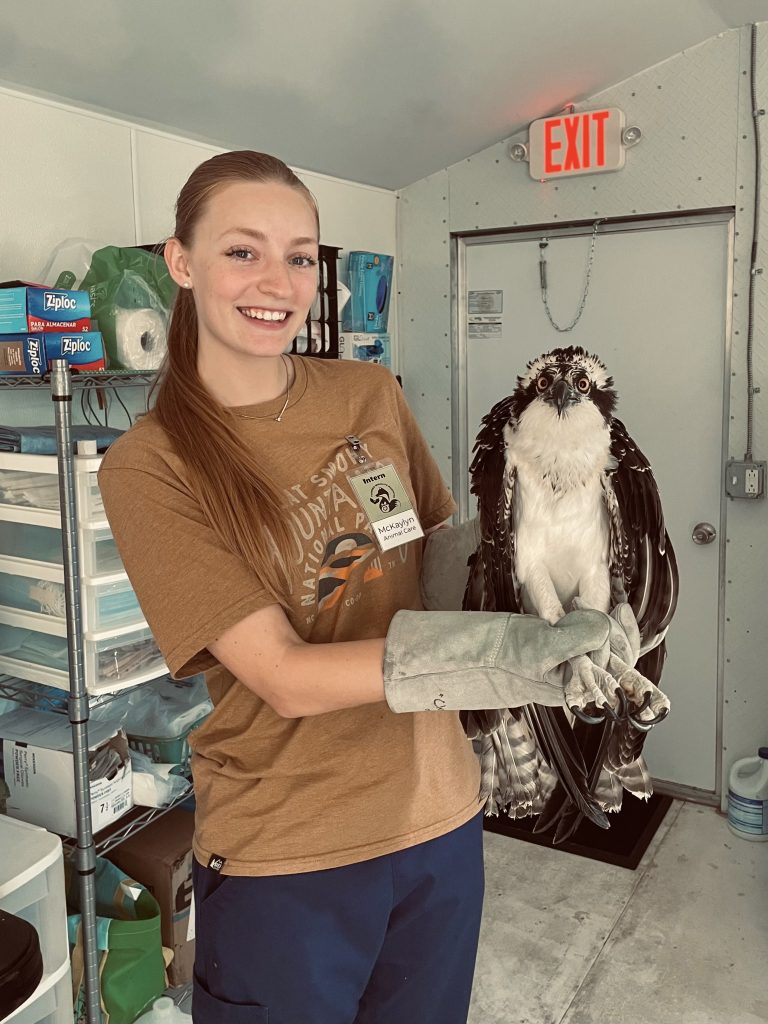
Merritt then secured a summer internship with Florida Wildlife Hospital, where her knowledge and experience working as an undergraduate researcher were put to the test.
As an animal care intern, her day-to-day schedule was never the same. Some days, she worked to rehabilitate species native to Brevard County; other days involved setting up age- and species-appropriate environments or preparing meals for and feeding their residents. During her internship, Merritt assisted in monitoring the health and behaviors of animals in the hospital’s care, ensuring their well-being throughout recovery.
Over the course of her 12 weeks at Florida Wildlife Hospital, she was able to rotate through various departments, including the nursery, intake and outside prerelease enclosures, which enabled Merritt to contribute directly to the rehabilitation process across all stages of care.
“I was even able to partake in unique opportunities, like observing necropsies and going on releases and renests,” Merritt says.
“Being able to learn from professionals in the field was an inspiring experience … that provided me with a comprehensive understanding of the delicate balance required to keep wildlife wild, fostering my passions for conservation and wildlife care,” she says.
She left her internship yearning for a career where she can make a positive impact on wildlife and their welfare.
“The most important thing I learned along the way was to take the leap. Even when you doubt yourself, even when you think it might be embarrassing and even if you think the answer will be no, take the chance.”
McKaylyn merritt ’25, marine biology
A Future in Conversation and Care
With graduation now on the horizon, Merritt is excited to explore more of the veterinary medicine field. She plans to enroll in a program that enables her to eventually become a certified veterinary technician.
“STEM gave me the tools to turn my curiosity into action. Now, I want to use those skills to make a real impact in conservation and animal welfare,” Merritt says.
Merritt implores aspiring marine biologists and all scientists to start learning about the world they live in now. Once she learned how urgently advocacy and knowledge about the threats our environment faces were needed, it evolved from a personal interest into a responsibility to make a positive impact.
Merritt follows that with one more crucial piece of advice: “The most important thing I learned along the way as to take the leap. Even when you doubt yourself, even when you think it might be embarrassing and even if you think the answer will be no, take the chance.”

This piece was featured in the fall/winter 2025 edition of Reinvented Magazine.