A new vessel will be docking at Florida Tech’s Mertens Marine Center: a 1/23rd-scale self-propelled model of the U.S. Navy’s R/V Melville, a research ship built in 1969. Now, ocean engineering students will get to analyze the ship’s maneuverability on a smaller scale.
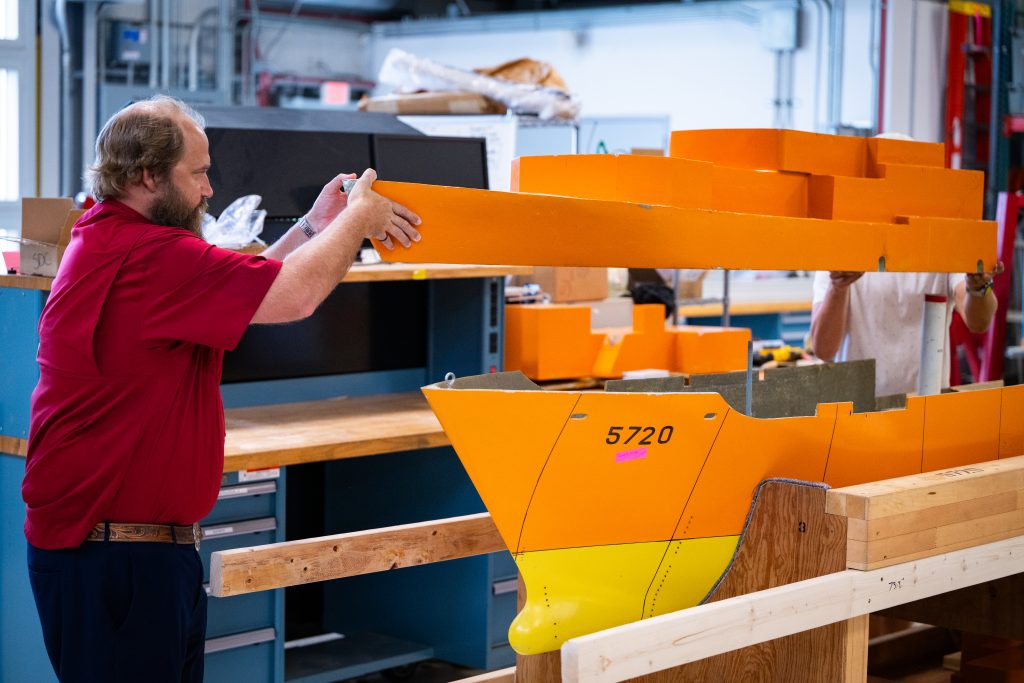
The model was acquired in an agreement between Florida Tech and the Naval Surface Warfare Center Carderock Division. It arrived on campus at the end of June and is undergoing refurbishing in the L3Harris Student Design Center before heading to the anchorage.
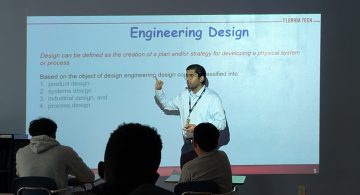
Travis Hunsucker, assistant professor of ocean engineering, said he plans to use the model for both research and class, where he’ll use it to teach his students experimental ship dynamics and hydromechanics.
Scaled down, the model is still substantial: about 530 pounds and 12 feet long. The boat is radio controlled, and Hunsucker’s students will program an autopilot feature for the model in the fall. Accelerometers and GPS sensors will measure how it maneuvers through the waves.
According to Hunsucker, collecting data on a large ship at sea would cost thousands of dollars. Using the model ship, they can scale the waves in the Indian River Lagoon to the model to gather similar real-world data. It also fills the need for experimental ship facilities within the university, he said.
“We teach students various…hand calculations and software tools, but now we can actually go out and get real data with this ship,” Hunsucker said.
In class, students will start easy, first looking at how the ship sits statically, Hunsucker said. After learning the appropriate hand calculations, they’ll learn numerical analysis through software. Then, they’ll maneuver the boat through the water and analyze the experimental data they gather.
Aside from the hard skills, Hunsucker also plans to use the model to show his students how to work through the experimental process, starting with meticulous planning prior to testing.
“There’s a tremendous amount of work that needs to be done ahead of time so you can have a good experiment,” Hunsucker said. “There’s nothing worse than having to repeat an experiment because you didn’t plan it well.”
Hunsucker will keep the model at the Mertens Center and will utilize the Indian River Lagoon and Crane Creek for testing.