By Erin Peterson
Call him the antidoomer: In a world that artificial intelligence (AI) seems poised to fundamentally upend, professor of management Abram Walton sees boundless potential.
“I’ve been teaching and researching technology, leadership strategy, human capital management and innovation for 20 years,” he says. “And I see AI as a catalyst for human flourishing.”
And while he understands the peril of AI in the hands of bad actors, he says those most poised to benefit from AI’s massive power are those who embrace its possibilities.
“It’s true that people often don’t want to change,” he says. “But when we encourage people to lean into it and embrace it, as these waves are coming, they won’t get knocked down by them. They’ll be able to ride them.”
Many at Florida Tech’s Bisk College of Business share Walton’s fundamental optimism. They are diving deep into the technology to understand its impact in their own areas of expertise and teaching its nuances to students in their classes.
College of Business experts see AI as an incredible tool that can speed progress in uncountable ways. It can supercharge productivity, fuel corporate insights and give smaller companies a better chance to compete with the behemoths, for starters. They’re clear-eyed about the dangers— but also, ready to harness its strengths for good.
Here, they share their vision of a future shaped by AI—one that, with the right steps, can become reality.
We can create an AI-fueled world that is innovative and ethical.
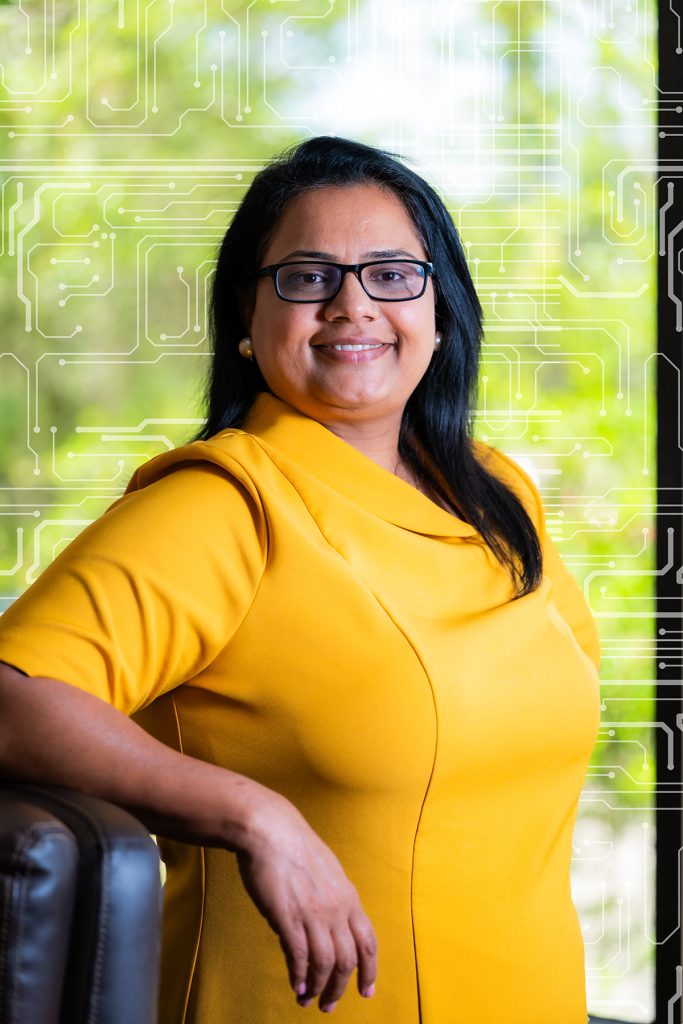
Jignya Patel is an assistant professor of information systems.
Right now, we seem to live in an AI landscape with two camps: people who want faster, bigger and better AI, and those who want much more regulation, guardrails and frameworks for its responsible use and development.
But we shouldn’t be fighting—we should be having more conversations. We need to put all the power players in one room to have a brainstorming session. That would include leaders of companies like OpenAI, Apple, Meta and Amazon. It would include major political leaders from around the world. And it would include the world’s top ethicists. The goal would be to come up with ideas and solutions together. This is important because AI is so powerful and dangerous.
We know that there are historical precedents for collaborative efforts with similarly transformational innovations, such as nuclear technology. We have many guardrails around nuclear power, and it works. We don’t see stories about people stealing uranium and threatening to bomb something.
It did take time to do the right thing with nuclear technology, but we know we can do the right thing. AI is moving fast, so we need to come up with ground rules, penalties and consequences at the same speed.
That’s why I’d like to see all these people coming together to talk, because they can have a huge influence on the trajectory of this technology.
We can level the playing field for smaller accounting firms.
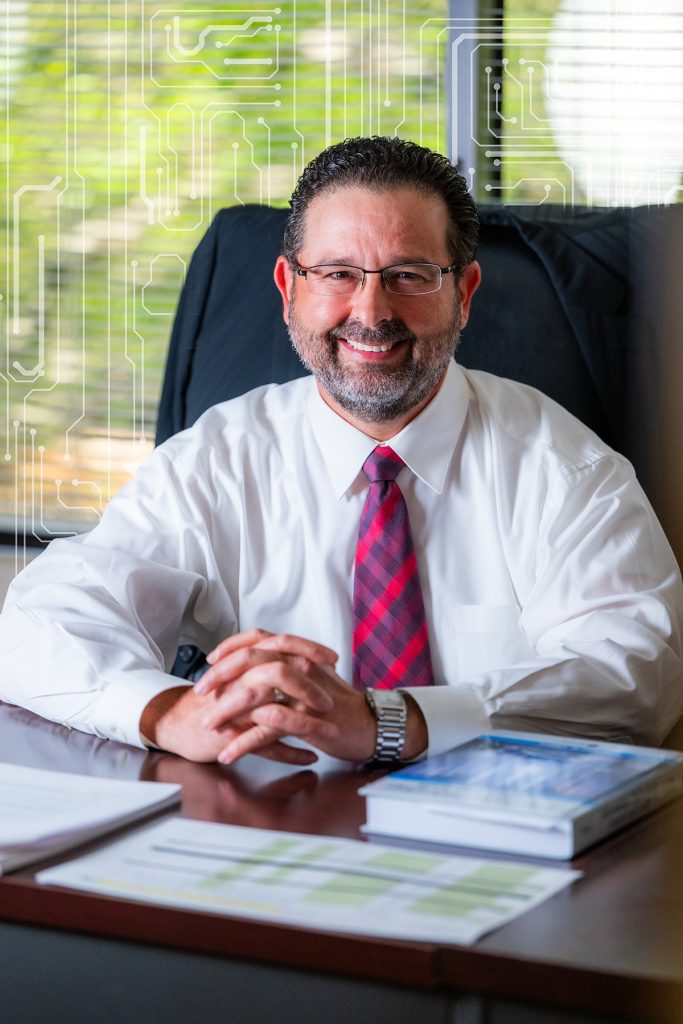
Angel Otero ’01 M.S., ’22 MBA, is an associate professor of accounting.
Imagine a world where AI is not just a tool reserved for the “Big Four” accounting firms but an accessible, game-changing asset for smaller, public accounting firms. These smaller firms, which serve countless businesses and organizations, often lack the financial and technological resources to compete with industry giants. However, with the right investment, AI could revolutionize how these firms operate, enhancing efficiency, accuracy and client service, while leveling the playing field in the accounting profession.
The Big Four have already demonstrated AI’s transformative potential by developing proprietary platforms and investing billions in AI-powered analytics, risk assessment and predictive insights. These advancements allow them to streamline audits, detect fraud more effectively and provide deeper business insights to their clients, among others.
But why should only the largest firms reap these benefits? The real opportunity lies in democratizing AI, ensuring that even small and midsized firms can harness its power to optimize their operations.
My vision is to develop an AI-powered ecosystem for smaller accounting firms. This platform would provide affordable, scalable AI solutions, from predictive financial analysis to automated risk detection and chatbot-driven client communications.
By leveraging AI, these firms could conduct audits more efficiently, identify irregularities with greater precision and offer personalized financial insights—capabilities that were once exclusive to their larger counterparts.
The impact would be profound: increased efficiency, reduced costs, enhanced fraud detection and improved client services. More importantly, it would foster a more competitive and diverse accounting industry—one where innovation is not confined to a select few but is accessible to all.
By empowering smaller firms with AI, the accounting landscape can be reshaped, ensuring that businesses receive high-quality, data-driven insights regardless of the size of the firm they engage with. This is the future of accounting—one where AI is not an exclusive advantage but a universal tool for progress.
We can unleash untapped human potential at every level through the strategic use of AI.
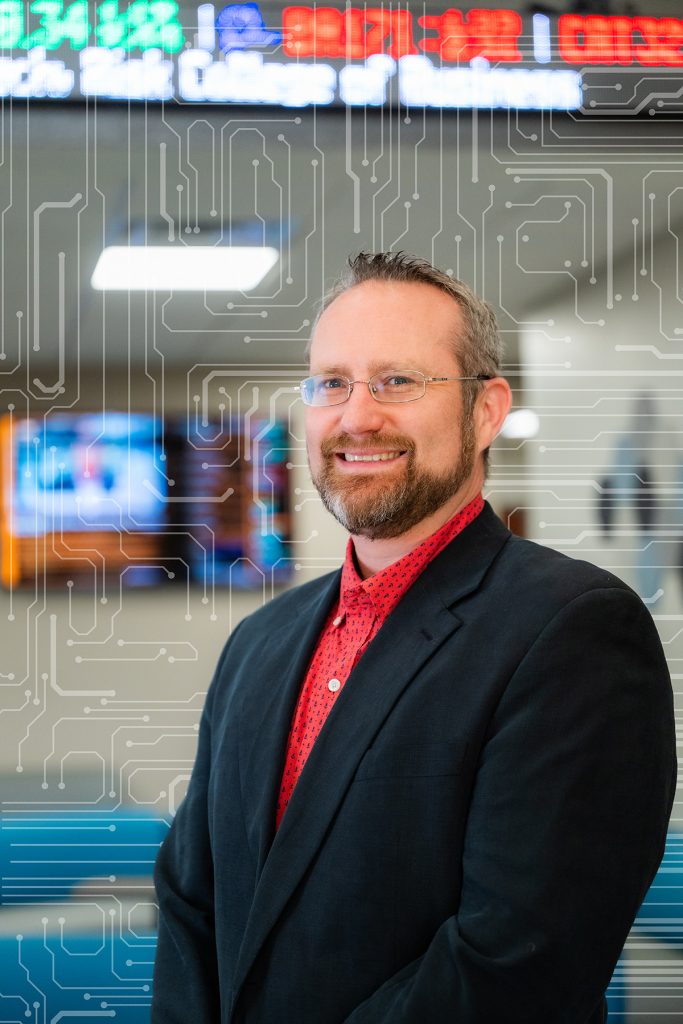
Professor of management Abram Walton is executive director of the Center for Innovation Management and Business Analytics.
For decades, the Lean Six Sigma philosophy has focused on eliminating waste and improving process flow in seven areas: inventory, motion, overprocessing, overproduction, waiting, transport and defects. But in recent years, it became clear that there was an eighth factor that might be even more important: untapped human potential.
Such untapped human potential includes people who are disengaged in their jobs or people who are in areas of the world where they don’t have the coaching or access to opportunity to thrive and flourish. But this untapped potential also exists at the corporate level and an even more macro level.
For example, surveys typically show that about two-thirds of people are disengaged at their jobs. But what if they could use AI as a coach and mentor to help identify their talents, get encouragement and move forward in their careers? AI can be their customized, always-available sounding board.
At the corporate level, AI systems could be built to minimize fraud, abuse and waste. We have whole industries built on top of the idea of deterring or monitoring these problems, like title insurance for homes. Transferring titles is time-consuming and expensive. But by using AI and pairing it with transparent “smart contracts” that are on the blockchain, we wouldn’t need title insurance at all.
At a global level, we know that intentional, multinational cooperation—typically through cooperative trading agreements—provides a winning economic model and a shared benefit of avoiding wars. By helping optimize supply chains across countries or anticipating potential trade disruptions, AI will allow us to collaborate and flourish in new ways.
AI can help not just people become the best versions of themselves but also organizations and countries become the best versions of themselves.
What if [employees] could use AI as a coach and mentor to help identify their talents, get encouragement and move forward in their careers? AI can be their customized, always-available sounding board.
Abram Walton
We can supercharge business innovation by strengthening AI safety measures.
Alina Malkova is an assistant professor business.

While AI can help businesses increase profits and lead to business expansion, we also know that most businesses are hesitant to use some types of AI because of security and unreliability.
Bigger firms, especially, are often taking a more conservative approach. This makes sense: They don’t want to disclose sensitive or personal data. They want to protect their intellectual property. And they worry about mistakes.
In many cases, firms are trying to develop their own internal AI systems. But it’s a slow, complicated and expensive process. You’ve got to create the technology and train the models. AI requires extensive computational resources, and it will likely require retraining for many workers. And while AI will probably replace some workers, right now, people are often still cheaper than this technology.
Some things that could help further the transformation include laws and regulations that protect corporate property rights and intellectual property. In some cases, because of the ways that AI systems are improving, we still don’t know the ways that corporations will need to protect themselves in the future.
When firms feel confident that AI systems are safe and reliable, we will see a huge boost in productivity and profitability.
When firms feel confident that AI systems are safe and reliable, we will see a huge boost in productivity and profitability.
Alina Malkova
We can prepare all students to succeed in tomorrow’s world.
Through cutting-edge courses, hands-on practicum experiences and powerful industry partnerships, students gain the skills and real-world exposure to excel in a rapidly changing world.
Christian Sonnenberg ’04, ’07 M.S., ’13 Ph.D., associate dean of the Bisk College of Business, knows that there’s plenty of handwringing in the academic world about AI in the classroom.
But he and his colleagues see AI as a tool, not a threat.
“In my classes, for example, students have created their own Microsoft Copilots—like chatbots or specialized widgets—to handle specific topics,” he says. “AI is something that they’ll have access to when they’re in the workforce, just like any other tool. So, knowing how to leverage it is going to provide benefits.”
At Florida Tech, faculty embrace change, develop practical approaches to integrating emerging technologies into the curriculum and give students the tools they need to thrive. Through a focused mix of business fundamentals, cutting-edge courses, extracurricular opportunities and real-world experiences with top companies, students graduate from Florida Tech with advantages that make them irresistible to employers—and well equipped for whatever the future might bring.
Here are just a few ways that the College of Business is designing meaningful learning experiences that will allow students to make the most of every moment at Florida Tech.
Business fundamentals paired with leading-edge tech topics
Students are grounded in business fundamentals through foundational courses in mathematics, economics and accounting. But they can also take courses so novel that students are more likely to be studying breaking news push notifications than a dusty textbook. One example: Applied AI and Machine Learning in Finance, a course that will roll out this fall.
Practicum experiences
All seniors have a practicum experience— an internship with a sponsoring organization and guidance from a Florida Tech practicum coordinator.
“The goal is for every student to have work experience before they graduate,” Sonnenberg says.
Student Business Incubator
The business incubator offers a long-term support structure that gives students opportunities to work on new ventures, get guidance from faculty members on how to run a business and even land funding to get their projects up and running.
Powerful Partnerships
Partnerships with large, highly regarded companies, including Northrop Grumman Corp. and Lockheed Martin Corp., as well as Patrick Space Force Base, offer a range of opportunities to students, including practicum and incubator-related work. Current employees of top firms often earn advanced degrees from Florida Tech.
Case Study Competitions
Students participate in case study competitions around the country. Recent competitions include the Templeton Business Ethics Case Competition at Stetson University, the Global Scaling Challenge at the University of New Mexico and the IACBE International Business Challenge. College of Business students are earning plenty of laurels: Last spring, for example, a team of Florida Tech students landed top honors at the Direct Effect Innovation Challenge in Jacksonville, creating an effective https://news.fit.edu/wp-content/uploads/2013/11/dr_wiggenhorn1-1.jpg campaign for LEGOLAND.
While Sonnenberg is proud of the work the College of Business is already doing, he adds that they continue to expand and improve their programming to make a business degree from Florida Tech even more valuable.
“Our goal is to position a student not only to have a career ready for them when they graduate, but also to be in a position to succeed in that career,” he says.
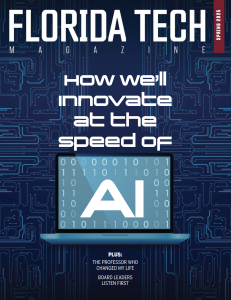
This piece was featured in the spring 2025 edition of Florida Tech Magazine.