By Karly Horn and Andy McIlwraith
Florida Tech’s first “campus” was three rented junior high school classrooms.
But what founding President Jerome P. Keuper lacked in land and laboratories, he made up for in confidence, vision and ingenuity.
As Florida Tech grew, so did Keuper’s aspirations. He dreamed. He planned. He acted.
Less than 70 years later, Florida Tech’s campus spans 130 acres, including every thing from the conventional—library, classrooms, labs, dining and residence halls, sports and recreation facilities—to the uniquely Florida Tech—botanical garden, public radio station, performing arts, student design, manufacturing, aviation and marine centers.
Today, Florida Tech is poised for another era of growth.
Traditional and online student enrollment has increased more than 27% since 2019, reaching over 10,000 students in fall 2025. During that same timeframe, first-time-in-college students have jumped over 43%, and the fall-to-fall retention rate increased from 74.3% in 2022 to 83.3% in 2025.
“We’re in a sustainable growth mindset,” says Brian Ehrlich, Florida Tech’s vice president of enrollment management. “As we grow, we want to have the best and brightest students, excellent staff, the top faculty. And the best people want to be in a great environment so they can do their best work—that’s what we need.”
So, in the spirit of Keuper, we dream, we plan and, over time, we act.
In May 2024, Florida Tech partnered with Credo, a higher education consulting firm, to aid in developing a master plan, a vital component of the university’s Forward Together, Boundless Potential Strategic Plan.
During the yearlong process, Credo helped evaluate current campus utilization, compared it with academia benchmarks and combined it with university goals and feedback from conversations and focus groups conducted with hundreds of community members, alumni, students, faculty, staff and more.
And in fall 2025, Florida Tech unveiled the Campus Master Plan.
“My voice and the voices of the rest of the community echo through every facet of the Campus Master Plan,” says Student Government Association (SGA) President Bryson Noble, a software engineering junior. “From the addition of more communal outdoor spaces to the academic facility renovations, housing enhancements and parking improvements, I can say with confidence that the master plan checks every box.”
Less a prescriptive checklist and more a dynamic, adaptable framework, the Campus Master Plan identifies areas most ripe for growth, removal and enhance ment in the next decade and beyond.
“As a construction management student, I’ve observed firsthand the potential our historic, yet distinctive campus holds,” says Genevieve Spitaletto, a senior and SGA treasurer. “When I first arrived four years ago, I noticed several areas that could benefit from modernization. Seeing the university now take tangible steps to enhance and revitalize the campus is truly inspiring, and it makes me very excited for the future of Florida Tech.”
By aligning the university’s physical spaces with its mission, the plan aims to create a dynamic living-and-learning ecosystem that attracts and empowers the next generation of Panthers.
“This Campus Master Plan is a clear statement of our confidence in the future of Florida Tech and its people,” President John Nicklow says in his Campus Master Plan introductory letter. “As we move forward together, we do so with clarity of vision and unwavering resolve.”
The Campus Master Plan segments proposed projects into four phases: foundational work, followed by tier one, two and three priorities. Here, we showcase a few of the exciting, transformative projects set to revitalize and unify campus—the Florida Tech of the future.
“In terms of inclusion and transparency and giving everyone an opportunity to participate and be heard, the master planning process set a new precedent for Florida Tech. It really demonstrates the values of the university in a practical application.”
Brian Ehrlich, vice president, enrollment management
Foundational Project Spotlights
Several high-impact initiatives are already underway, laying the foundation for Florida Tech’s campus transformation. These projects address immediate needs while setting the stage for larger changes to come.
Crimson Crossing
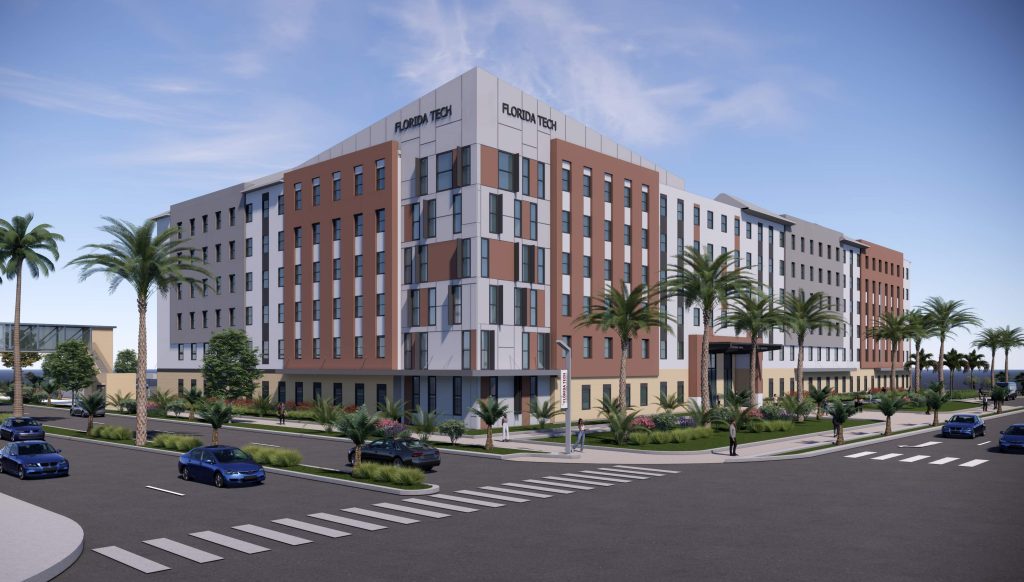
What it is: A new, six-story, 556-bed housing complex on the northeast corner of Babcock Street and University Boulevard
The Benefit: Student housing for increasing enrollment—projected to grow another 2% in 2026—is currently Florida Tech’s No. 1 priority. The immediate focus is on meeting unmet demands (about 260 beds) and restoring the residential requirement for first- and second-year students, a proven high-impact practice.
Highlights:
- One- to four-bed, apartment-style units
- Common spaces to facilitate study, programming and socializing on each wing
- 132 parking spaces, including accessible and electric vehicle stalls
BONUS: Creates enough capacity to enable renovation of existing housing, such as the Housing Quad and northern Southgate apartments, in later phases
Pedestrian Bridge
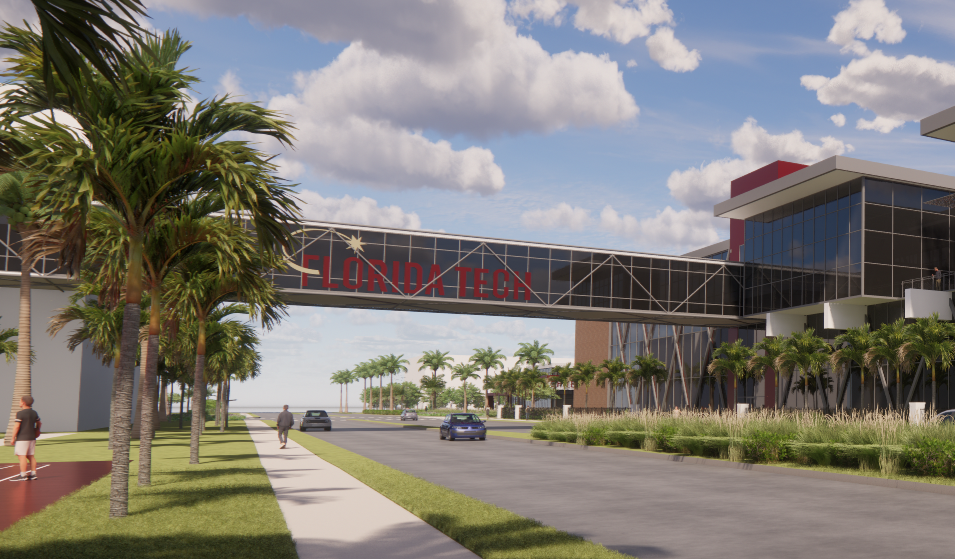
What it is: A bridge over Babcock Street connecting Crimson Crossing to the academic core of campus
The Benefit: Once all three student housing phases are complete, roughly 1,700 students will live on the east side of Babcock. The bridge will provide a safe walkway to main campus over a busy street that many students cross multiple times daily.
Highlights:
- Improves overall campus walkability, linking key parts of campus with ease and energy
BONUS: Acts as a bold visual statement near our entrance—creating a sense of arrival and reinforcing the university identity to the larger community that utilizes the major state road
Athletics Gateway
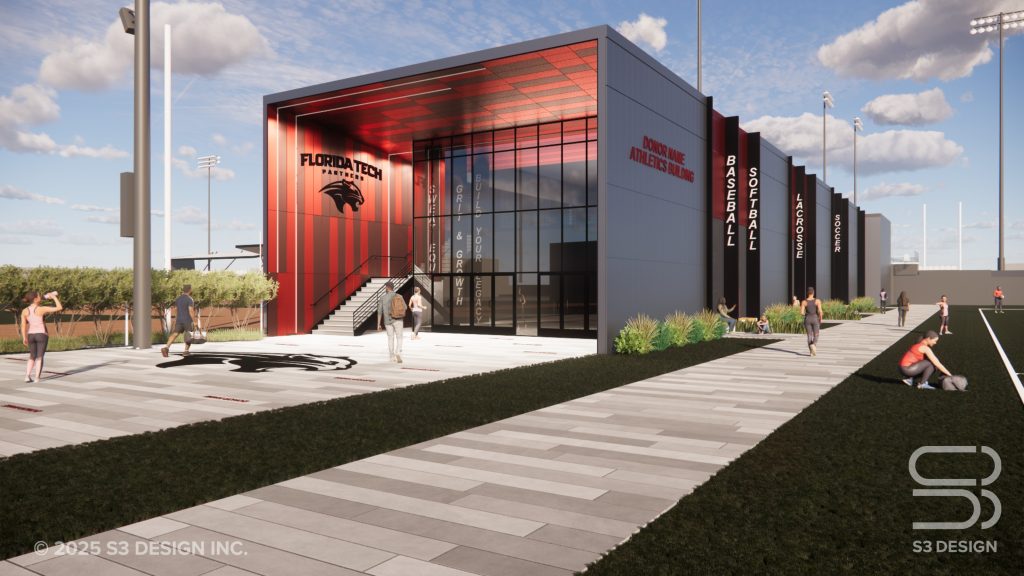
What it is: An additional entrance on the southwest corner of campus to provide direct access to a new field sports complex and field house
The Benefit: The gateway will establish a more unified, spirited and accessible home for Florida Tech Athletics that will redefine how the campus experiences game day and align with the Athletics Master Plan, developed with S3Design in 2023.
Highlights:
- A fan-centric facility with views of existing softball, baseball and soccer fields, along with dedicated locker rooms for Panthers, visiting teams and officials
- Athletic program offices
- Parking, an entry gate and protected lobbies, concessions and restroom facilities
BONUS: Relocating offices from the Charles and Ruth Clemente Center for Sports and Recreation leads to opportunities to enlarge and reconfigure existing fitness and weight-training facilities.
Bryson Noble, software engineering junior, SGA president
“The Master Plan sends a strong message to prospective students: We are building the future of higher education around you, and we want to succeed together.”
Transformational Project Spotlights (Tier 1)
The next wave of projects will redefine the Florida Tech campus experience, transforming how the university welcomes and educates students, fosters and showcases innovation, and creates valuable links between people and programs.
Welcome Complex

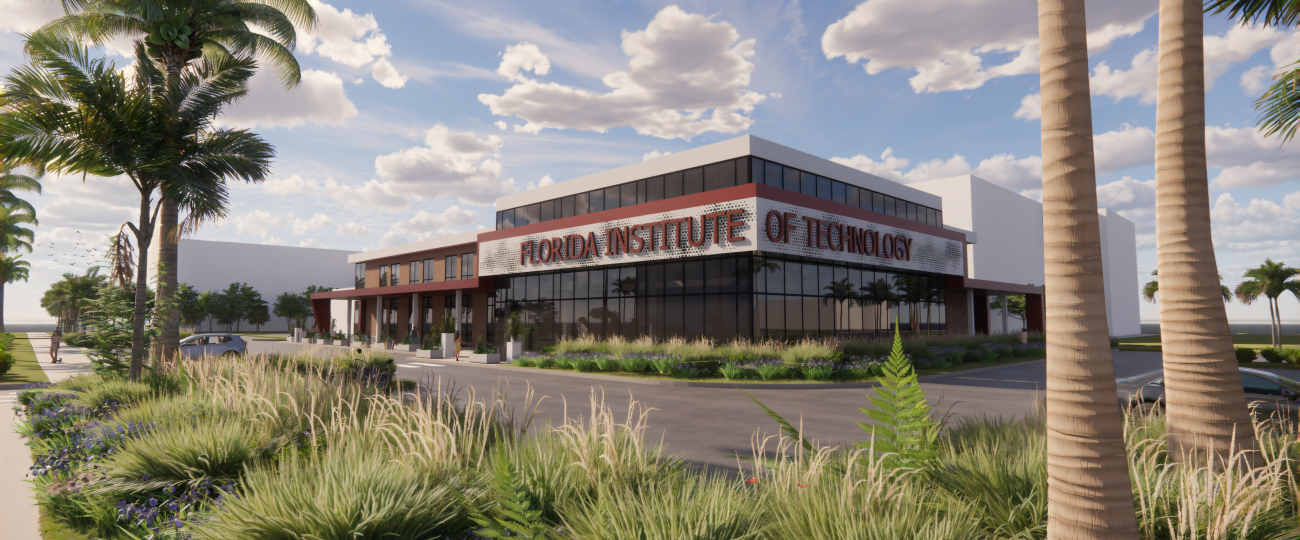
What it is: The university’s “front door” on the southwest corner of Babcock Street and University Boulevard, uniting admissions, financial aid and other vital campus services in one vibrant, student-centered space
The Benefit: Relocating the admissions and student service functions across Babcock Street defines an entry and allows Florida Tech to determine the type and amount of space, as well as how the welcome experience should take place, without current restrictions.
Highlights:
- Approximately 50,000 square feet
- Includes staff offices, service points, comfortable small and large meeting rooms, a larger presentation room
- Home to: Office of Admission, Office of Financial Aid, Office of Career Services, Academic Support Services, Copy Center, new campus store
- Views toward the bustling core of campus
BONUS: Instead of loading onto the trolley to cross busy Babcock Street, visitors can exit the Welcome Complex onto a footbridge through a rain garden to start their campus tours.
Student Design and Fabrication Space
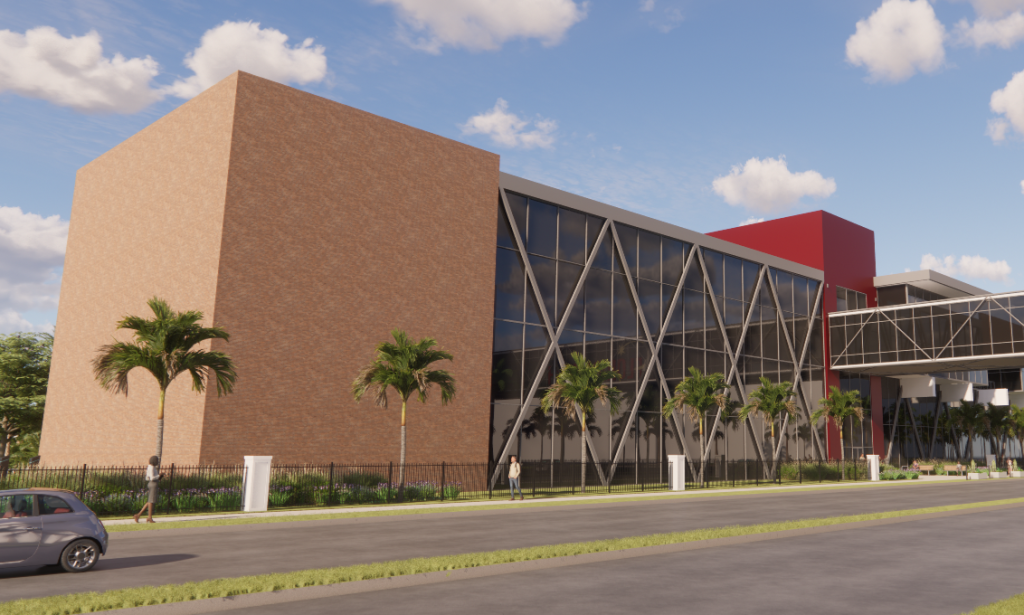
What it is: A bold, visible hub for hands-on learning, creativity and collaboration with space for prototyping, fabrication and interdisciplinary teamwork that showcases Florida Tech’s signature maker culture and spirit of innovation
The Benefit: Hands-on learning is the cornerstone of a Florida Tech education. While the existing L3Haris Student Design Center and Machine Shop are exemplars of this, as enrollment grows, so will demand for these kinds of facilities.
Highlights:
- Approximately 36,000 square feet
- Expansion, upgrade and/or relocation of existing labs, support spaces, project rooms, ideation spaces, CAD and computer labs, offices, testing facilities, assembly shop
- New computing space
BONUS: A new, updated makerspace supports the strategic plan’s emphasis on innovation, collaboration and solution-oriented talent development across programs.
Research and Innovation Center
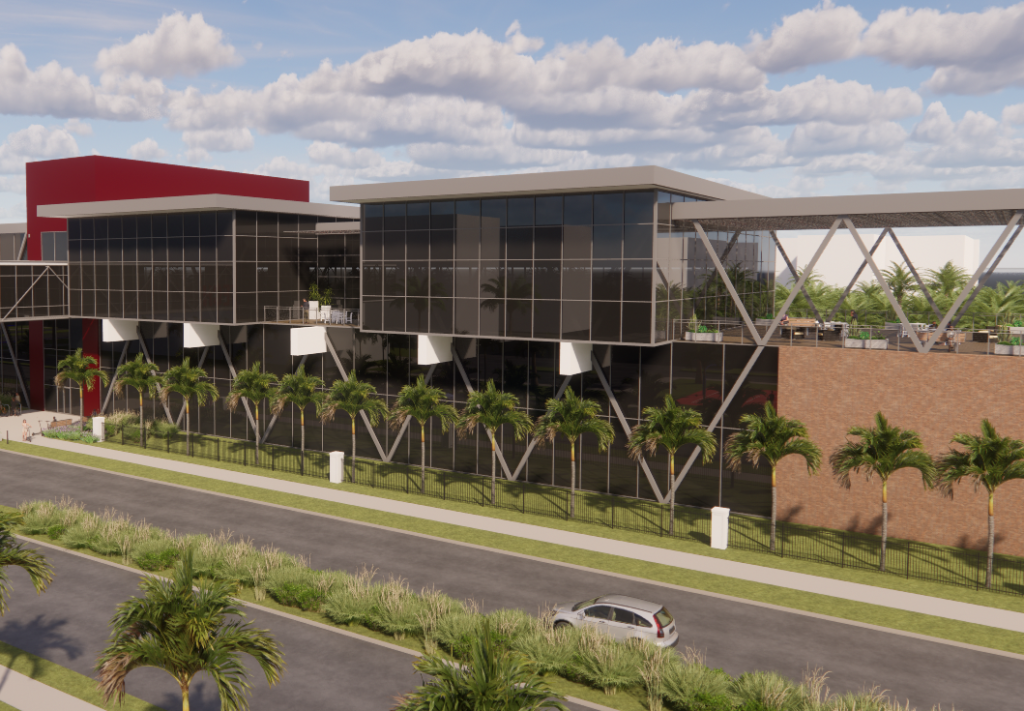
What it is: A new, interdisciplinary research facility that will bring cutting-edge labs, collaborative spaces and innovation into the spotlight, showcasing Florida Tech’s growing research enterprise and supporting discovery across science, engineering and beyond
The Benefit: A Research and Innovation Center of this magnitude will help recruit and retain students and faculty while further solidifying Florida Tech’s Carnegie Research 2 status, a key goal outlined in the university’s Forward Together, Boundless Potential Strategic Plan.
Highlights:
- Approximately 80,000 square feet
- Replaces Academic Quad and Frueauff building functions
- Relocates some off-campus research functions to campus
- Potential deck overlooking Patterson Botanical Garden and footbridge to Gleason Performing Arts Center
BONUS: Building on the west side of Babcock Street accomplishes a number of goals: anchors one side of the main entrance; uses space already occupied by the Frueauff Building and parking rather than greenspace; and creates a dramatic presence on busy Babcock Street.
Genevieve Spitaletto, construction management senior, SGA treasurer
“Florida Tech’s ‘Forward Together’ is more than just an element in the strategic plan—it’s a promise to our community that every voice matters and plays a role in shaping the university’s future.”
Aspirational and Long-Term Project Spotlights (Tiers 2 & 3)
With a focus on existing and emerging academic needs and opportunities, these long-term projects will enhance students’ learning experience while strengthening campus cohesion and efficiency.
Psychology Building
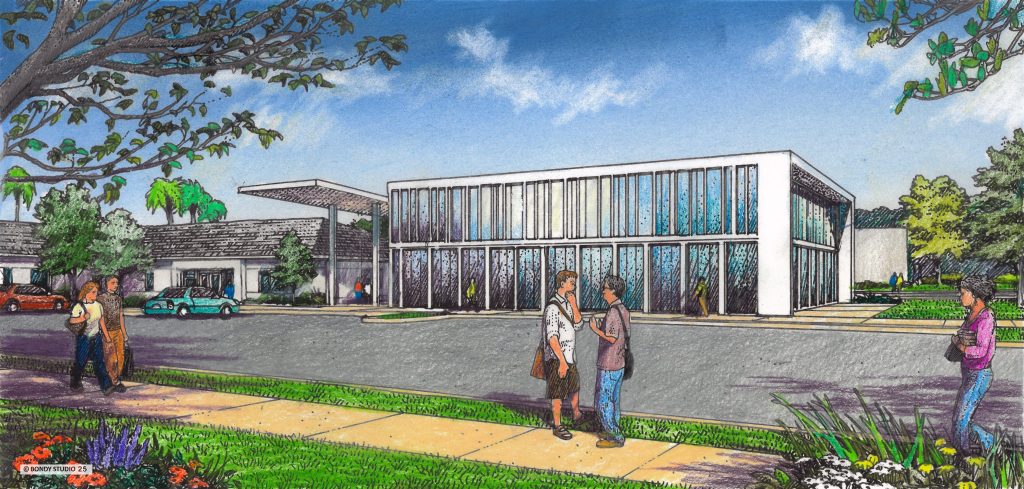
A dedicated home for the School of Psychology will bring faculty, students and labs back under one roof.
Boathouse
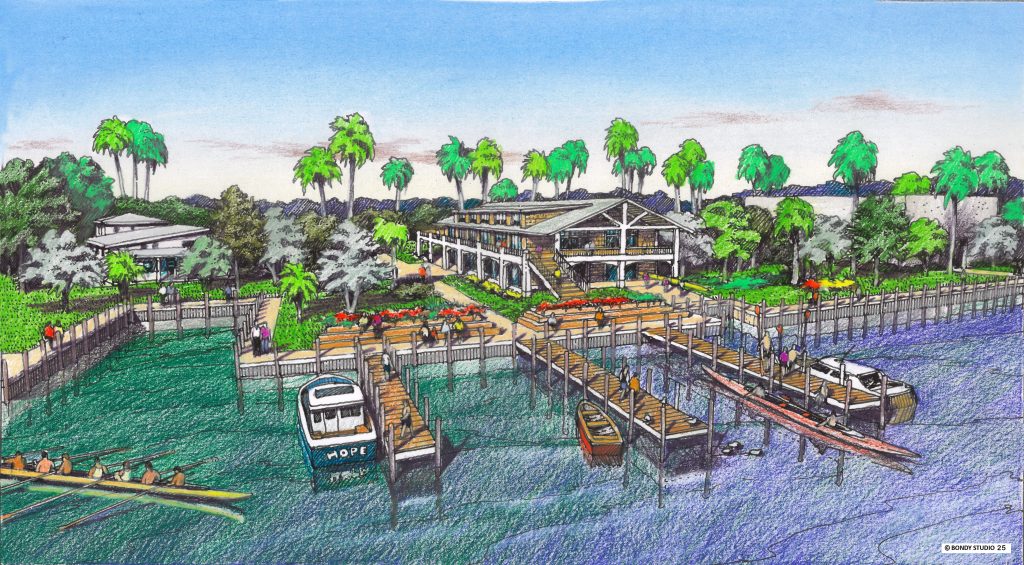
Set along the Indian River, a three-story, modern facility for marine research, training and water-related sports will enhance access to the waterfront and support Florida Tech’s unique strengths in ocean engineering and marine science.
Bisk College of Business Building
A new, two-story building where the Academic Quad currently sits will bring Bisk College of Business offices, classrooms, conference and collaboration spaces, and community collaboration centers to campus.
A Student Spin
For their senior design project, Spitaletto and her team drew inspiration from the Campus Master Plan’s COB building concept, adopting its location and overall layout suggestions. The senior design team’s proposal then takes plans a step further, developing a more detailed design that includes floor plans, architectural schematics, AutoCAD and Revit Designs, and other specific requirements to bring the concept to life.
“There were many elements to consider while developing this proposal—it’s a challenging project, and we understood that from the start,” Spitaletto says. “We’re all hardworking students who wanted a project that would not only challenge us but also inspire us to create something meaningful for the place we’ve called home for the past four years.”
Skurla Annex
An addition to Skurla Hall will accommodate consistently increasing College of Aeronautics enrollment, with features such as relocation of currently off-campus labs, additional research and simulator labs and two new 50-seat classrooms.
Music Building
A facility adjoining and providing easy access to Gleason Performing Arts Center will include offices, studios, practice rooms, a multipurpose practice-recital-performance space and a music courtyard for outdoor practice, allowing sound to reach the entire Crawford Green.
Housing Expansion
Additional modern apartment-style living spaces will replace the remaining Southgate buildings north of Crimson Crossing, and older on-campus halls—such as those in the Housing Quad—will be renovated with a focus on first-year housing that is more home-like and inviting, as well as unique features that promote community, personal growth and shared experiences.
President John Nicklow
“[The Campus Master Plan] is designed to align our physical environment with the university’s vision to be recognized as a premier institution for improving the human condition and solving the challenges of tomorrow.”
Finishing Touches
Florida Tech’s Campus Master Plan doesn’t stop at buildings. It brings together everything in between: the walkways, greenspaces, gathering spots and landscapes that shape how campus feels, flows and functions. These connecting elements unify the student experience, tie together academic and residential zones and elevate Florida Tech’s identity as a vibrant, welcoming place to learn and grow.
Shaded Pathways and Outdoor “Rooms”
Offer relief from sun and rain while creating places to pause, connect and collaborate
Pedestrian-First Zones and Traffic-Calming Features
Improve safety and accessibility throughout campus
Thoughtful Landscaping, Stormwater Features and Botanical Garden Preservation
Reflect a deep respect for Florida’s natural beauty and Florida Tech’s commitment to sustainability
—President John Nicklow
“Florida Tech is more than a collection of buildings; it is a living and learning space that fosters bright futures.”

This piece was featured in the winter 2026 edition of Florida Tech Magazine.