On a hot Sunday afternoon at Valkaria Airport, Brian Williams stands at the edge of the runway with a tape measure in hand. His teammates are lined up beside him in safety vests, chalking the landing line they’ve drawn across the asphalt.
It’s a practice session, the kind the Florida Tech Flight Team holds nearly every week to prepare for the Safety and Flight Evaluation Conference (SAFECON).
Moments later, a Piper Warrior aircraft dives toward the line, engine humming, nose flaring just inches above the ground. The wheels touch. Six feet short. Williams nods.
“That’s good,” he says quietly, writing down the number.
The pilot taxis back, ready for another pass.
Scenes like this—students learning from the trenches, preparing not for exams but for life—happen across campus year-round.
They are building bridges meant to withstand thousands of pounds of stress, presenting business cases to panels of executives, applying behavioral science to competitive athletes and cracking cybersecurity challenges designed by professionals who want them to fail.
The standard, in every case, is not set by a rubric. It is set by a judge who doesn’t know them, a clock that doesn’t stop or an opponent who is preparing just as hard.
Florida Tech students don’t just study. They compete. And in the process, they learn.
The Gold Standard
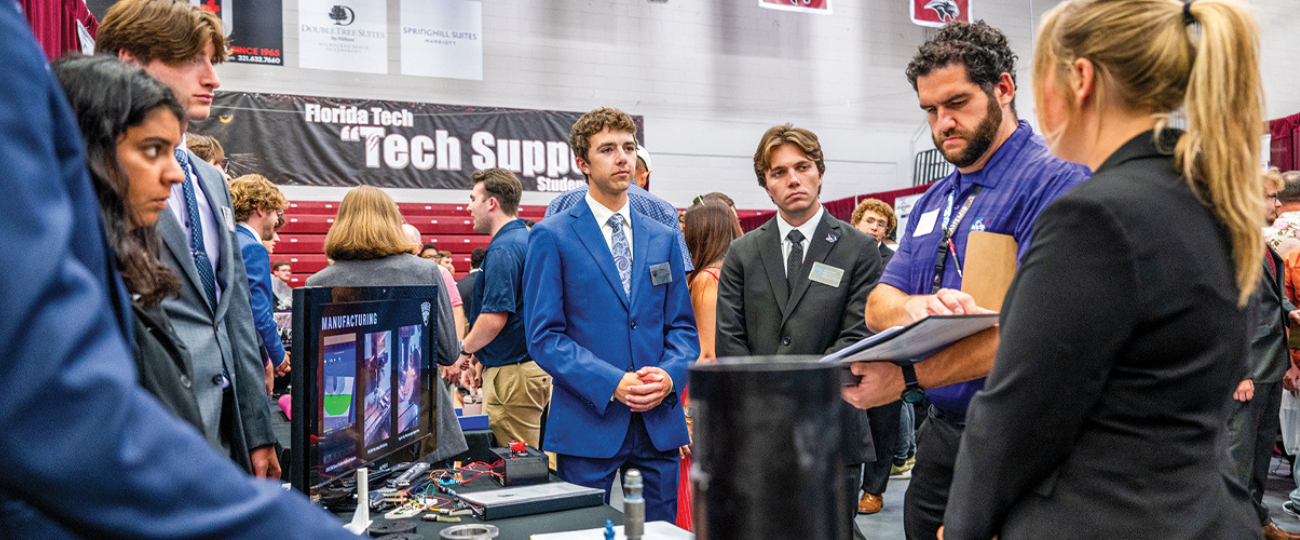
Stand in the Clemente Center during the Northrop Grumman Engineering and Science Student Design Showcase, and you’ll see what that looks like at scale.
More than 230 capstone projects fill the gym floor, each defended by the students who built it. The judges—industry professionals, not professors—move between stations, asking questions the rubric didn’t prepare anyone for.
Felix Gabriel ’22, ’25 M.S., knows the showcase from the inside out. He competed as a student. Then, as a lab manager in the L3Harris Student Design Center, he worked alongside his team to support students as they developed their projects year-round.
“As a student, I wondered, ‘Why would they bother talking to me—a random 22-year-old presenting his project?’” Gabriel says. “I eventually realized, they’re just scientists, engineers and professionals in the field who actually care about the work and genuinely enjoy it.”
Their questions were hard, but Gabriel quickly realized they weren’t meant to trip him up. Judges challenged his design choices, asked why certain approaches weren’t considered and, when satisfied with his answers, offered alternatives.
They were brainstorming out loud alongside him. They cared about his work—something Gabriel had not expected, he says.
That dynamic—external stakeholders evaluating student work against professional standards, not academic ones—drives the Bisk College of Business’ approach to competition, as well.
Instructor Tim Muth organizes and advises students in many of the intercollegiate business case competitions they participate in.
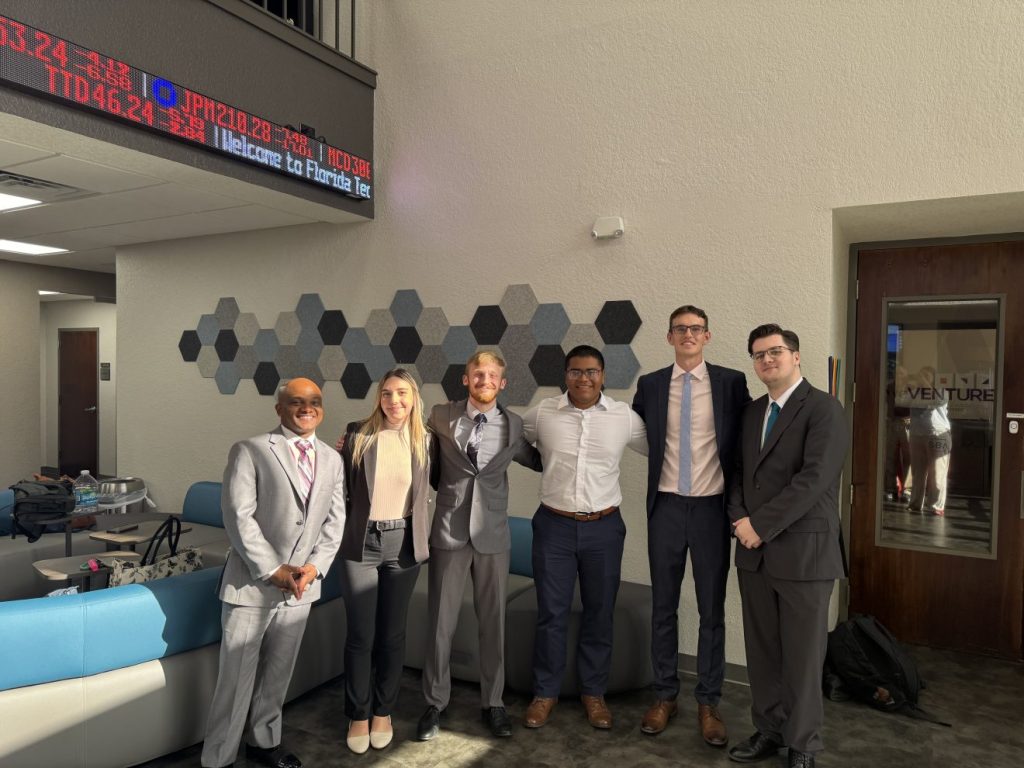
In these competitions, like the Global Scaling Challenge or IACBE (International Accreditation Council for Business Education) Student Case Study Competition, teams act as consulting firms charged with solving actual problems facing real companies, developing and presenting their recommendations to a panel of judges that often includes representatives from the company for which they are “consulting.”
“When you’re on a stage presenting to real companies, real executives and leaders in their fields, you face the possibility of losing your credibility as a professional,” says Meghan Walker, an information systems senior. “It feels like you have your career at stake rather than just your grade.”
And that, Muth says, is the point.
“The students can play us; they can’t play the judges,” he says. “The term I use with students is ‘an actionable and realistic plan.’ … In school, students can put all sorts of unrealistic things into a project, and we often let it slide. But in competition, the judges won’t let it slide.”
Competition Is the Classroom
Not all of Florida Tech’s competitive academics happen outside the classroom. For some students, competition is embedded in their courses.
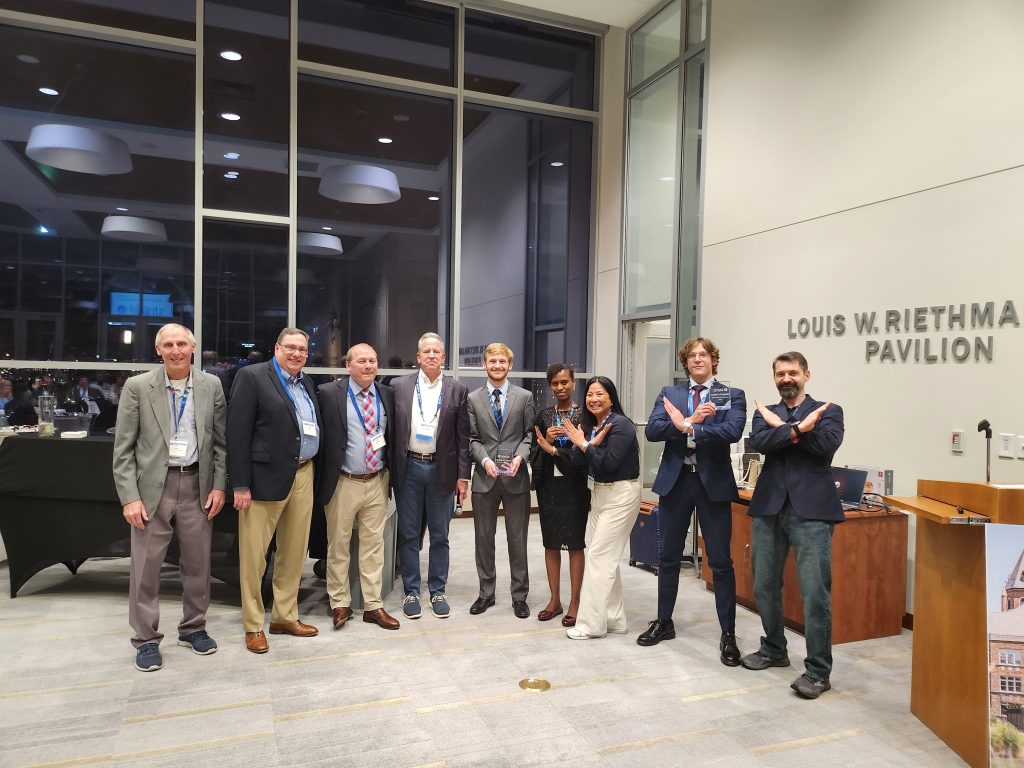
Through X-Culture, Muth’s International Business course doubles as a global competition. Over eight weeks, Florida Tech students are placed on virtual teams with peers from universities across the world, tasked with solving real problems for multinational clients.
The teams are international by design: a deliberate friction that forces students to navigate cultural differences, time zones and communication barriers while still delivering professional-grade work.
The best performers are invited to the X-Culture Global Business Week, an international symposium where top students from around the world compete in live case competitions for real companies.

“X‑Culture is all about international cooperation,” said Muth, who is a part of X-Culture’s global leadership team and helps coordinate the business challenges.
In the College of Aeronautics, Debbie Carstens ’96 MBA builds the same principles into her Human Performance 1 course.
Her students compete in the Airport Cooperative Research Program (ACRP) University Design Competition, a national competition, administered by the Transportation Research Board and sponsored by the National Academies and the Federal Aviation Administration, that asks teams to develop design solutions enhancing safety and efficiency in airport operations and the National Airspace System.
Teams spend the entire semester on a single project, moving from brainstorming through research, prototyping and cost-benefit analysis. Carstens has run the course this way for a decade.
“Learning is far too often theoretical for students,” she says. “This project provides them with a way to apply classroom concepts to the real world.”
“Learning is far too often theoretical for students. This project provides them with a way to apply classroom concepts to the real world.”
Debbie Carstens ’96 MBA, Professor, college of aeronautics
Pass or Fail
For T.J. Boylan, a civil engineering senior and president of Florida Tech’s American Institute of Steel Construction (AISC) student chapter, the stakes are structural.

He spends months each year preparing for the annual AISC Student Steel Bridge Competition, for which he and his team must design and fabricate a scale steel bridge that survives real load testing.
The finished structure spans roughly 22 to 24 feet and carries 2,500 pounds applied across multiple vectors, with tolerances measured in fractions of an inch.
A bridge that deflects more than a quarter of an inch during loading fails.
One that exceeds its length limit by more than half an inch is disqualified. Before any of that, the bridge must pass a comprehensive judge’s inspection—every bolt checked, every measurement verified.
The fabrication process is a test of its own. Team members use bandsaws, angle grinders and welding equipment. The work runs late into the night. But when fatigue sets in, quality drops and the risk of injury rises. Regardless, on competition day, there is no partial credit for effort.
“When the judges come around, it’s pass or fail,” Boylan says. “It has to be 100%. There’s no room for error. … In real life, if you’re designing a bridge and you’re wrong, people could die. So, everything becomes a life-or-death scenario.”
The competition floor is a preview of the profession, he says.
“Students from other universities become competitors in the job market. It’s like multiple companies in a bidding process, where five people submit a bridge design, and my bridge has to be better than your bridge in order to get the job,” Boylan says.

For FITSEC, Florida Tech’s cybersecurity competition team, the stakes look nothing like steel and load ratings. But the pressure is just as real.
Members compete in capture the flag competitions: timed events where teams work through cybersecurity challenges to find hidden strings of data, called flags. Challenges span categories, including cryptography, open-source intelligence, reverse engineering and binary exploitation.
“Preparing for a competition is doing competitions. That’s the best preparation you’re going to get,” says Maria Linkins-Nielsen, a computer science senior and FITSEC vice president.
Many of the skills competition demands are never taught in class. The best way to develop them is exposure—entering every competition available, on any platform, at any hour, she says.
“The best part of competing is that while you’re doing it, you can still learn,” says Jaylin Ollivierre, a computer science senior and FITSEC president. “Competition is different because you can take everything you’ve learned, collaborate with others and keep learning as you go.”
“The best part of competing is that while you’re doing it, you can still learn. Competition is different because you can take everything you’ve learned, collaborate with others and keep learning as you go.”
Jaylin Ollivierre, FITSEC President
Better Together
There is a misconception about competitive environments: that they produce individuals, not teams. That the drive to outperform creates friction rather than cohesion. For students at Florida Tech, however, success depends on teamwork.
Leaning into that notion, the School of Behavior Analysis has partnered with Florida Tech’s esports teams through the Behavior Performance Coaching program (BPC), a branch of the Experimental Analysis of Behavior, Economics, and Esports with Kaitlynn (EEEK) Lab, led by assistant professor Kaitlynn Gokey ’12 M.S., ’20 Ph.D.
Through the program, behavior analysis students, known as performance coaches, serve alongside esports coaches, observing matches, collecting data and working to develop specific, measurable skills in players and coaches alike.
“Operant learning says we learn by doing,” Gokey says. “That means if you want people to perform well in competitive environments, you have to throw them into a competitive environment.”
For her students, that means working in an environment they cannot fully control—one that is unpredictable, fast-moving and unlike anything a clinical setting provides.

“It usually starts with us watching a practice match or a competition, and we pay attention to behaviors that impact what we want to work on,” says master’s student Adrienne Lafond, performance tech for the Valorant teams. “Some of the common things we look at include communication, how players respond to coach feedback, what happens after a mistake and how they handle pressure. We take notes and track those behavior patterns.”
Gokey’s team has noted improvements in communication—players talking more when it matters, less when it doesn’t—along with fewer self-deprecating remarks during matches, better sportsmanship and greater receptivity to feedback. Surveys asking players whether they found the training helpful came back nearly perfect.
“They’re definitely making gains, because the data shows they’re making gains,” Gokey says.
The program is producing results and breaking new ground in the process.
“No other school is doing this, so it’s not like we have established research articles to reference outside of our own work,” says doctoral student Alyson Intihar ’23 M.S., performance coach for the Overwatch teams. “That means we have to rely heavily on the application piece. It’s extremely valuable for real-time application. I’ve learned so much.”
The Thing About Losing
For many students, some of the most valuable lessons come from the moments when things go wrong.
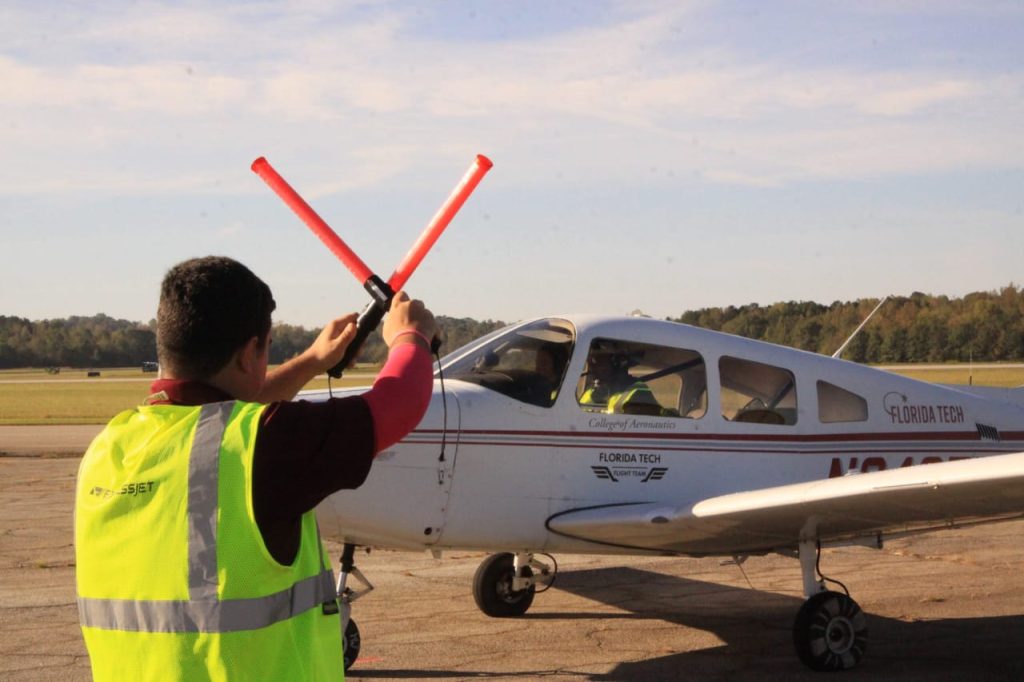
SAFECON, hosted by the National Intercollegiate Flying Association (NIFA), spans more than a dozen events across two days, testing pilots in everything from short-field landings and power-off approaches to aircraft recognition, navigation and simulated instrument flight. Every fall, the top three teams from each regional competition advance to nationals in the spring.
When the Flight Team finished fifth at regionals in 2023, there were tears.
“I told myself, ‘Next year, things will be different. This won’t happen again,’” says Williams, an aviation management with flight senior and Flight Team captain.
The following spring, another school declined its invitation to nationals. Florida Tech got in but finished at the bottom.
“You experience the lows, but you have to let yourself feel them. It’s part of being human,” Williams says. “We took the time to feel it. And then, the next question became, ‘How do we make sure we’re never here again?’”
Likewise, Florida Tech’s bridge broke during the aesthetics portion of the 2024 AISC Student Steel Bridge Competition. The team ran out of time before reaching the timed construction phase. Their bridge, which would have been 50 pounds lighter than the winning entry, never got tested.
But their resilience did.
For Boylan, the cost of losing was proportional to the investment.
“When you bring back nothing, it’s very easy to feel defeated—like you’ve wasted hundreds of hours of your life and have nothing to show for it,” he says.
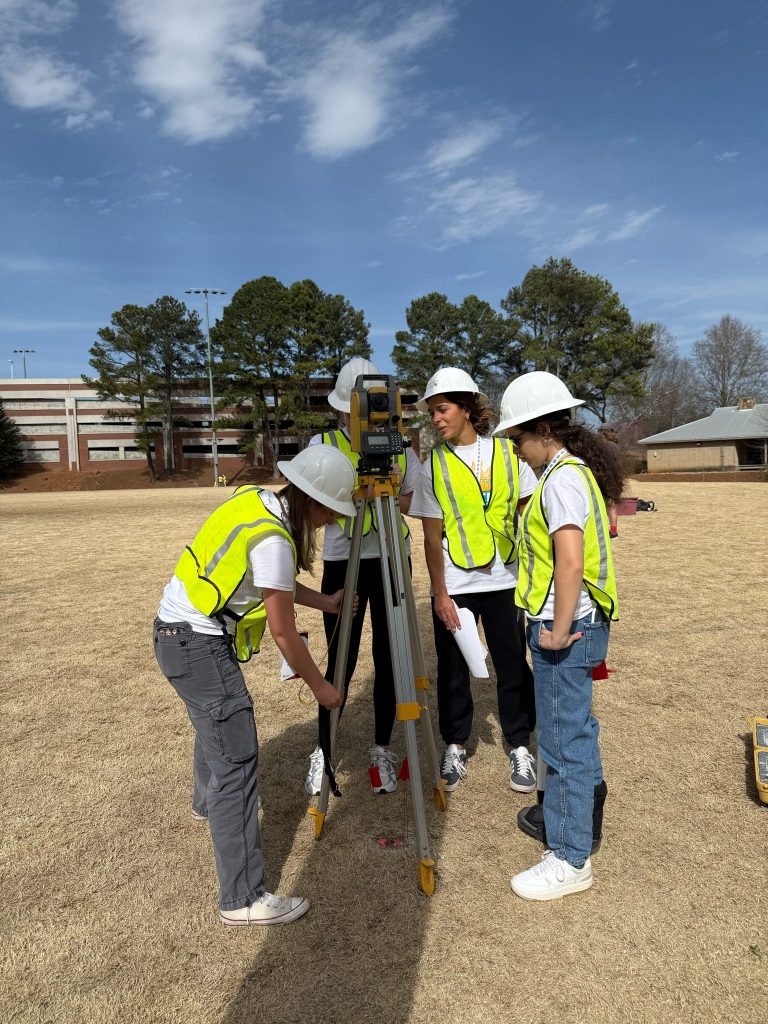
Alex Knodel, a civil engineering senior and president of Florida Tech’s American Society of Civil Engineers (ASCE) student chapter, knows that feeling, too.
Florida Tech’s ASCE chapter competes against other schools in a series of civil engineering challenges at the organization’s annual regional symposium, where first-place finishers in the main events earn a berth at the national championships.
Part of the symposium, the surveying competition requires teams to complete a series of timed field tasks—pacing distances, determining elevations and producing topographic maps—using the same tools and methods they’ll rely on in the field as engineers.
At the 2025 ASCE Civil Engineering Student Championships, the surveying team was undone by something deceptively simple: unit conversion. It was an unexpected requirement; a problem they hadn’t practiced for. And the mistake cost them.
“In the moment, it was pretty defeating because it was simple stuff that we were missing—not because we didn’t know it, but because we hadn’t practiced it and didn’t expect it to come up,” Knodel says. “Now, we have another thing we can work on throughout the year to be better prepared.”
The Value of Winning

Two years after finishing at the bottom, the Flight Team used that pain as fuel. At regionals, they earned a third-place finish and automatic qualification for nationals. At the 2025 SAFECON National Aviation Championship, they came home with 14 medals and eight trophies.
“It was an incredible feeling,” Williams says. “The energy was high; the whole room felt lighter. The flight home, the drive home—everything was happier.”
One of the most memorable moments of Knodel’s college career came when her team placed first in the surveying competition at the 2025 ASCE Southeast Student Symposium.
“I can’t even express how excited and proud I was. I think that was the proudest I’ve ever been of a group of people in my entire life,” she says. “I’ve never felt closer to a team. It was an unreal experience.”
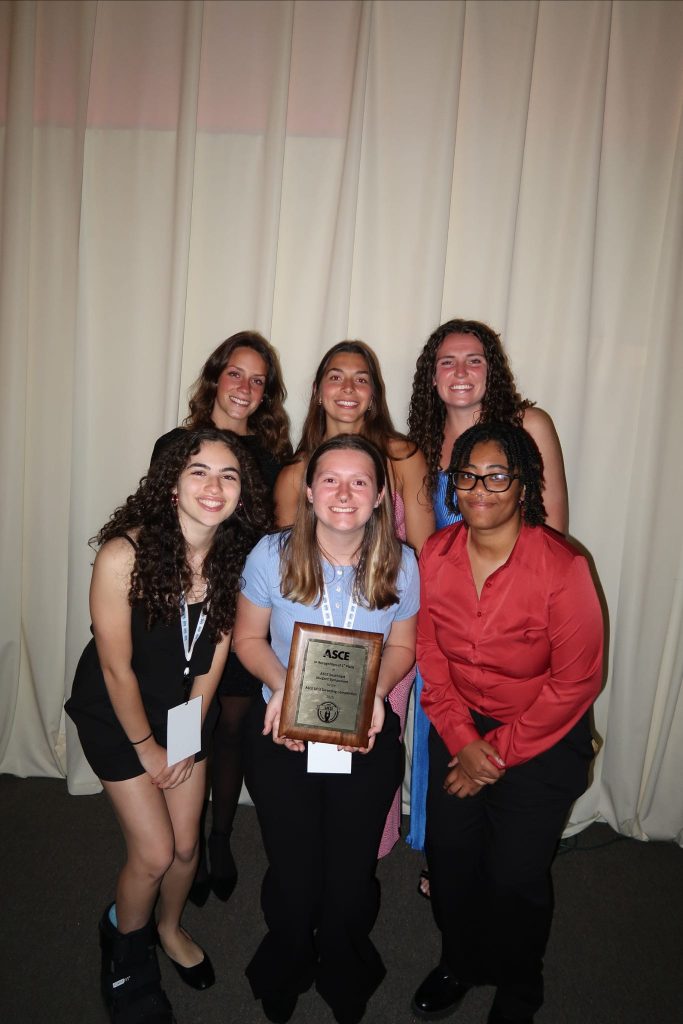
For Walker, placing third in the 2025 Global Scaling Challenge produced the same shift.
“It was really shocking because I didn’t think we were going to place at all. It definitely gave me more confidence in myself and in my ability to speak to high-level professionals,” she says.
Walker credits her competition experience with helping her secure an internship at Vertex Applied Innovation Hub.
“In my internship, I do a lot of communication directly under our executive director. Presenting has really helped me not feel nervous when talking to her or asking for her opinions,” she says.
That confidence—not trophies—is what Muth always pushes his students to pursue.
“That’s what I always preach to them: You can do lots of different things—sports, clubs, anything—but you want at least one thing that sets you apart from everybody else,” Muth says. “And for them, this might be that thing.”
Beyond the Trophy
Competition gives students the chance to demonstrate their skills, build connections, face challenges that mirror real professional environments before they graduate and, sometimes, open the door to their next big opportunity.
At the Student Design Showcase, Gabriel has seen it more times than he can count.
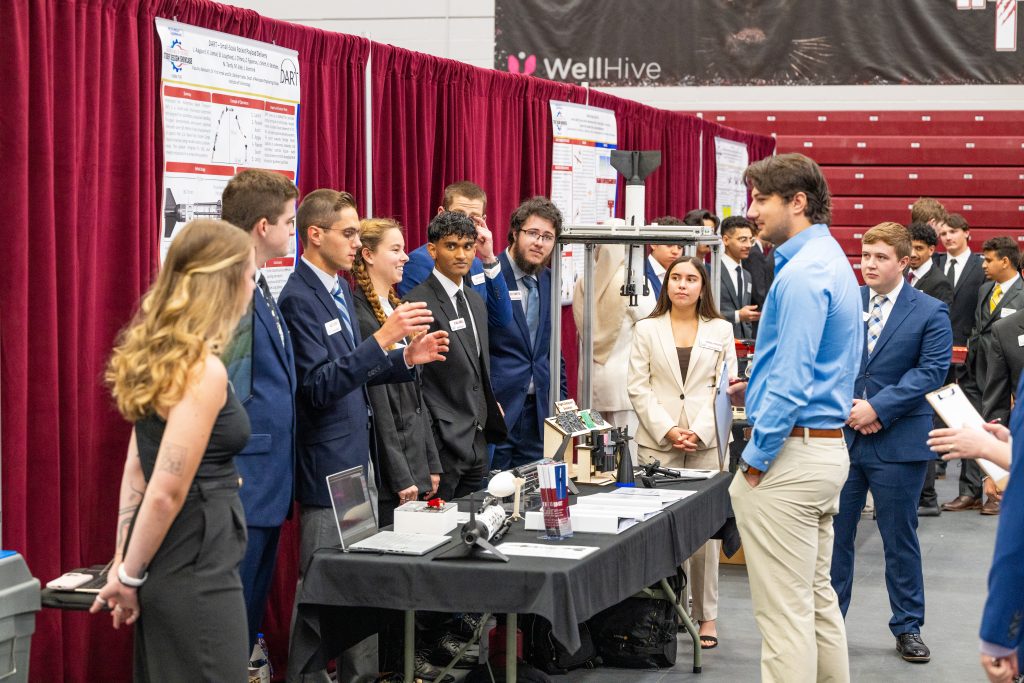
“I’m of the opinion that the showcase is the reversal of a career fair and that many of these companies use the showcase as a recruiting tool,” he says. “Everyone who attends brings job opportunities—or at least valuable connections.”
Employers understand that pressure is a teacher and that the students who seek it out leave better prepared than those who don’t. At Florida Tech, students don’t compete because they have to. They compete because it is part of who they are—and who they aspire to be.
It is on that signature spirit—serious, scrappy and relentlessly hands-on—that Florida Tech’s competitive culture is built.
“We’re not afraid of hands-on work. We’re not afraid of building a prototype. We’re not afraid of failure,” Gabriel says. “I think it’s simply who we are—it’s in Florida Tech’s DNA.”
This piece was featured in the spring 2026 edition of Florida Tech Magazine.