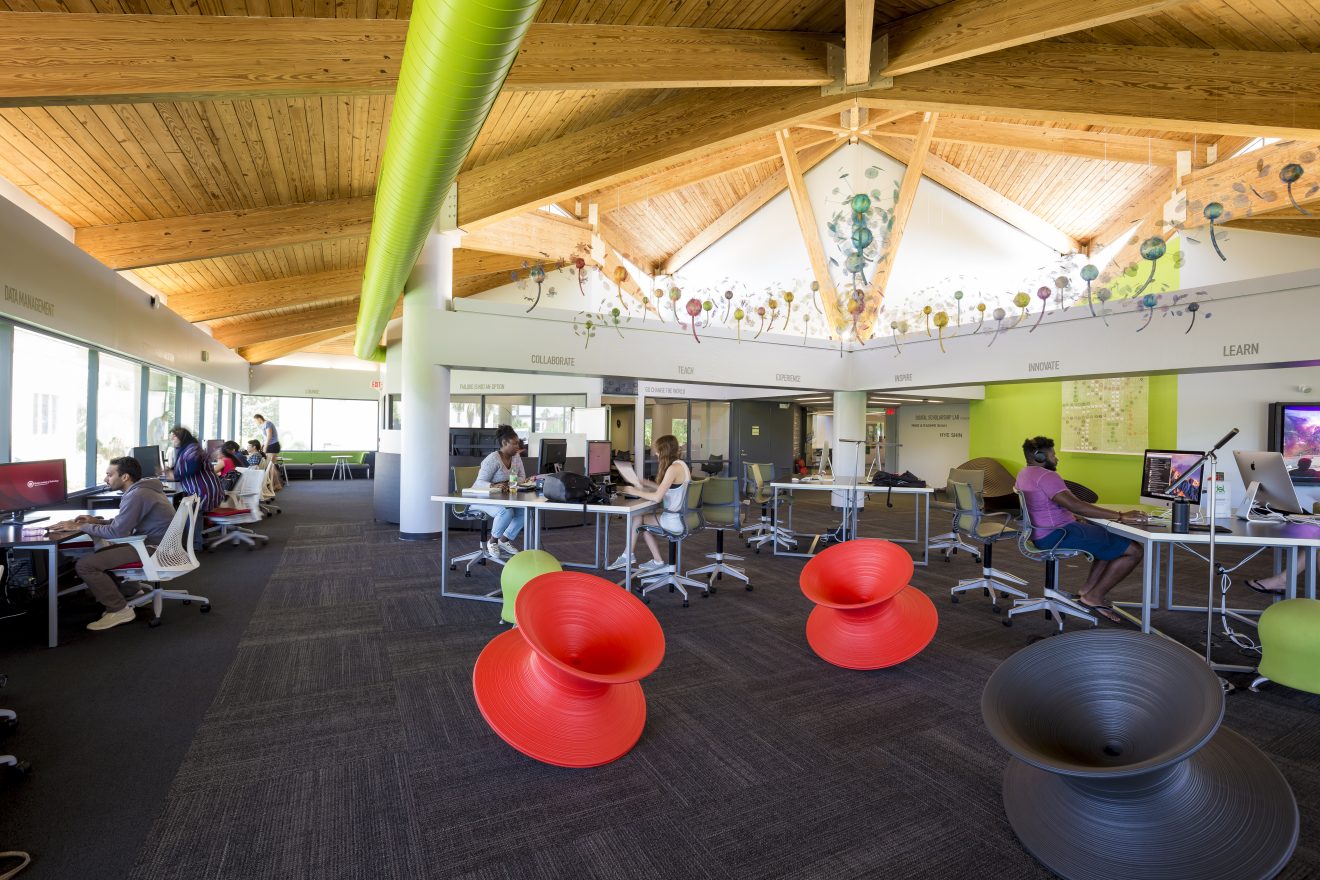
When the Digital Scholarship Laboratory (DSL) opened in Evans Library in January 2016, it was designed as a place where technology, research and creativity could intersect.
Ten years later, the space has grown into one of campus’s most versatile resources, supporting everything from immersive virtual reality experiences to podcast production and 3D prototyping.
Located on the second floor of the library, the DSL gives students and faculty access to specialized tools that help bring ideas to life. The lab was created to support research and teaching across disciplines by offering advanced digital technologies and expertise that individuals might otherwise find difficult to obtain.
That mission continues today. To celebrate the milestone, DSL innovation specialist Martin Gallagher shares 10 things you may not know about the lab.
10 Things You Might Not Know About the DSL
1. It’s designed for every discipline.
“The DSL was designed with everyone in mind. It doesn’t apply to just one department or curriculum. We are open to all, and we have technology and software available to students, regardless of their chosen degree. We aim to expand opportunities for learning.”
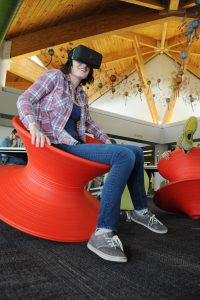
2. Virtual reality (VR) is part of the tool kit.
“Virtual reality can be a powerful tool for learning—calming the mind, creating focus and strengthening memory. When learners are relaxed and emotionally engaged, retention follows naturally. It’s also a lot of fun.”
3. It houses a full podcast and video studio.
“Our podcast studio is widely used and provides a strong communication medium for discussion, learning and outreach to the community and industry. It is also a fantastic medium for retaining ideas and group focus.”
4. A massive video wall powers presentations.
“Our video wall is used for many project presentations. It provides a large-scale view of ideas and can also serve as a relaxation screen, featuring fish tanks, fireplaces in the winter and meditation videos.”
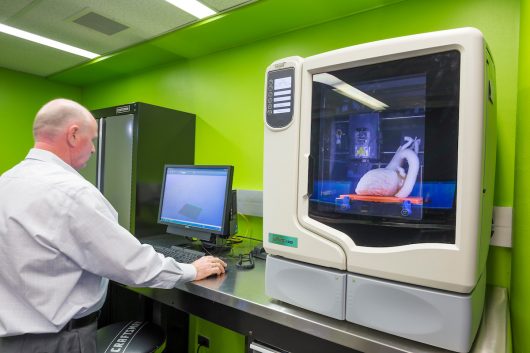
5. Its 3D printer brings ideas to life.
“Many ideas and projects require hands-on interaction to fully understand their purpose. Our 3D print lab allows users to turn concepts into reality. Students frequently print project components and custom parts for assembly. It’s a highly used and essential part of the engineering tool kit.”
6. Not all its technology is digital.
“The artwork was designed by an Orlando-based artist, who was commissioned by a former dean of libraries, to create these unique pieces for the DSL.”
Next time you are in there, see if you can find all the words in the textile above the grey couch.
7. Its GIS tools map the world.
“Our GIS [Geographic Information System] software enables detailed and targeted visualizations through maps and charts. This helps present complex data models in a way that’s easy to understand.”
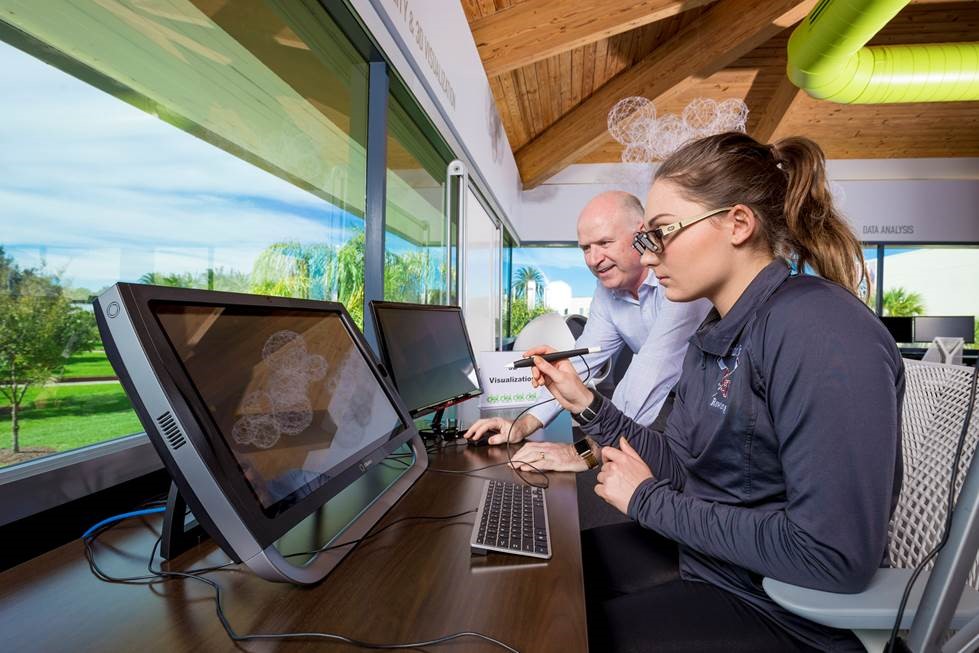
8. Ready-to-use creative software is available there.
“Adobe Creative Suite and many other programs are available to support creative development across video, music, design and AI media. Our systems provide professional-level capabilities that help students build industry-ready skills.”
9. The space is built for collaboration.
“The DSL is a hub for collaboration. We have two collaboration stations with screens that can accommodate up to four laptops, along with open spaces and comfortable seating. It’s a relaxed environment for discussion and teamwork. We even have a full-body massage chair that students use while brainstorming ideas.”
10. The university uses it as a showcase space.
“The DSL is a showcase space used for library and university programs and functions. The audience loves the architecture and décor, as well as the views. I take pride in giving tours to groups from across the university, as well as industry and community partners. We see ourselves as a source of inspiration for the university and continually challenge ourselves to offer new insights and skill sets to all.
This piece was featured in the spring 2026 edition of Florida Tech Magazine.