On any given day along Florida’s Space Coast, the sun rises over the Atlantic, rocket plumes carve white arcs into the sky and music drifts from radios tuned to WFIT 89.5 FM.
For 50 years, WFIT has been more than just a station on the dial. It’s been a cultural touchstone, a bridge between Florida Institute of Technology and the community—and a place where music, news and connection thrive.
“WFIT is a unifying force for musicians, music lovers and people who want to stay informed,” says Stephen Yasko, WFIT’s general manager. “Our mission is to bring the community onto Florida Tech’s campus and to be a home for those who find inspiration through music that’s not played anywhere else.”
As WFIT marks its 50th anniversary, those words ring truer than ever. What began in 1975 as a student-run radio station has evolved into a nationally recognized, noncommercial public radio outlet, blending National Public Radio (NPR) news with a signature swirl of music genres, local voices and community service. And while its history is rich, the story of WFIT today—and its role in shaping tomorrow—is perhaps even more compelling.
“WFIT is a unifying force for musicians, music lovers and people who want to stay informed. Our mission is to bring the community onto Florida Tech’s campus and to be a home for those who find inspiration through music that’s not played anywhere else.”
Stephen yasko, wfit general manager
A Station Like No Other

It’s easy to romanticize humble beginnings, but WFIT’s earliest days were, quite literally, underground. For decades, the station broadcast from the basement of Roberts Hall. Volunteers helped build walls, hang acoustic foam and wrestle with stubborn equipment. The space frequently flooded, and mold was a constant battle. The station’s 10-watt transmitter barely reached beyond campus.
“We started as a student-run station, just students doing music,” recalls Terri Wright, who began her WFIT career as a volunteer DJ in the early 1990s before becoming general manager from 1998 to 2023. “Then, we added news and became the first station in Brevard County to have HD broadcasting. So, we’ve certainly evolved.”
Today, WFIT broadcasts from a modern 4,100-square-foot facility complete with six studios, a performance space and state-of-the-art equipment. The station runs at 4,700 watts, its signal stretching across most of Brevard County and into parts of Indian River County. Its mixed format blends locally produced shows, NPR news and a music library so deep it defies commercial radio norms.
Voices That Make a Difference
While WFIT has adapted to technological change, it remains proudly old-school in at least one way: The music is still handpicked by the people who care most.

For Fred Migliore, host of “FM Odyssey,” that creative freedom is everything. For more than three decades, his Sunday morning program, a thoughtful blend of storytelling and music, has featured hundreds of interviews with famous names such Billy Joel, Jackson Browne and Dan Fogelberg and has touched countless lives.
“Listeners keep tuning in because it feels like a conversation,” Migliore says. “It’s not just the music—it’s the voices, the stories and the discoveries.”
Despite this, Migliore insists his most profound moments have been with his audience. He recounts a listener who once called him, trembling, to say a song he played saved her life during a moment of crisis.
“When you hear stories like that, it’s just amazing. That’s when I was reminded how powerful music is. It’s one of the few things left that still unites us,” he says.
Radio With a Pulse
WFIT’s commitment to local music isn’t just talk—it’s woven into the station’s identity. Shows like “Keller Radio,” hosted by program director Steven Keller, regularly feature local and touring artists performing live in the studio. It’s an approach that resonates deeply with newer hosts such as Hannah Burgett, host of WFIT’s only live late-night program, “The Pop Underground.”

“WFIT is a beacon of the Space Coast’s cultural scene,” Burgett says. “There are so many people in this area with different backgrounds and musical interests, but WFIT’s uniquely varied programming brings everyone together under the banner of community radio.”
Burgett’s show, centered on “pop but underground,” illustrates how WFIT thrives on originality and personal connection.
“The coolest thing about WFIT is that you don’t just get the songs—you get the experience, expertise and personality of the hosts,” Burgett says. “Your streaming service can recommend a song you might like, but can it tell you about the time it met the artist at a show or suggest similar tracks that aren’t on streaming platforms? WFIT won’t replace your streaming service, but if you need something a little more human in your routine, WFIT has a high-quality show for everyone.”
From blues to reggae, world music to indie pop, WFIT’s sound is anything but uniform. The station’s diverse programming reflects the region’s eclectic tastes and the passions of its hosts.
“The format changed from alternative punk music to straight-ahead jazz, then smooth jazz, then a combination of both. And eventually, we became Triple A, which is ‘adult album alternative,’” Wright says.
Through each evolution, one thing remained constant: WFIT’s sense of place.
“There are no other locally owned radio stations in Brevard County anymore,” Wright says. “If you compare it with what’s on the dial right now, most stations are part of conglomerates. If you go from one station to another, you might hear the exact same music because it’s all programmed nationwide. We’re a great asset because we live in this community; we know what’s going on, and we can share that with people.”
Bridging Campus and Community
Spend any time listening to WFIT, and one truth becomes clear: It’s a station deeply rooted in its community. From local nonprofits to the environment, WFIT’s airwaves serve as a stage for voices often overlooked.

Wes Sumner ’18 DBA, Florida Tech’s vice president for external affairs, sees WFIT as a powerful storytelling platform for the university.
“WFIT is one of the jewels of Florida Tech,” Sumner says. “The institution has a great resource in WFIT in that it is an outlet to share the good news of Florida Tech—its research, its people—with the larger community in a way that is very accessible to them.”
His own show, “Inside Florida Tech,” is a brief segment spotlighting faculty research, student successes and university initiatives. “It’s one of the neatest things I’ve been able to do because I get a front-row seat to what members of the university community are doing,” Sumner says. “It’s a privilege to share that good work with a larger audience.”
One of WFIT’s signature programs, “Coastal Connection,” hosted by Wright, shines a light on Brevard County’s nonprofits and grassroots efforts.

“I reach out to nonprofits that are doing amazing things in our community,” she says. “It’s wonderful because there’s a lot in the community I don’t know about, and it’s my opportunity to share that with people who hopefully get involved.”
“WFIT is about being tied to the community much more strongly than other radio stations,” Yasko says. “It’s not about how much money you have in your advertising budget; it’s about how much good work you’re doing to fulfill your mission in Brevard County.”
Environmental coverage is a hallmark of WFIT’s mission, and segments such as “Lagoon Minute” keep listeners informed about one of Florida’s most fragile ecosystems.
“The Indian River Lagoon is a huge issue,” Wright says. “There are a lot of different organizations working to improve it, and I have an opportunity to speak with many of them and highlight improvements, challenges and things that are happening there.”
While WFIT provides national context through NPR news programs, including “Morning Edition” and “All Things Considered,” it firmly prioritizes local news coverage delivered by staff and volunteers who live in the area.
A Place to Learn and Grow
For Florida Tech students, WFIT offers a rare chance to gain real-world broadcasting experience. Joshua Mearig, a multiplatform journalism senior, first discovered WFIT through his audio journalism class and soon began helping cover newscasts when staff were away.
“Getting into the studio and feeling comfortable talking behind a mic was something I probably never would’ve built just by being in class,” Mearig says. “I was able to build a whole lot more skills by being in the studio every day, twice a day, for two or three weeks at a time.”
Mearig hopes to stay connected to radio after graduation.
“Radio always seemed like a cool thing and something I’d like to be involved with,” he says. “Journalism and music are two things radio blends together. So, being a part of the radio station really reinforced for me that that is something I would really like to do moving forward.”
Student volunteers like Mearig are part of a long tradition. Jonathan Adams ’04, a former volunteer, remembers WFIT as a place that shaped his confidence and career path.
“I had an idea, and even without much education in radio, WFIT was very supportive and allowed me to do something different and share what brought me joy,” he recalls. “I wasn’t learning anything about music or audio in school—I was studying computer science—and they taught me the board. It was like a whole other education I was getting outside of my classes.”
Adams, who hosted “Tuesday Night Jazz with a Groove” in the early 2000s, has since spent nearly two decades working in audio development, blending his passion for technology and music. But he never forgot the lessons he learned behind the board in the basement of Roberts Hall.
“Radio is about community—your neighborhood, your friends, everyone tuning in together,” Adams says. “WFIT is a pillar of the community. When you’re listening to a commercial radio station, and it’s just the same feed being broadcast in California or Ohio, you don’t get a sense of place. But with WFIT, it’s the people in your backyard.”
“Radio is about community—your neighborhood, your friends, everyone tuning in together. WFIT is a pillar of the community.”
jonathan adams ’04, former wfit volunteer
A Vision for the Future

Though WFIT remains deeply connected to its roots, its eyes are fixed firmly on the future. New technology, digital platforms and shifting audience habits present both challenges and opportunities.
“We’re kind of becoming dinosaurs because most people don’t listen to radio anymore, especially kids,” Wright says. “There’s streaming, satellite and on-demand programming, so radio is kind of old school. The only thing we have that streaming doesn’t is the fact that we’re right here, in Brevard County, and we can tell people about what’s happening here.”
Yasko agrees, acknowledging the changing media landscape.
“We just installed a new state-of-the-art automation system. It’s the backbone of the radio station and has streamlined our operations,” he says. “I’m excited about bringing more local news to the air, as well as bringing the essence of WFIT into more digital platforms, like our website, TikTok and Facebook, so that we are always where our listeners are.”
The Heart of the Space Coast
Fifty years after its first broadcast crackled out of Roberts Hall, WFIT remains an irreplaceable soundtrack to life on the Space Coast. Its blend of diverse music, trusted news and genuine community connection ensures that listeners tuning in will always find something that speaks to them—whether it’s a rare pop gem, a local news brief or the gentle encouragement of a familiar DJ’s voice.
For five decades, WFIT has proven that local radio isn’t just surviving. It’s thriving, because it has never lost sight of what matters most: the community that keeps listening.
This is WFIT at 50: locally owned, fiercely independent and still making waves.
Support WFIT
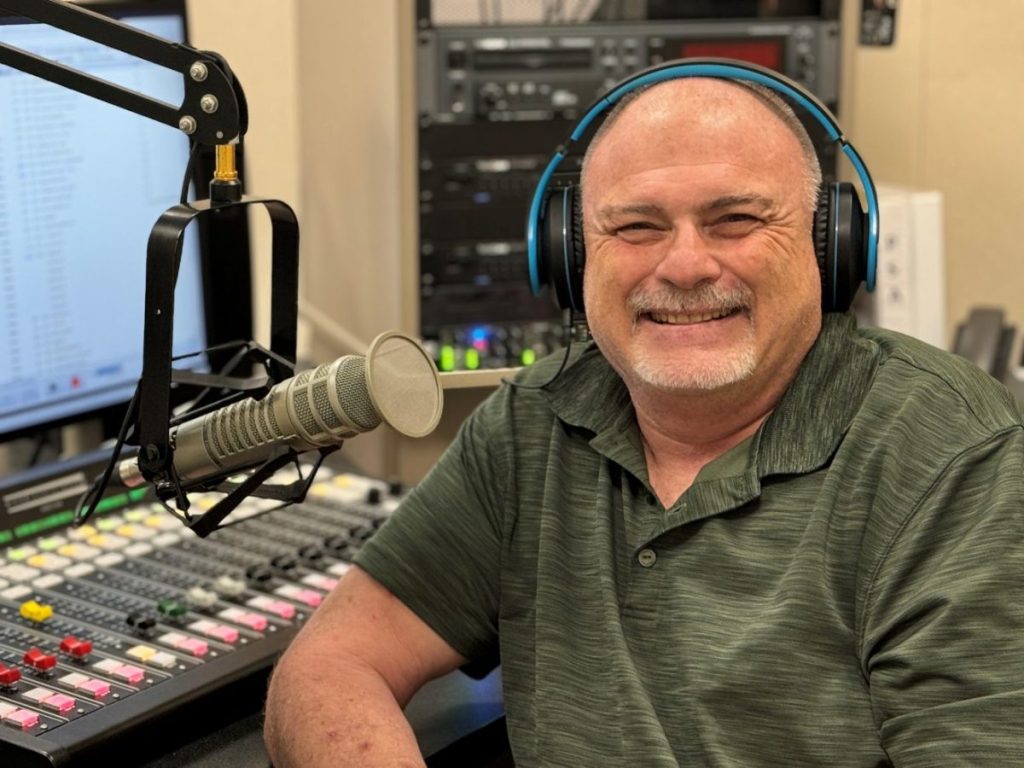
Recently, federal and state funding have been eliminated for public radio and television stations. Sadly, this new reality translates to an extensive budget reduction for WFIT.
Although we have been diligent in raising additional funds and economizing where we can, to meet this shortfall, we have had to eliminate three staff positions. While these changes affect some programming and fundraising, we are resolute in our commitment to Brevard County and the Space Coast and will continue exploring cost-effective ways to realign our programming with the current economic reality.
It remains our privilege to serve this community. That said, we could use your generous support now more than ever.
— Stephen Yasko, WFIT General Manager
Visit the WFIT website to learn how you can contribute.

This piece was featured in the fall 2025 edition of Florida Tech Magazine.