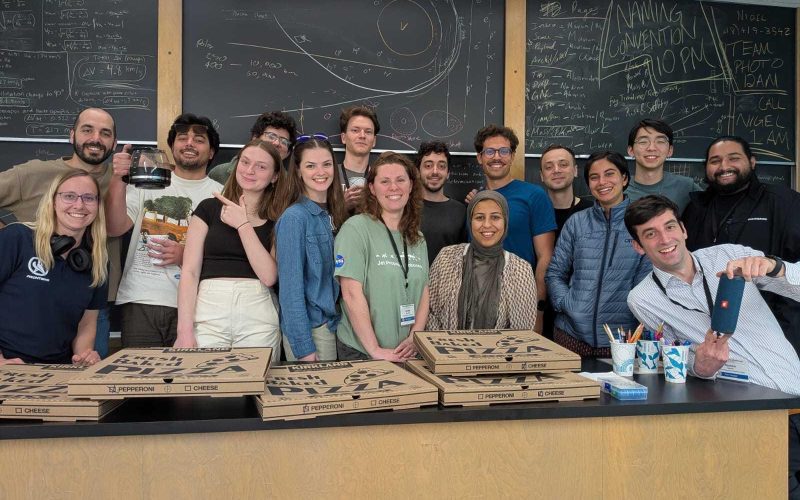
Amelia Brumfield, a Ph.D. student in aerospace engineering, participated in the prestigious Caltech Space Challenge in the spring, and her 16-member team won.
The Challenge is a five-day event started in 2011 by two California Institute of Technology (Caltech) graduate students that has 32 graduate students from the best universities in the world come to the university’s Pasadena campus to compete in designing a space mission.
More than 500 students applied this year, and the selected students – 16 each on Team Voyager (Brumfield’s team) and Team Explorer – came from schools including Georgia Tech, Stanford, Imperial College London, Harvard, Delft University of Technology and MIT in addition to Florida Tech.

The task they faced was to design a mission to investigate the history of water and volatiles on retrograde comet P/2005 T4 (SWAN), then enter a minimum two-year elliptical orbit in Venus’ upper atmosphere to study atmospheric loss and solar wind interactions.
“Given five days to prepare a mission proposal, the teams worked tirelessly to develop and present their unique concepts, which were judged by a panel of NASA and industry experts,” Brumfield said.
During the week, team members collaborated with various experts from the Caltech-based Jet Propulsion Laboratory and industry through technical reviews and presentations. The program also included immersive tours of Caltech and JPL laboratory facilities, providing deep insight into professional mission design and testing environments.
Team Voyager’s winning proposal was SEAHORSE (Spectroscopy for Escape in Venusian Atmosphere and Hydrogen Outgassing in Retrograde SWAN Encounter).
Brumfield explained: “It proposed a comet flyby to characterize the nucleus, coma, tail and local dust-plasma environment, supported by two deployable probes (Fry-1 and Fry-2) to improve spatial sampling. Then, after the two-year minimum orbit around Venus, it would conduct a technology demonstration of air-breathing electric propulsion using in Venus’ atmosphere as the propellant.”
Brumfield’s role involved helping identify the instrumentation suite for SEAHORSE, supporting risk analysis and characterizing the density and pressure of Venus’ upper atmosphere.
“I gained insight into the various aspects of space mission design and experience working alongside a diverse group of graduate students and experts,” she said.