By Andrea Gajic
Gaining professional experience before graduation is no longer just an advantage: It’s a critical step in launching a successful career. It’s where theory meets practice, answering the crucial questions every student faces: Do I enjoy the physical application of my major? How do my classroom skills translate to the real world?
But how do students juggle demanding coursework, find these opportunities and make a real impact in the workplace? We spoke with four Florida Tech students who successfully navigated this path: Veronica Montero-Sanchez (civil engineering), Deztynee Bryan ’25 (meteorology), Candela Solis Zampini ’24 (mechanical engineering) and Lindsey Reilly (aerospace engineering). From interning at the National Center for Atmospheric Research to working in test engineering for a defense contractor, these students turned part-time jobs and internships into valuable career preparation.


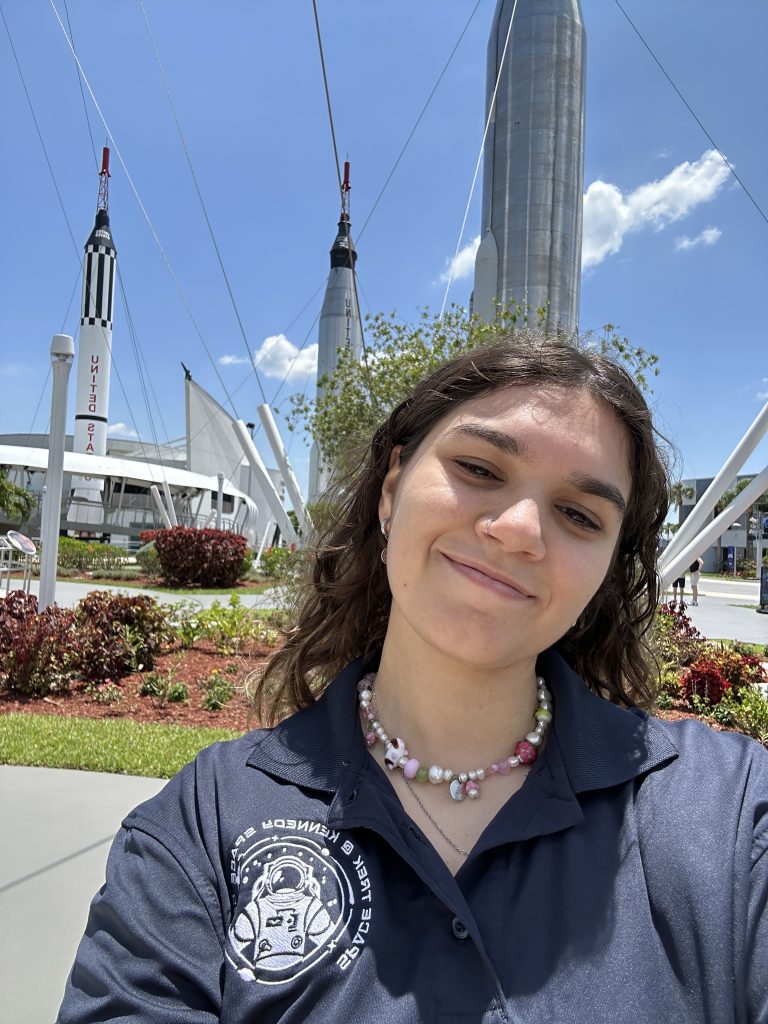

Their experiences were transformative, helping to clarify uncertain futures and solidifying lifelong passions. Their collective experiences offer a roadmap for any student looking to get a head start, detailing the challenges, strategies and profound rewards of gaining professional experience before the cap and gown.
The Motivation: Why Work Before You Graduate?
“I wanted to be absolutely sure that I enjoyed the physical application as much as the theoretical.”
Veronica Montero-Sanchez, civil engineering

A common thread among the students was the desire to gain a glimpse into their futures and see their academic knowledge in action.
“My motivation was to see if I liked my chosen field,” Montero-Sanchez says. “I wanted to be absolutely sure that I enjoyed the physical application as much as the theoretical.”
This practical experience ultimately helped her envision a “more concrete future” and confirmed she was on the right path.
Zampini echoes the sentiment, explaining that she wanted to see how what she was learning in class applied to the real world. Beyond bringing the concepts in her textbooks off the page, she hoped to discern what kind of work she most enjoyed and where she could see herself in the future.
For them, the experience was about more than just a line of a résumé—it was about shaping their future by getting a clearer idea of their interests and what day-to-day work truly looked like.
For others, the motivation was reinforced by strong academic mentorship. Bryan noted that her professors and the Florida Tech American Meteorological Society (AMS) Student Chapter consistently emphasized the importance of gaining hands-on experience. She took the advice to heart and pursued an internship that ultimately strengthened her passion for science and solidified her career goal to become a hurricane researcher, she says.
Some students also had more direct goals, such as seeking an internship to enhance their learning and set them up for a job in the future. Whether driven by curiosity, mentorship or career strategy, each student sought to bridge the gap between theory and practice.
The Hunt: How to Secure Your Spot
Once you’re motivated, the search begins. The students we spoke to found success through a variety of channels, proving that there’s no single “right” way to find an opportunity.
Go Digital, and Get Involved
Online job boards are a great starting point, but what you do offline can make your digital application stand out. Montero-Sanchez found her internship on Indeed but believes what solidified her chances was her extensive involvement in organizations such as the American Society of Civil Engineers (ASCE). She took on leadership positions and even started a personal podcasts about civil engineering, demonstrating a passion that went far beyond the classroom.
Similarly, Zampini spent time actively checking job postings, but she tailored her applications to highlight the coursework and hands-on projects that were most related to each position.
Bryan found that getting involved in workshops and conferences allowed her to learn more about what opportunities are available.
Network, Network, Network

Don’t underestimate the power of a good conversation. Conferences, conventions and workshops provide invaluable face-to-face interactions that can help you secure a role. Career fairs are also a good place to meet with recruiters and speak with companies, providing context to your résumé that they may not get when you apply online.
Zampini connected with her future company at a convention, an interaction that provided crucial insight into what type of person they were looking for and what their expectations were. This allowed her to frame her experience more effectively, she says.
Bryan also found success to an AMS conference, where she had the chance to speak directly with the program lead for the National Science Foundation Significant Opportunities in Atmospheric Research and Science (NSF SOARS) program. That conversion gave her valuable insight into the program and helped her determine it was the right fit for her.
Career fairs are another key venue for these interactions, and most colleges host them on campus, making them an accessible way to get face time with recruiters at your favorite companies.
Reilly found this to be particularly true as she spoke with a General Dynamics Electric Boat representative at a career fair. The conversation led to an internship offer, and her interviewer later became her supervisor, proving that a face-to-face connection can provide recruiters with the missing piece they need to make the decision to hire.
Leverage Your Community
“My professors consistently offered recommendations, advice and encouragement, which was a major factor in my search.”
Deztynee Bryan ’25, meteorology
To study a discipline is to become a member of its community of scholars and learners. Make sure to use every opportunity your community offers! Those same conferences and conventions that allow you to network can also help you learn skills you can leverage on applications and can help you learn more about available opportunities. They can also help with résumé review and can point you in the right direction.
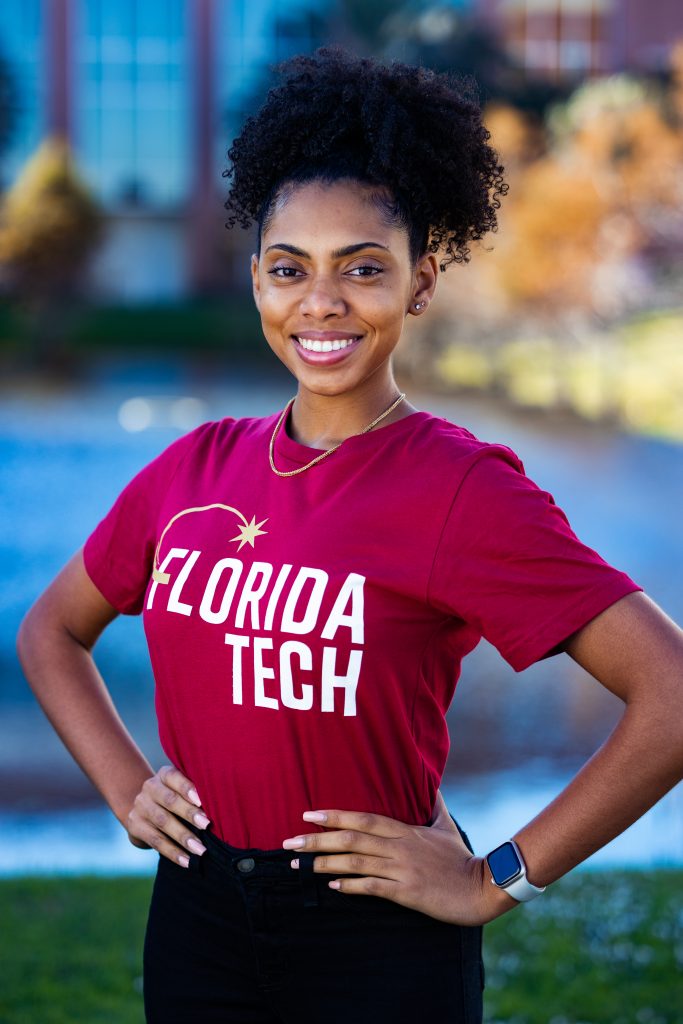
Reilly prepared for her successful career fair interaction by first working with Florida Tech’s Career Services office to refine her résumé.
Alumni, professors and peers are also invaluable resources. For example, meteorology alumni played an integral role in Bryan’s experience by sharing opportunities with the Florida Tech AMS Student Chapter, contributing to a growing list of internships and research experiences for undergraduate (REUs).
She also spoke with previous interns at conferences to better understand which programs best suited her interests and career goals.
This community support extends to university faculty, as well.
“My professors consistently offered recommendations, advice and encouragement, which was a major factor in my search,” Bryan says.
The Balancing Act: Juggling Work, School, Life
An internship or job adds a new layer of responsibility to a student’s already busy life. The universal key to managing it all: time management.
Nearly every student mentioned the importance of creating an organized schedule. For some, that was a skill they’d been practicing since high school. For others, it was something new that they were mastering.
The core strategy involved using a calendar to track deadlines for work, classes and personal events, helping to avoid last-minute stress.
“Dedicate specific time for studying and specific times for work,” Zampini advises. This allows you to focus fully on each without feeling pulled in two directions, she says. Challenges are inevitable. The biggest hurdle for most was balancing professional responsibilities with academic commitments, especially during midterms and exams. Montero-Sanchez knew it was time to reevaluate her schedule when she received a lower grade than she usually would on an assignment. That moment was a wake-up call, she says, and it reinforced the principle that academics must remain her top priority.
Stepping into a professional environment also presented its own set of challenges, Reilly says. She overcame the initial nervousness she felt in a professional setting by remembering to ask questions.
“Asking questions doesn’t show weakness and instead shows that you’re engaged and want to perform well at your job,” Reilly says.
Zampini overcame the feeling of uncertainty in her experience by also staying open to feedback and treating every task as a chance to learn, she says.
The Payoff: Gaining a New Perspective
Jobs and internships fundamentally reshape students’ understanding of their chosen field. It’s where abstract theories from the classroom collide with the complexities of the real world.
“The experience helped me connect what I’d been learning in school with real-world applications,” Zampini says, “and I could see how the theories and concepts I’d studied actually played out in practice.”
This connection was tangible for many. Montero-Sanchez, for example, learned that her mechanics of materials and statics knowledge was essential for understanding the purpose of design criteria and public safety. Similarly, Reilly saw a direct line from her academic lab courses to her daily work.
“Test engineering is all about finding issues and solving them, a skill I honed through hands-on troubleshooting and analysis in school,” she says.
Internships also reveal unexpected aspects of a profession. Montero-Sanchez admitted her experience threw her for loop. “I discovered how much teamwork is involved in engineering, especially on a roadway project,” she says.
“All of the disciplines work closely together since the smallest change can make or break a design.”
Bryan was impressed by the collaborative culture at the National Center for Atmospheric Science, as well.
“Everyone is warm, inviting, and very helpful,” she says.
This real-world context is invaluable for making informed career decisions. Bryan found that immersing herself in the lifestyle of a researcher and experiencing both the difficulties and successes of the profession confirmed her desire to become a hurricane researcher and motivated her to pursue graduate studies.
For others, it illuminates a specific career path they hadn’t considered. Montero-Sanchez, for example, realized that instead of her previously selected civil engineering specialization, she preferred construction engineering and inspection (CEI) work and structural design.
Internships can also inspire ambitious goals. Zampini’s realization that she wanted a career that combines research with hands-on problem-solving and collaboration was a key factor that influenced her goal to one day join the U.S. Space Force and contribute directly to advancing space technology and exploration.
Beyond the invaluable experience, perhaps the most tangible benefits of a successful internship is its potential to convert directly into a full-time job offer.
Think of an internship as a monthslong job interview where employers evaluate not just your technical skills, but your work ethic, problem-solving abilities and fit with the company culture.
For companies, extending a job offer to an intern—someone who has already been trained and has demonstrated his or her value—is a low-risk, high-reward decision.
For students, it provides a clear and often less stressful path to post-graduation employment, allowing them to enter their final year with the security of a job offer in a familiar environment.
Words of Wisdom: Final Advice For Your Journey
Be Persistent
Rejection is part of the process, and it’s crucial not to be discouraged.
“Never stop applying,” Zampini says. “It doesn’t matter how many times you are going to get rejected; there is someone out there that is willing to give you a chance. It takes time to be noticed, but you will eventually land a job that you actually like.”
Build Your Network

Every student emphasized the importance of connections.
“Connect early with both peers and professionals in your field of interest,” Bryan says. “Learning from their experiences can help you identify potential career paths and determine which internships or jobs best align with your goals.”
Reilly agrees.
“Prioritize building connections—whether through professors, alumni or networking events,” she says.
A practical way to do this, Bryan suggests, is to get involved with national organizations and campus clubs, which she found to be incredibly rewarding. Her involvement provided her with many tools that benefited her during her internship and as a young scientist.
Showcase Your Unique Strengths
Beyond networking, it’s important to build a résumé that reflects who you are and engage in activities that highlight your unique strengths and passions. The goal isn’t just to be employable; it’s to be yourself.
“Focusing on personal growth, not just employability, can help you stand out and bring diversity to the team you will join,” Bryan says.
Confirm Your Passion
Ultimately, an internship or job is the best way to ensure you’re on the right track.
“Knowledge you gain [from an internship] is unlike anything they teach you in a classroom,” Montero-Sanchez says. “It provides you with a better understanding of your field and a clear idea of what your future will look like. The most important thing is knowing that you are making the right decision with the degree you chose to pursue.”

This piece was featured in the fall/winter 2025 edition of Reinvented Magazine.