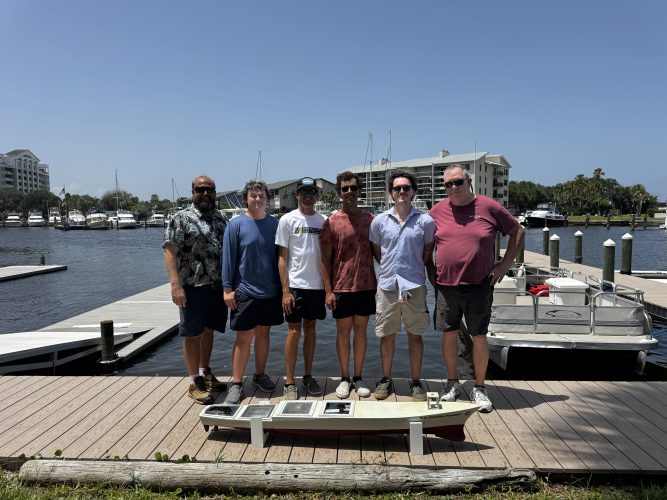
If you see a boat full of people all watching a smaller, remote-control boat in the Indian River, your first thought probably isn’t that they are testing Navy warships.
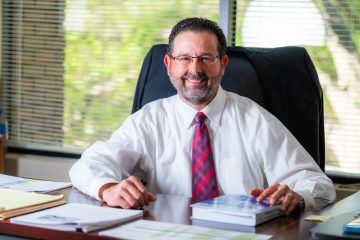
But that may be exactly what’s happening: Ocean engineering assistant professor Travis Hunsucker ’11 M.S., ’16 Ph.D., and his students are designing and testing scale models of Navy ships to understand how changes in hull shape affect performance, with the goal of developing designs that can lead to faster, more efficient and more stable vessels.
Hunsucker was selected as one of just nine Naval Sea System Command (NAVSEA) Professors in the country earlier this year and in this role is responsible for research and education focused on ship design with Navy-relevant capabilities. He has three active grants from the Navy, funding research on education in ship design and unmanned surface vehicles.
As important as the research itself is, it also serves as a powerful learning tool for students.
“We are trying to build students who can design ships of all types,” Hunsucker said.
His main goal is providing students with an environment where they can not only learn the principles of design in the classroom but also participate in hands-on testing of their own designs.
Already, some of Hunsucker’s students are taking what they are learning in the classroom and lab and applying it to real-world design work for the Navy – and vice-versa.
As a part of the Navy’s STEM Student Employment Program, three Florida Tech ocean engineering seniors spent their summer at the Naval Surface Warfare Center Carderock Division working with professionals in the field to design a boat hull for their senior design project, very similar to the work they have done with Hunsucker.
Brianna Ellis, one of the students who went to Carderock along with Zoey Shepard and Collin Morr, said taking a project from design to testing allowed her to see theoretical lessons from the classroom evolve into hands-on learning experiences.
“It was cool to actually design something and to build it and get to test it and get to actually see results from something we made. That was a really cool experience,” she said. “And then also just being able to work in their special facilities, which most students don’t get to do, was an awesome opportunity.”
This program differs from a typical internship because the students, before they’ve graduated, are already employed as civilian members of the Navy. They started in their sophomore or junior year, and their education can be shaped to build skills they will need when they begin full-time work upon graduation.
“I’ve been doing an internship with NAVSEA thorough the Carderock Division since sophomore year. I went to the career fair and met my supervisor there,” Shepard said. “It’s definitely a nice supplement to what I’m doing in school.”
Now that the summer program has ended, the students returned to campus to continue honing their design skills in Hunsucker’s Hydromechanics and Naval Architecture Lab.

At Carderock, the students tested their designs in large, expensive tow tanks, which are long troughs of water that a model hull can be pulled through to measure its resistance properties. Here in Melbourne, Hunsucker and his students are taking their work straight into the field by testing their models in the Indian River Lagoon.
The research team is trying to show that testing model boat hulls in the Indian River Lagoon will provide valid data that can be applied to the design of full-size boat hulls. They are using a “benchmark” hull, which is a hull that has been tested in numerous other facilities, so they can compare the accuracy of their data against the data collected elsewhere.
Once they confirm the validity of the river data, that’s when the innovation begins.
The team will design and 3D-print boat hulls and test their hydrodynamic properties, then share that data with the Navy to inform future ship design. Each of the new hull designs will use the same sensors and motor, so that the researchers can isolate the variable of hull shape while keeping all other factors the same.
“We’re building a Navy destroyer where we can take the forward third off and put another forward third on and just test the hydrodynamic properties,” Hunsucker said. The modular system allows the researchers to understand the effects of changing only that portion of the model.
Hunsucker explained that the process of testing these 3D-printed models in open water like the Indian River Lagoon is a new approach that only he and his team are utilizing.
“The goal is to develop the processes that we can test multiple hull forms to understand the impact of the changes in the hull on the resistance and the impact of the changes of the hull on the seakeeping,” Hunsucker said.