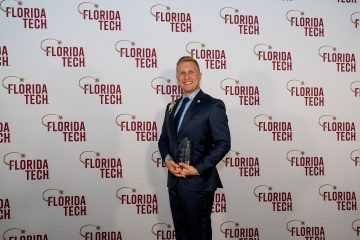
MELBOURNE, FLA. — A new agreement between Florida Tech and Eve Air Mobility will supercharge student experiences in this evolving field by providing industry-level technical challenges for them to tackle, guest lectures, potential internships and more from the Melbourne-based urban air mobility business of aerospace corporation Embraer S.A., the participants announced today.
The Memorandum of Understanding Florida Tech and Eve signed also calls for discussions on future research collaborations in areas of interest to both parties, including aviation human factors, aviation operations, autonomy, aviation business management approaches and aviation psychology.
“This partnership plays a vital role in advancing cutting-edge research and driving innovation across the urban air mobility ecosystem,” said Luiz Mauad, vice president of Customer Service at Eve Air Mobility. “We believe that partnering with a prestigious, STEM-focused university like Florida Tech will help establish a strong pipeline of high-quality talent through internships pilot projects and local career fairs. More importantly, this MOU lays the foundation for ongoing collaboration, enabling us to tackle real-world challenges together and co-develop curriculum that aligns with the evolving industry needs.”
That exposure to real-world challenges associated with advanced air mobility (AAM) is one of the most valuable aspects of the agreement, said Meredith Carroll, professor of aviation human factors in the College of Aeronautics, director of the ATLAS Lab and, along with Benjamin Emeterio ’21, ecosystem strategy lead at Eve Air Mobility, co-leader on the two-year MOU.
“We can provide theoretical problems for them to solve, but if Eve has actual technical problems in need of innovative solutions, that process gives students real-world experience – and it’s a motivating factor,” she said. “If they produce a great solution, maybe there will be interest in internships or even employment. So, it really enhances the educational aspect of the courses.”
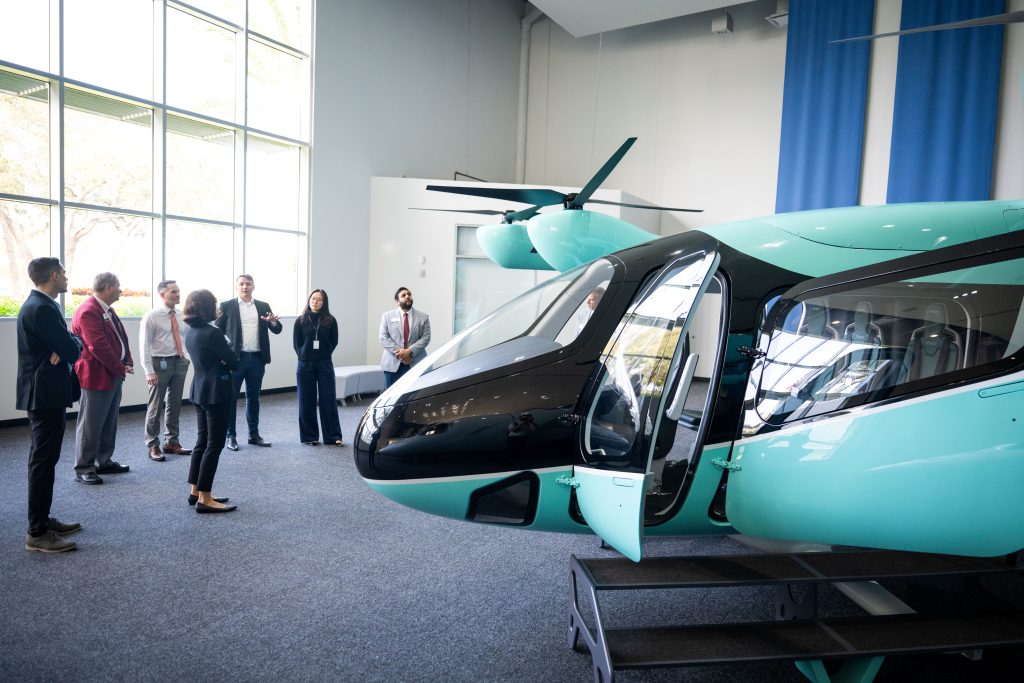
Because Eve is dedicated to the development of a range of solutions for the urban air mobility market, including an electric Vertical Take-Off and Landing (eVTOL) aircraft, future research can tap into a variety of critical areas, Carroll and Mauad noted.
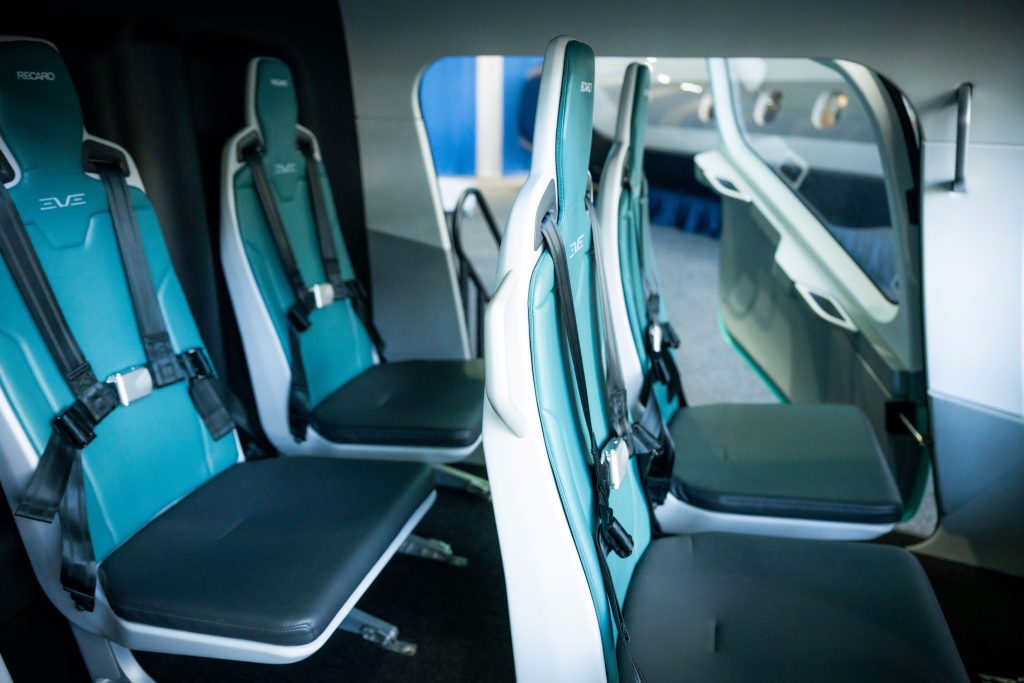
One topic that plays to this partnership’s strengths is a future focus on an understudied participant: the passenger on these electric-powered air taxis. Eve built a cabin facsimile and has done user experience testing, but the field is still rich with unanswered questions, Carroll said.
“On some of the proposed flight paths, people will experience acceleration forces that are very different from their experience on an airliner,” she said. “Are they going to tolerate that well? Will they want to fly again? So, the sounds, the vibrations – studying those factors, how they impact human comfort. That might be a cool topic on which we could collaborate.”
Another research area could center on Eve’s work on Unmanned Traffic Management. As air taxis come to airports and other transportation centers, conceivably just a decade or so away, managing diverse types of vehicles in the airspace will be critical. Coupling that effort with Florida Tech’s air traffic controller program is a collaboration worth considering, Carroll said. The rise of this type of transportation – point-to-point, environmentally friendly, designed to excel in crowded urban environments – is inevitable and important, Mauad said.
“The evolution of eVTOL aircraft and advanced air mobility marks a turning point in how we think about transportation, urban planning and sustainable mobility,” said Mauad.
Over the next five years, the industry focus will be on developing regulatory and safety frameworks to continue to build public trust in this transportation system. A decade out, Mauad sees eVTOLs “fully integrated” into major cities.
“By year 15, I hope UAM has widespread international adoption and autonomous operations become standard,” Mauad shared. “At this point, UAM will no longer be considered a novelty, but rather a necessity which significantly reduces urban congestion, carbon emissions and travel time.”