MELBOURNE, FLA. — Five new images from the European Space Agency’s (ESA) Euclid space telescope mission continue to further our exploration of the “Dark Universe.”
With help from NASA’s Jet Propulsion Laboratory, Euclid’s mission is to grow our understanding of “dark matter” so scientists can precisely chart its presence in the universe. According to NASA, dark matter is an invisible substance of unknown composition that is five times more common in the universe than “regular” matter.
Euclid returned its first five images in November 2023 after launching from Cape Canaveral that summer. Now astronomers and scientists are examining a new batch released in late May. The five new images feature views of varying sizes — from a star-forming region in the Milky Way galaxy to clusters of hundreds of galaxies. NASA predicts that by 2030, Euclid will create a cosmic map that covers almost a third of the sky, thanks to the field of view that is wider than both the Hubble Telescope and the James Webb Space Telescope (JWST).
“These are magnificent images, which showcase the power of the Euclid telescope,” said Eric Perlman, an observational astrophysicist and professor at Florida Tech.
Perlman explained why these new images are so powerful and important.
What is your reaction to these images and why are they significant?
Eric Perlman: The view they show of these objects is strikingly different from what other observatories, in particular Hubble and JWST, show, for a few reasons.
First of all, JWST and Hubble offer deeper, higher-resolution views, with JWST specifically being an infrared telescope, whereas Hubble and Euclid primarily operate in the optical and near infrared. Euclid was built with a very wide-angle camera, so it gives you a unique view. With any of these images, download them at maximum resolution, starting at the widest possible view, then pick four or five regions and zoom in step by step. What you get when you do this is really powerful. You see the broader picture (on a much wider scale than Hubble or JWST can offer), and then you zoom in and get the high-resolution view at close to Hubble’s or JWST’s resolution, but not its depth, as Euclid tends to concentrate on that wide-angle view.
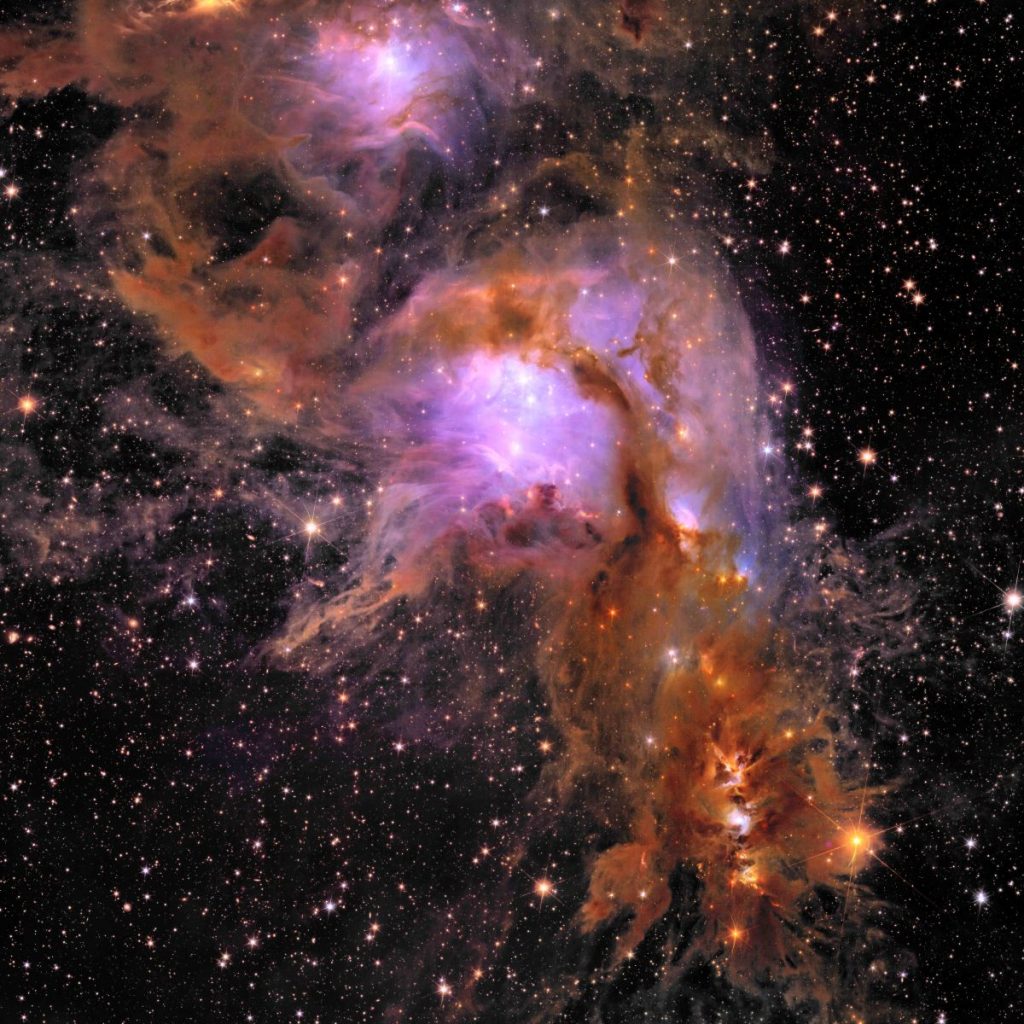
Image Credit: ESA/Euclid/Euclid Consortium/NASA
Second, each image shows some amazing things about the objects they capture. Whether you’re talking about the image of M78 – a star formation region in our own galaxy – where you see the distribution of gas and newly born stars on a scale we’ve never seen before, or NGC 6744 – a fairly typical, massive spiral galaxy that isn’t too different from our own – where we get a glimpse of the galaxy that is both wide and deep in a way we’ve never done before. Or take the clusters Abell 2390 and Abell 2764, where we see an enormous number of galaxies, both in the cluster center and behind it, as well as in the clusters’ outskirts.
Finally, the combination of the wide-angle lens and Euclid’s close-up view allows you to see both the large-scale distribution of matter as well as the fine details. In the case of an object in our own galaxy, like M78, we see a fascinating large-scale structure, with huge amounts of gas and stars and lots of clumps and filaments of gas. But then zoom in and you see amazing detail – new stars being born, lighting up the gas and clearing it out to reveal other stars nearby, filaments within filaments. The detail is just amazing.
Or take the Abell 2764 cluster image, where they picked a region where the cluster center is off in one corner. This allows you to see not only the cluster center and outskirts, lots of galaxies in each region of the cluster, the arcs and distorted shapes of the galaxies behind, who have their light bent by gravity, but other things. Move over to the bright star in the lower left-hand part of the image, and you see not only the star, but also a gravitationally lensed arc, and lots of galaxies underneath it. You can do this with each of the images, and it’s just really powerful.
How do these images and future use of Euclid compare to what the U.S. is trying to do with JWST?
Perlman: What’s different about these images is their wide-angle view, as well as the fact that they are in the optical and near-infrared. JWST is specifically an infrared telescope. Any image you see from JWST is in a different band – a significantly longer wavelength – so you’re looking more through the dust and at cooler stars or gas. Euclid would show you the larger scale distribution of the stuff, and of course if the stars or gas is warmer. And then, there’s the wide-angle versus very deep and fine-scale – take any image, and those two views give you widely different illustrations. It’s the same thing here. Euclid also has a second instrument that allows it to take low-resolution spectra of the sky, so it will be able to give us not just a wide-angle view, but a wide-angle, 3D view, measuring also the distance of objects on a large scale.
How do these new Euclid images change our understanding of dark matter and dark energy?
Perlman: What these images do is to give us a view of both dark matter and dark energy (the term for the unknown source of the universe’s expansion) that is much broader scale than anything we’ve ever seen. Dark matter, for example, interacts with normal matter via gravity alone. It emits no light. So, the only way we can see it is by looking at the distribution of matter and observing what it does to light via gravity. If we do this on both the large and small scales, we look at how it clumps together, and maybe we’ll be able to discover if that is different from normal matter. Dark energy is also difficult to study. It seems to affect how the expansion of the universe changes with time, but we have no idea what it is, or how it has evolved in history. This large-scale, 3D view will help us try to understand how dark energy has evolved, whether it has changed with time, and what the relationship of dark energy and dark matter may be.
How does this relate back to your own research?
Dr. Perlman: My own research is on the centers of galaxies, particularly their central black holes. Most supermassive black holes don’t do very much. Like the one in the center of our galaxy, they sit there, taking in matter when it gets too close, but they don’t take in much matter or have bright accretion flows because matter isn’t being forced inside.
One of the questions I’m most interested in is, what causes a black hole to become active, take in lots of material and have bright accretion flows? We can only study that with the kinds of multi-scale views of a galaxy that Euclid is providing. I also study jets: large and energetic flows of matter coming out of the centers of galaxies that are actively accreting. Euclid’s wide-angle view is going to give us an appreciation of their structure and impact on surrounding matter in new ways we’ve never been able to look at before.
About Eric Perlman
Eric Perlman, Ph.D., is an observational astrophysicist whose research concentrates on the nuclei of galaxies and their physics and evolution, particularly those in which the central black hole has a large rate of accretion and is abnormally active. His funding includes two NASA Long-Term Space Astrophysics grants and two National Science Foundation Astronomy & Astrophysics grants, as well as two dozen approved Hubble Telescope and Chandra Observatory grants.