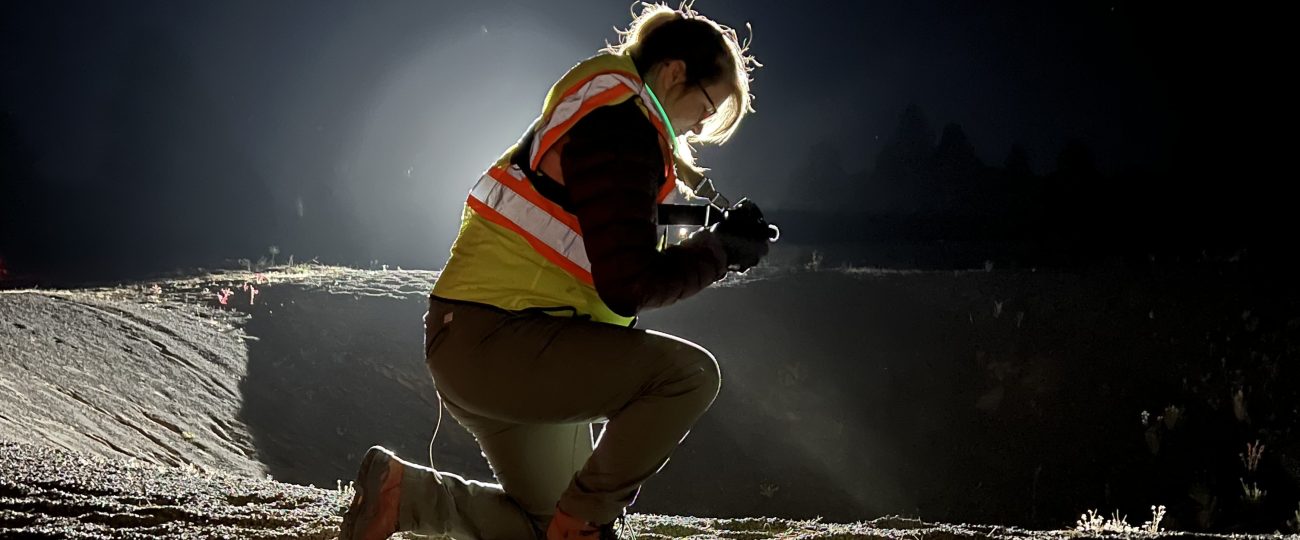
Marie (McBride) Henderson ’13 fell in love with the moon early in life—and has since transformed that passion into an extraordinary career.
Henderson is a planetary scientist at NASA’s Goddard Space Flight Center, working in partnership with the University of Maryland, Baltimore County, since 2021.
A key contributor to NASA’s return‑to‑the‑moon efforts, she served as deputy lunar science lead for the Artemis II mission.
Looking ahead to future Artemis missions, she will take on the role of science officer, supporting astronauts from the Mission Control Center as a science flight controller.
But long before she worked alongside astronauts and mission control, Henderson was a high school student in a small Pennsylvania town—someone who dreamed of NASA but didn’t yet know how to reach it.
Florida, she admits, “wasn’t even on the radar.”
That changed the day she stumbled across Florida Tech on an old college‑match website.
“I was looking at space sciences and aerospace engineering, because I wasn’t sure which path I wanted yet—and that’s when Florida Tech popped up,” Henderson says.
What caught her attention wasn’t just the academic programs, but the university’s origin story.
“The line that sold me was that Florida Tech was founded during the Apollo program so Kennedy Space Center employees could take night classes,” Henderson says. “I wanted to work for NASA, and here was a university literally built from the history of space exploration.”
“The line that sold me was that Florida Tech was founded during the Apollo program so Kennedy Space Center employees could take night classes. I wanted to work for NASA, and here was a university literally built from the history of space exploration.”
Marie (McBride) Henderson ’13
From that moment, the decision was easy.
“It ended up being the only school I applied to,” she says. “Once I learned about it, it was my first choice—the only place I wanted to go.”
Today, that same passion for space exploration defines her work.
“My work ranges from training astronauts in lunar science and imaging to leading the Science Evaluation Room in Mission Control,” she explains. “This modern version of Apollo’s ‘science backroom’ played a critical role during the mission, and I guided the science team there through key moments, including the lunar flyby and downlinking the first images returned from the moon.”
One of the Artemis II mission’s challenges was that the science team didn’t know the lunar illumination the astronauts would see until the spacecraft was en route to the moon. Because of that uncertainty, much of the science planning happened after the successful launch and translunar injection burn.
“Once we got the updated trajectory around the moon and could simulate the crew’s view, the team quickly built the Lunar Targeting Plan, which described what features the astronauts should image and describe for lunar science,” Henderson says. “Their observations helped us connect years of orbital data with what they were seeing in the moment.”
Henderson also collaborated closely with data systems specialists to map how information would travel from the spacecraft to the ground and, ultimately, into the hands of scientists for analysis.
“During the Artemis II mission, every bit of training, every simulation, every planning session and every data workflow we built mattered,” Henderson says. “All of it came together so our team could make the absolute most of every moment the crew spent looking at the moon.
“It was an honor to be a member of the Lunar Science Team and to be a part of the success and ‘moon joy’ of the Artemis II mission.”
Q&A
FLORIDA TECH CONNECTION: ’13 B.S. space sciences: solar, earth, planetary
JOB IN AN ALTERNATE UNIVERSE: Cake baker
CELEBRITY TO PLAY YOU: Emma Watson
LAST BOOK YOU READ: The Guest List by Lucy Foley
FAVORITE PLANET: Earth
This piece was featured in the spring 2026 edition of Florida Tech Magazine.