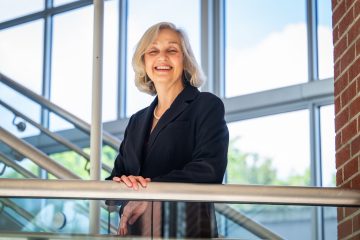
For Felipa Chavez, the path to academia wasn’t a single decision—it was shaped over time by her upbringing, her community and a deep belief in the power of education.
Growing up in the Bronx, New York, as the daughter of immigrants, Chavez was raised in a household where hard work and learning went hand in hand. Her mother, a single parent, worked two jobs, often leaving early and returning late. But Chavez was never without support. A network of family members reinforced a shared belief that education was the path forward.
“My mom told me, ‘My job is to make sure you have a roof over your head and food in the fridge. Your job is to go to school, do well—and not just do well, but do better than we did, and make your way in the world because knowledge is power,’” Chavez said.
That expectation shaped everything that followed. Whether it was her uncle driving to her house from New Jersey after work to help her with her homework or the discipline she developed as a self-described latchkey child, Chavez learned early how to persist through challenges—lessons that remain central to how she teaches today.
As an assistant professor at Florida Tech, Chavez brings that same mindset into her classroom, where learning is active, applied and deeply personal.
As a student, she was often the one friends turned to for advice, though her career path wasn’t immediately clear. As an undergraduate at New York University, she double-majored in psychology and broadcast journalism, unsure which direction to take. It wasn’t until the final stages of her senior year—after being accepted into multiple doctoral programs—that she committed to psychology.
“I don’t know if I chose psychology or if it chose me,” Chavez said. “I was always the one giving advice and helping people figure things out.”

After earning her doctorate from the University at Buffalo, she completed a National Institute on Alcohol Abuse and Alcoholism postdoctoral fellowship at the Research Institute on Addictions. There, she studied how parental substance use affects parent-child interactions and subsequent early childhood development.
That work laid the foundation for her focus on children and families, including her specialization in Parent-Child Interaction Therapy (PCIT), for which she is an internationally certified Within Agency Trainer. Much of her research is leading the field in adapting this evidence-based treatment to better serve Black and Latin families—bridging cultural understanding with clinical practice.
Academia allowed Chavez to combine teaching, research and clinical work, and Florida Tech felt like the right fit. Drawn to its close-knit environment, she joined the university in her first academic role.
In the classroom, Chavez blends traditional lecturing with storytelling, using examples from her clinical work and personal experiences to bring concepts to life.
“In my classes, I always emphasize application: We read it in the book, but how do we use it in real life?” she said.
Chavez regularly involves students in hands-on work, including a recent community-based initiative adapting Teacher-Child Interaction Therapy (TCIT) to coaching fundamental basketball skills at local after-school programs. The aim is not only to shape and build athletic ability and foster a healthy lifestyle through engagement with sports, but also to foster youth’s development of core ego strength, healthy self-esteem and identity.
Led by Florida Tech women’s basketball player Lana Ammash as part of her honors project, the initiative combines structured activities with behavioral coaching strategies—giving students the chance to see their learning in action.
She also incorporates protégé learning, a method in which students teach course material to their peers—pushing them beyond memorization toward true understanding.
“My goal isn’t for students to remember everything from my class,” Chavez said. “It’s for each of them to walk away having mastered at least one topic deeply.”
Chavez is especially inspired by undergraduate students and their willingness to take risks. She sees teaching as a reciprocal process—one where learning flows in both directions.
“The world is always evolving, and each generation brings its own perspective,” she said. “I get insight into their world, and that’s exciting.”
At the core of Chavez’s work is a simple goal: help students become fearless learners, equipped not just with knowledge but with the confidence and critical-thinking skills to apply it in meaningful ways.
“I hope students carry what they’ve learned into their future roles as parents—raising the next generation in a way that helps build a better world,” Chavez said. “I don’t know if I’ll accomplish this, but I do know that I give everything I have to trying because it matters. My hope is that it will make some small difference for someone, somewhere, at some point—and that’s enough.”
This piece also appeared in the spring 2026 issue of COPLA Connections.