Florida Tech assistant professor of English Anna Muenchrath has been named a 2025 Fellow of the American Council of Learned Societies (ACLS). This prestigious honor – the second ACLS Fellowship for Muenchrath – will fund her research into how algorithmic influence on human-made data drives literature translation and ultimately, culture, in the United States.
The fellowships grant scholars up to $60,000 for six to 12 months of full-time research and writing. Muenchrath was one of 62 recipients selected from a pool of more than 2,300 applicants.
Muenchrath’s project, “Amazon Crossing: Translation Publishing, Algorithmic Data, and the Future of the Literary Marketplace,” will directly investigate how algorithmically produced and processed data affects the U.S. translation market. Centering her study on the Amazon publishing imprint Amazon Crossing, Muenchrath will use her findings to explore how humans use algorithms to replace their own judgement and selections and the implications that could have on our culture.
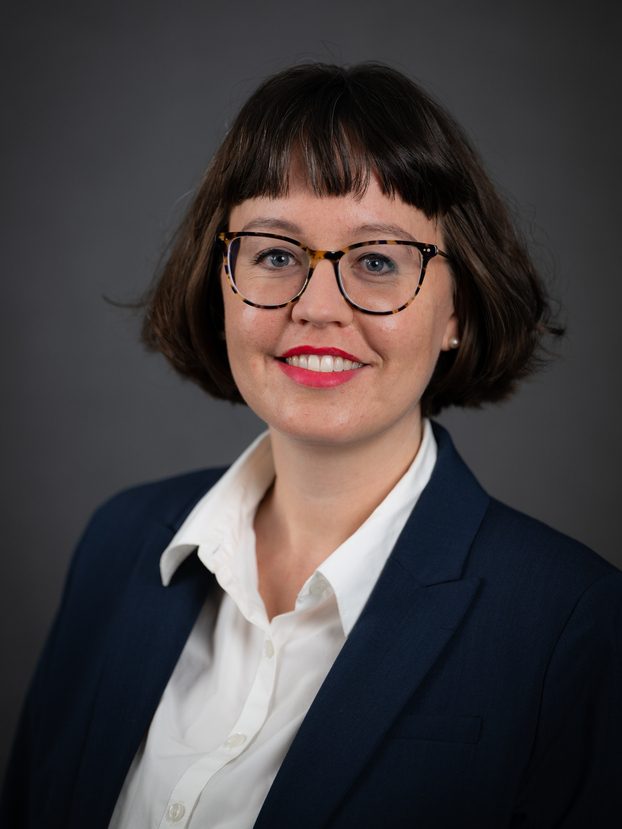
“The idea that algorithms are affecting not only our work lives or our interactions on the internet, but also the kind of art, literature, and music that we have access to offline is something that people may not be aware of,” Muenchrath said.
Muenchrath’s research addresses questions that are “fundamental to the human experience,” she said, such as what culture is for, who profits from it and who gets to create it and why.
“The ACLS fellowship is one of the most prestigious awards for humanities scholars. We are thrilled this esteemed society has recognized Dr. Muenchrath with an award to further develop her cutting-edge scholarship,” said Heidi Hatfield-Edwards, associate dean of the College of Psychology and Liberal Arts and head of the School of Arts and Communication.
Prior to this fellowship, Muenchrath focused on how human translators and institutions have shaped literature around the world. As she expanded her research to include algorithmic translation publishers such as Amazon Crossing, she set out to learn how the organization uses data to determine which books it translates.
She emphasized that her research is a prime example of why the humanities are necessary to understand artificial intelligence.
“The humanities are absolutely vital to interrogating the role of machines in our society,” Muenchrath said. “If the sciences are interested in questions of what can be done, the humanities are often interested in questions about what should be done and how to live a life conditioned by technological change.”
Muenchrath was also an ACLS fellow in 2022. That project, “Actors, Institutions, and Networks: Recovering Agency in Global Literary Circulation in the Twentieth and Twenty-First Centuries,” focused on understanding the values of our literary marketplace. She studied how institutions like US world literature anthologies, the Council of Books in Wartime, the Iowa Writer’s Workshop, Oprah’s Book Club and Amazon’s translation imprint are responsible for shaping our literary environment.