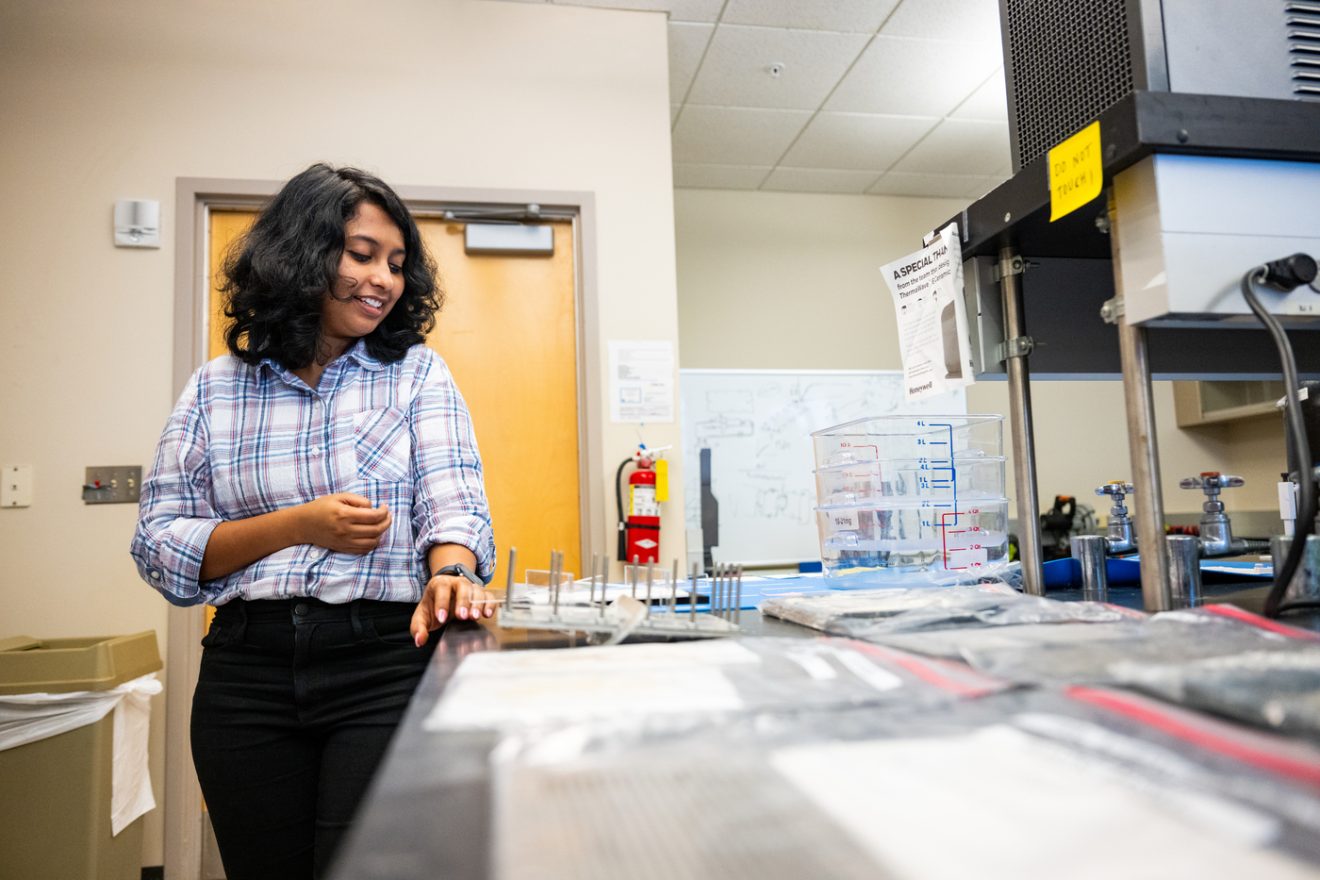
Ph.D. candidate Sharon Bondugula is cooking up a revolutionary new product that will help reduce greenhouse gas emissions by harnessing carbon dioxide (CO2). The porous product ditches expensive materials for pantry staples, and it can be made at home with ingredients including yeast, sugar and the thickening agent xanthan gum.
Though it has the makings of a cake – and that’s how Bondugula describes her product – it is a thin, paste-like coating that captures CO2 from power plants by separating it from post-combustion gas streams. The material is slathered on a plate and connected to a power plant’s gas flow.
This process promotes clean energy by reducing harmful gas emissions while simultaneously giving power plants a way of containing CO2 for distribution, Bondugula explained.
Bondugula is a mechanical engineering student studying under assistant professor Darshan Pahinkar, who focuses on heat-driven energy systems. She was captivated by carbon dioxide capture, a practice on the rise that aims to reduce harmful emissions.
“If we don’t remove the CO2 that’s coming from places that emit it or from that atmosphere, global temperatures could increase,” Bondugula said. “To limit that, a lot of people are working on capturing these greenhouse gases, especially carbon dioxide and methane.”
Different methods of capturing CO2 from power plants do exist, varying between absorption and adsorption of the gas. Absorption is when gas molecules are soaked into a liquid, while adsorption is when they stick to the surface of a solid material. Adsorption requires energy, such as heat, to attract the particles.
Unfortunately, Bondugula said, the existing methods of capture using adsorption can be costly and inefficient. If the material is too thick, more heat is required. If the thick material is also porous, the heat is more likely to escape.
This yeast-based alternative is porous – imagine the holes inside a loaf of bread – but it’s thin enough that the heat can travel more efficiently. That way, the material maintains its porosity, which opens more space for CO2 particles to stick.
“Porosity makes all the adsorbent particles more accessible,” Bondugula said.
Bondugula’s goal was to create a more affordable alternative to existing adsorbent solutions, many of which require expensive materials. She and Pahinkar tried various freeze-drying techniques, eventually substituting xanthan gum to help the product keep its shape. After introducing xanthan gum as a binder, they realized that they could bake the product like bread, adding an adsorbent as an ingredient.
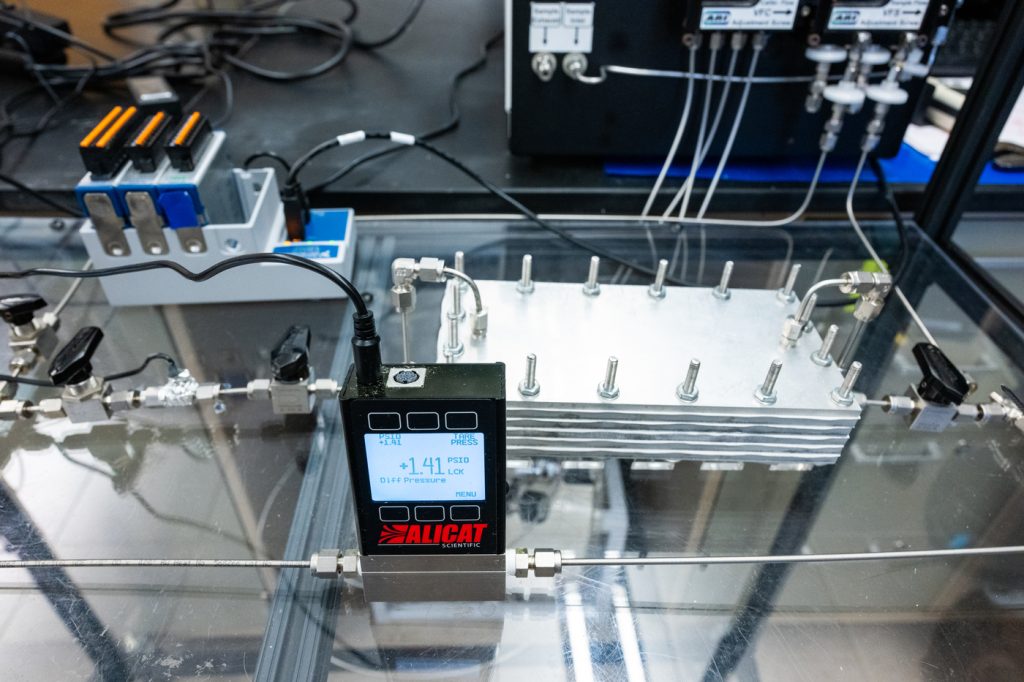
Bondugula’s method proved cost-efficient – all its ingredients can be purchased at the grocery store, and the cake can be made on-site. All manufacturers need to do is mix yeast, sugar, xanthan gum and their adsorbent of choice. For Bondugula, that’s Zeolite 13X for its accessibility and affordability. Then, the solution is heated in an oven to develop its pores and rigidity.
Once in use, the cake acts almost as a checkpoint, capturing the CO2 particles as the rest of the gas continues to the atmosphere. CO2 sticks to the walls of the cake like bats flying and landing in a cave, she said.
The benefits extend beyond cleaner plant emissions, Pahinkar noted. Plants can sell the concentrated CO2 to other manufacturers, including those who make diamonds, plastic or even carbonated beverages. Using captured CO2 instead of burning new carbon is just one more way of reducing the impact of fossil fuels, he said.
“That carbon dioxide must come from somewhere,” Pahinkar said. “It could come from this.”
Their current recipe is only designed to attract CO2. However, in future research, Bondugula and Pahinkar would like to incorporate materials that can adsorb other gases, such as water vapor and methane. “All we need to find is the material that loves one gas over the other,” Pahinkar said. “We have so many avenues that we can take.”