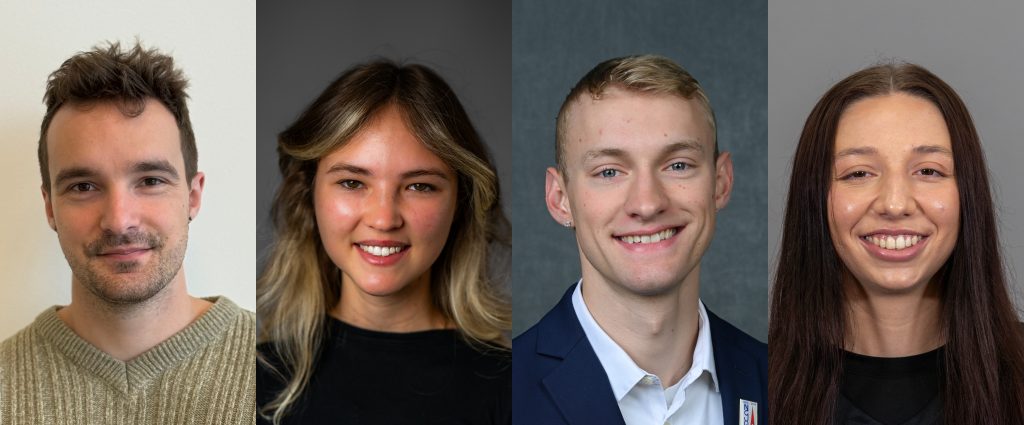
Four Florida Tech students have been awarded the National Science Foundation Graduate Research Fellowship (NSF GRF), one of the most prestigious honors available to graduate researchers in the United States.
Russ Smith ’25, Kaitlyn Dunn, Emily Acampora and Quintin Peters have each been awarded the fellowship, a highly competitive honor that provides recipients with a $37,000 annual stipend and a $16,000 education allowance for three years. The program, established in 1952, has funded more than 70,000 researchers, including at least 40 future Nobel Prize recipients.
Smith, a chemical engineering Ph.D. student, is researching the extraction of critical minerals and materials from unconventional sources—including biomass, sediment, electronic waste, coal waste and industrial waste—under associate professor Toufiq Reza. The research addresses domestic supply chain concerns for minerals used in defense, alternative energy, automotive infrastructure and consumer electronics.
Smith conducted research under Reza throughout his undergraduate years at Florida Tech before pursuing his doctorate and said two summers at Idaho National Laboratory focused his work on the national security dimensions of critical mineral supply.
“I am very grateful to all of my friends, colleagues, advisors and family for supporting me and teaching me every day,” Smith said. “I would not be where I am today without all of these people.”
Dunn, a biomedical engineering senior, is developing machine learning algorithms that combine data from multiple medical imaging sources to improve cancer detection. Her work, conducted under professor Nezamoddin Kachouie, focuses particularly on low-dose radiation imaging, which is commonly used in rural and underserved hospitals, where image noise can obscure tumors that might otherwise be caught earlier. The algorithms are designed to assess tumor texture and help physicians identify high-risk patients and prioritize urgent care in emergency settings.
Dunn said she plans to host machine learning and artificial intelligence workshops at local public high schools as part of a broader commitment to STEM outreach in under-resourced communities.
“Receiving this award means that people truly believe in my ability to make an impact through research. That is something I don’t take lightly,” Dunn said. “I’m extremely grateful to be entering a stage of my career where curiosity is not just encouraged but trusted as a tool for real impact.”
Acampora, a biomedical engineering senior who will begin her Ph.D. at Florida Tech in the fall, works in assistant professor Careesa Liu‘s lab. Her research targets fibromyalgia, a chronic widespread pain condition that disproportionately affects women. Because the condition stems from changes in how the nervous system processes sensory input, it produces no visible clinical markers—leaving many patients to spend years seeking a diagnosis.
Acampora is working to identify brain-based signals that could give physicians an objective measure of the condition. A four-year member of the Florida Tech women’s basketball team, she credited Liu and her lab colleagues with shaping her growth as a researcher.
“This fellowship, for me, is an opportunity to continue pursuing meaningful research that will affect how fibromyalgia is understood and, ultimately, diagnosed,” Acampora said.
Peters, a biomedical engineering Ph.D. student, studies blink-related oscillations—the brain’s processing of visual information during spontaneous blinking—using electroencephalography, also under Liu. His research centers on how concussions alter that process, with the long-term aim of creating a standardized, objective measure of concussion severity.
Peters, a former gymnast at the University of Michigan and a certified NCAA gymnastics judge, said his athletic background and his family’s military ties inspired the work. He said he hopes to one day give clinicians a diagnostic tool for concussions comparable to an X-ray for a broken bone.
“This award means so much to me,” he said. “It is a representation that the research I am doing can make a significant impact on the world.”
The award is likewise meaningful for the university.
“The NSF GRFP award draws applications from the likes of Harvard, Stanford, MIT, the University of Michigan and Georgia Tech—institutions with substantial resources and a rich history in scientific research,” Peters said. “I hope that the students here at Florida Tech who have won this prestigious award show people that we can compete with these larger institutions.”