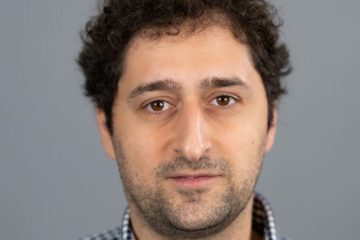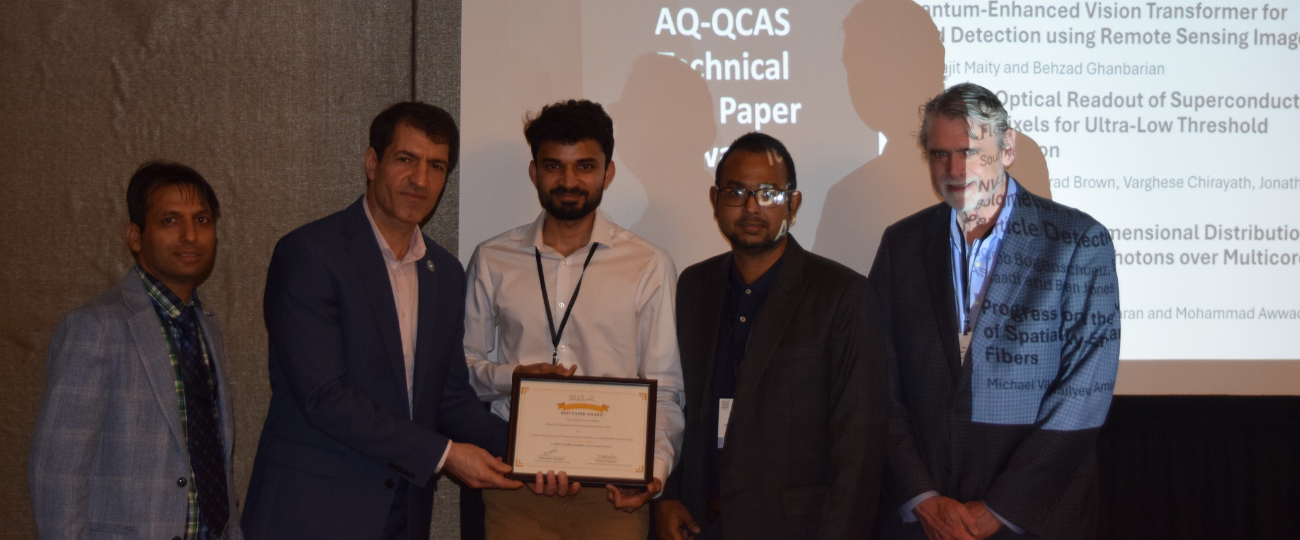
Florida Tech assistant professor Naveed Mahmud received the best paper award at the Applied Quantum Computing and Quantum Circuits and Systems Workshop, held during the 19th Institute of Electrical and Electronics Engineers (IEEE) Dallas Circuits and Systems Conference April 10-12 at Southern Methodist University in Dallas.
Systems engineering Ph.D. student Piyush Sonawane ’24 M.S., served as first author and presented the work at the conference. Andrew Kelly ’25, a computer engineering master’s student, was second author.
Mahmud’s paper, “Latency Characterization of Quantum-Classical Workflows on an Embedded System-on-Chip,” examines a core challenge in quantum computing: As hybrid quantum-classical algorithms process heavier workloads, the communication delays between quantum and classical systems become a significant bottleneck. Mahmud and his co-authors characterized those latencies using a cost-effective embedded system-on-chip communicating with a quantum processor, producing what the researchers describe as a performance blueprint for future low-latency system design and integration with utility-scale quantum computers.
The paper reflects the broader focus of Mahmud’s research group, which investigates hybrid quantum-classical computing systems, particularly the integration of classical accelerators, such as graphics processing units and field-programmable gate arrays with quantum processors, and benchmarks their performance and dependability for full quantum application deployment.
“This award means a lot to me, as this is the first research collaboration between my student co-authors and myself,” Mahmud said. “As their advisor, I feel very proud of the work and their achievement.”
The work was supported by a National Science Foundation Computer and Information Science and Engineering Research Initiation Initiative award Mahmud received in fall 2025. The grant totals $149,999 over two years, running through summer 2027.