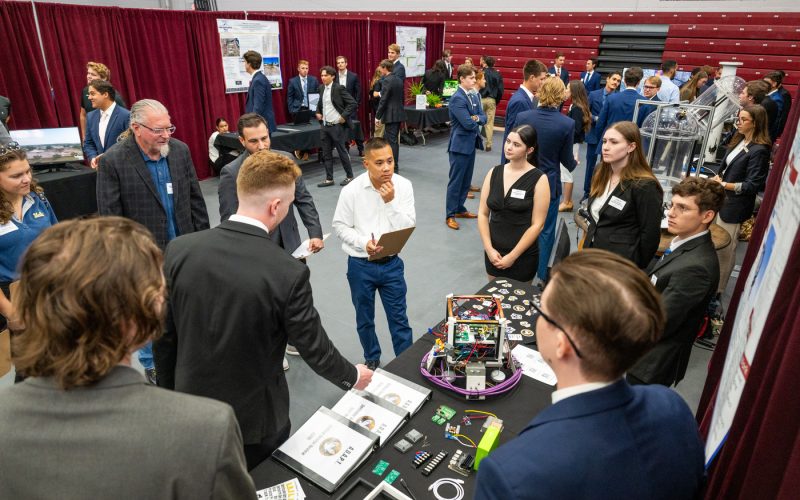
MELBOURNE, FLA. — What happens when hundreds of very smart students want to make their world a better place? Come to Florida Tech’s Clemente Center on Friday, April 24 and see for yourself.
That’s where and when Florida Tech convenes its annual Northrop Grumman Engineering & Science Student Design Showcase featuring student projects in science, engineering, aeronautics, psychology and more.
The 200 or so projects in the showcase are the most ever for this event, representing the broadest swath of disciplines since Northrop Grumman’s $1 million endowment gift in 2009 provided critical, ongoing support for students’ hands-on work.
Media may attend between 10 a.m. and 2 p.m. Friday but are asked to RSVP to Adam Lowenstein at adam@fit.edu to ensure access.
Here’s a closer look at just a few of the projects featured in the 2026 showcase:
Project: The Microburst Day Potential Index: Improving Launch and Public Safety
Description: The project is powered by 850 lines of code capable of detecting microbursts—powerful wind gusts that can cause tornado-level damage. Senior Zachary Kopel, who wrote the code, is collaborating with the 45th Weather Squadron at Cape Canaveral Space Force Station and will present his research directly to the squadron.
Why it matters: Kopel’s work aims to identify atmospheric conditions that can threaten everything from rockets on the launch pad to nearby communities, homes and people.
Video: Zachary Kopel talks about the project.
<><><><><>
Project: BioPulse
Description: BioPulse is a high-strain-rate testing device designed to better understand how materials behave under extreme, high-speed conditions. Biomedical engineering senior Andrew Carr and his team are focused on capturing how materials respond in scenarios like car crashes or high-impact sports environments where traditional, slower testing methods fall short.
Why it matters: Understanding how materials perform in critical moments may lead to life-saving improvements.
Video: Andrew Carr talks about the project.
<><><><><>
Project: Stability Analysis through Bipropellant Engine Research (SABER)
Description: Aerospace engineering senior Whitney Reinkoester and her student design team are developing SABER (Stability Analysis through Bipropellant Engine Research)—a propulsion project focused on understanding and minimizing combustion instability in rocket engines.
Why it matters: Combustion instability remains a critical safety concern for both spacecraft and crew members. Through careful design, machining, and testing, the SABER team aims to improve propulsion reliability and contribute to safer missions in the aerospace industry.