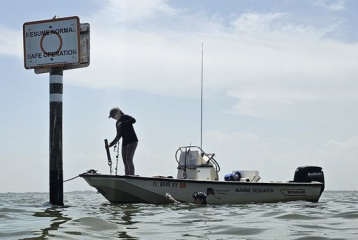
Florida Tech students Kenna Peters ’26 and Kelsey Fox were awarded the Dr. Richard Lincoln Turner Endowed Research Fund in Biological Sciences fellowship. They each received a $1,658 Grant-in-Aid of Undergraduate Research in Biological Sciences for their research projects.
The fund supports undergraduate research in organismal, cell or molecular biology. To apply, students submit a research proposal with an abstract, introduction, project aims and budget. A committee then reviews each entry and decides which projects will receive a portion of the fund.
Peters, who received the award as a senior, is now a marine biology master’s student with a bachelor’s degree in marine conservation. Her research, titled “Finding Jaws: DNA Barcoding Shark Cartilage to Identify Species,” tested whether DNA from shark jaw cartilage can be used to identify the species the jaws belonged to. The technique is rarely used because tissue samples are the norm for DNA extraction.
Accurate identification matters because many shark species look alike, and some can only be distinguished through genetics. Misidentification is a major obstacle to shark science, particularly as more than 70% of sharks and rays have been lost in the past 50 years, and many sharks are shifting their ranges in response to global warming.
Working with dried, unlabeled jaws from sharks sampled in the coastal northwest Atlantic, Peters extracted DNA from 28 of the 32 samples she was given and identified five species: blacktip, sandbar, spinner, Galapagos and lemon sharks.
Her results show that cartilage can be a reliable source of DNA for species identification, opening new opportunities for shark conservation and species management.
“Receiving this award to continue my research project was groundbreaking,” Peters said. “The jaw project that I had been working on was a global collaboration with Minorities in Shark Science, and the funding through this award thus not only benefited my research but the team as a whole. I am beyond thankful for receiving this funding and the opportunity that it awarded me to continue my research.”
Fox is a senior double majoring in genomics and molecular genetics and marine biology. Her research is titled “Linking Natural Variation of Cytochrome P450 Metabolism to Chlorfenapyr Resistance in Caenorhabditis elegans.”
Her research studies how genetic differences influence an organism’s response to environmental toxicants. Understanding these differences is important because individuals can react differently to the same chemical exposure, making it difficult to accurately assess toxicant risk in humans.
Using the roundworm C. elegans as a genetic model, Fox investigates how natural genetic variation affects susceptibility to chlorfenapyr, a commonly used insecticide. Her goal is to identify the specific genes and genetic variants that contribute to differences in toxicant responses and better understand the biological processes involved. She plans to use genome-editing techniques to find the particular variants that most strongly affect susceptibility.
Ultimately, this research may improve how toxicant risks are evaluated and contribute to more personalized approaches to human health by recognizing that individuals may not respond to environmental exposures in the same way.
“Receiving this award has been incredibly meaningful because it has reinforced my belief that I have the capacity to pursue graduate studies and a career in biological research,” Fox said. “The support has enabled me to continue my involvement in undergraduate research, helping me develop the technical skills, confidence and scientific independence needed to become a successful researcher as I prepare for the next stage of my academic and professional journey.”
Though their projects differ, both students used the fund’s support to gain hands-on research experience as undergraduates, the kind of work the fund was created to make possible.