In its early days, Florida Tech was described as a “night school for missilemen.” More recently, it is “Florida’s STEM university.” A new, nearly $600,000 grant awarded to three School of Arts and Communication faculty will help the university explore and embrace another description, this one centered on its defining virtues:
“Curiosity, creativity, integrity and teamwork built on engagement and oriented towards purpose.”
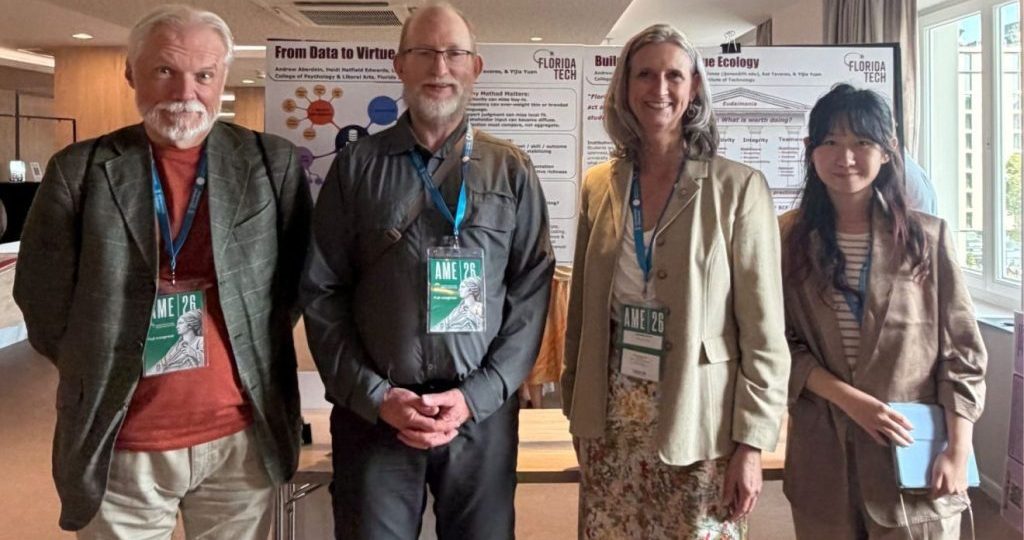
Rightfully renowned for its STEM education, Florida Tech can also help students develop and utilize the virtues from that opening statement – determined after extensive campus surveys – and others that support them, such as humility, courage and resilience, with the new Institutional Impact Grant award from Wake Forest University’s Educating Character Initiative which is funded through Lilly Endowment Inc. Florida Tech was one of just 49 universities across the country to receive a 2026 grant.
Titled “Cultivating Core Character Through the General Education Core,” Florida Tech’s initiative seeks to deepen beyond technical skills what students take with them after graduation.
“All of those useful skills may well cease to be useful well within our students’ working lives, but hopefully building a deeper structure of character is something that’s going to give them the ability to survive changes and evolve with those changes over the course of their lifetimes,” said co-principal investigator Andrew Aberdein, professor of philosophy and chair of humanities in the School of Arts and Communication.
Co-principal investigator Heidi Hatfield Edwards, professor and head, School of Arts and Communication, said it is about encouraging considerate decision making in students. “That idea that as they make decisions about whatever it may be, that they’re doing so thoughtfully, considering outcomes and thinking more deeply than just, ‘I’m going to do this because that’s here right now.’”
The goal is to integrate the program across Florida Tech, and there will be opportunities to move that forward through faculty colloquia and other student engagement, said Lars Jones, assistant professor in the School of Arts and Communication and co-principal investigator.
The overall focus at the start, however, will be on general education classes in the School of Arts and Communication and how to make those (and their instructors) better reflect this enhanced emphasis on Florida Tech-relevant virtues.
“It is not wholesale changes, but there are going to be differences in how we approach what we teach,” Jones said. “Intentional thinking by the instructors, and therefore then intentional teaching with students.”
Florida Tech Provost John Z. Kiss applauded the winning team for landing this major grant and said it will help make Florida Tech’s already in-demand students even better equipped to succeed after graduation.
“One of the things that makes me most proud as provost is seeing our students leave Florida Tech ready to make an immediate impact. They already graduate with the technical expertise, work ethic and excellence that employers value,” Kiss said. “This initiative will help them further develop qualities like curiosity, resilience and character, making them even more effective professionals, leaders and community members.”
In a recent interview, Aberdein, Edwards and Jones talked about how success with an earlier grant helped secure this one, ways to approach implementation and how this initiative can help students live deeper, more meaningful lives. Answers have been lightly edited for clarity.
Q: Winning this major award was preceded by winning a smaller, capacity-building grant that helped make the new one possible. What did that grant allow you to do?
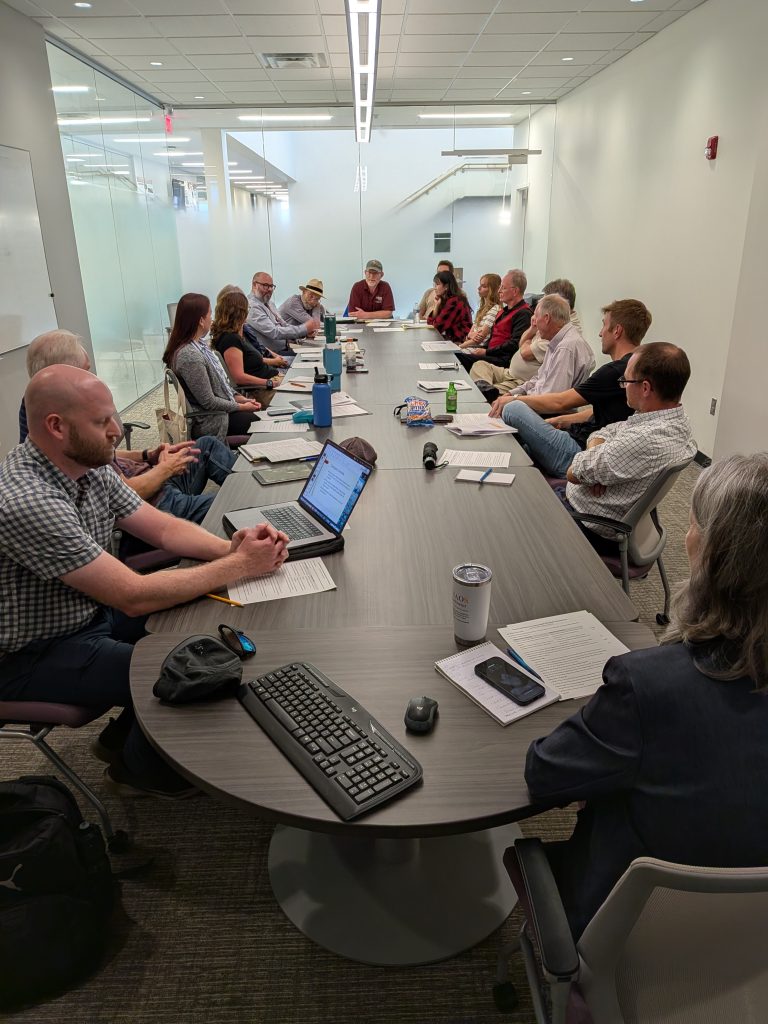
Aberdein: So we got the smaller grant partly to figure out what character education might look like at Florida Tech. (Doing that involved) focus groups, analyzing university documents, seeing where the university is already talking about these things and trying to find a consensus view as to what the Florida Tech take on this is. We ran focus groups for faculty and staff as well as focus groups for students to try to gauge their sense of what they expected character to be, what they thought Florida Tech was already doing, what they thought Florida Tech should be doing.
Edwards: We talked with students, staff, faculty, different departments beyond just the academic departments. We interviewed all the deans and as well as other administrators to really get that understanding of who we are as an institution in terms of character virtues….We wanted to know how they perceived character virtues, what was important to them personally, what they thought was important for students and for the institution.
Q: After doing this fact gathering and so forth, you applied for – and won – this larger grant, highlighting in your application the work mentioned above and how there is widespread enthusiasm for the project across campus. How do you begin to roll this out?
Jones: So after we kind of surveyed everything and we said, okay, these are the primary virtues that seem best to define Florida Tech (curiosity, creativity, integrity and teamwork) and supported by additional virtues highlighted by our research (including wisdom, resilience, humility, courage and open-mindedness). And so we built a snapshot of what our virtues are, and that forms the basis of what the program is about.
We didn’t say we’re just going to impose these virtues, which is one strategy some schools do. Other schools go to their founding documents: ‘This is our creed, and so this is what we’re going to teach.’ Or sometimes the administration says, ‘Well, this is what we want you to do.’ It gets implemented. And then sometimes it’s just more of a democratic vote, but that doesn’t always get full traction. (Our approach) is kind of a mix of those different approaches.
Q: One focus of the new grant is to use general education courses to start to bring this effort into the classroom. How would a course be different once you add facets of the character-building initiatives?
Edwards: It is important for us to start with where we are, so using those core classes and then building to collaborations with our colleagues across campus. So say in COM 1101, where students are learning how to express themselves and write, maybe they’re learning about open-mindedness and self-control and humility in ways that are going to help them to build to that virtue of curiosity as they advance through their other classes – to where when they get to their more advanced major classes, they’re really, truly exhibiting those virtues.
Jones: Andrew came up with the title, ‘cultivating.’ And so this is about creating opportunities, things in the classroom: We cultivate character by thinking about it, talking about it, writing about it, looking at virtuous exemplars. So all of these things are important, but it’s about reaching the students.
Aberdein: We are not trying to impose a single curriculum. We’re trying to leverage the strengths that our faculty already bring to their teaching and nudge them into being a bit more character forward on this.
Q: With some of the grant funding you will hire a postdoc. What will that person do?
Aberdein: The way I think of it is the library has instructional librarians. We want kind of an ‘instructional character’ person. So someone who is a specialist – people do PhDs in this area. We’ll hire someone with that kind of background who can then be a resource for faculty, teach the (occasional) class themselves, but also drop in and teach a class in a whole bunch of different courses. Try really to make it as easy as possible for faculty to buy in.
They will be contributing to curriculum but also developing things like a Canvas module that you could drop into a class, say a COM 1101 section, or different sections of whatever course, could utilize this module.
Q: What are ways you hope students could benefit from enhanced engagement with these virtues?
Jones: In our focus groups, we realized people were often thinking about virtues in an instrumental way. ‘I’ll be just curious enough to pass this class.’ So what we’re hoping to do is kind of bump the needle more to an evaluative form of the virtues, like curiosity for curiosity’s sake rather than curiosity because it gets me an “A.”
That’s the consensus we’re asking students to consider: What kind of life do you want, what kind of person do you really want to be? With this program, what foundation can we give students to think about the kind of lives they want to live?
Edwards: I think that’s where we want to go: We absolutely want our students to get degrees and get good jobs and be successful, and we also want them to thrive as human beings. This is a three-year grant, but and we see this moving well beyond that. We want to establish this as a real value-added element of being a part of the Florida Tech community. And it’s not just about the students, right? It’s about us as educators. It’s about us as an institution.
Aberdein: It’s a matter of bringing things out. I think quite a lot of this is encouraging people to be more reflective about their own behavior, to think a little bit more about things that maybe they’re doing anyway.