What do aircraft, spacecraft and robots have in common? In my experiences at NASA and Florida Tech, I’ve learned that the future of flight isn’t just about futuristic “flying taxis” or highly accurate and functional robots; it’s about people.
At the heart of every complex technology are humans interacting with automation and each other to enhance safety on the ground, in the sky and in space. My human factors and safety research has taught me repeatedly that even the most advanced technology depends on understanding humans.
My introduction to this concept wasn’t in a university classroom or on a jobsite. I grew up watching “Star Wars” and reruns of “The Jetsons.” I was mesmerized by the automation of the starship fleet and by Rosie, the robot performing household chores.
At the same time, I was fortunate to have access to my very own rocket scientist, whom I fondly referred to as “Dad,” a Delta rocket propulsion team member for over 30 years.
My interest in aeronautics began at birth. I viewed rocket launches from my front yard and explored Delta rocket control rooms on employee family days. That propelled me into an 11- year career at NASA-Kennedy Space Center (KSC) before I began my tenure as a Florida Tech faculty member.
Last year, I returned to my roots on a sabbatical working with NASA on a control room research study for the In-Situ Resource Utilization Pilot Excavator (IPEx)—a robot created to dig up regolith, or lunar soil, to extract and transport hydrogen, oxygen and water resources essential for life support.
The research identified 50 recommendations for enhancing the next-generation control room design to optimize humans’ ability to monitor robotic excavators.
“The biggest challenges aren’t just technical—they’re human. That’s why human factors research will always be the bridge between imagination and implementation.”
deborah carstens ’96 mba, professor, college of aeronautics
In my first lesson, I recalled “The Jetsons” and “Star Wars”: Automation augments human performance. IPEx may be the brawn, but the brains behind it are the humans who designed and developed the robot and supporting systems and directed it to perform.
Advanced Air Mobility (AAM), another of my research interests, promises to revolutionize transportation with electric vertical takeoff and landing (eVTOL) vehicles, which could be crewed or uncrewed.
While exciting, it presents new challenges, such as when operations become uncrewed and decision-making and problem-solving by a ground-based operations manager or remote pilot in command (RPIC) become vital in detecting anomalies differently from how a traditional pilot does.
That brings me to the second lesson: Redundancy is at the core of safety. Every “Star Wars” mission had a backup plan, and Rosie was the backup for fixing malfunctioning machines.
In the real world, there are layers of redundancy, from backup systems to human oversight of automation, resulting in safer operations.
The first two lessons lead to a third: trust. In “Star Wars,” human characters believed in flying cars and flying support from R2-D2. In the real world, consumers and operators must have that same level of trust for new concepts to succeed.
The takeaway: The biggest challenges aren’t just technical—they’re human. That’s why human factors research will always be the bridge between imagination and implementation.
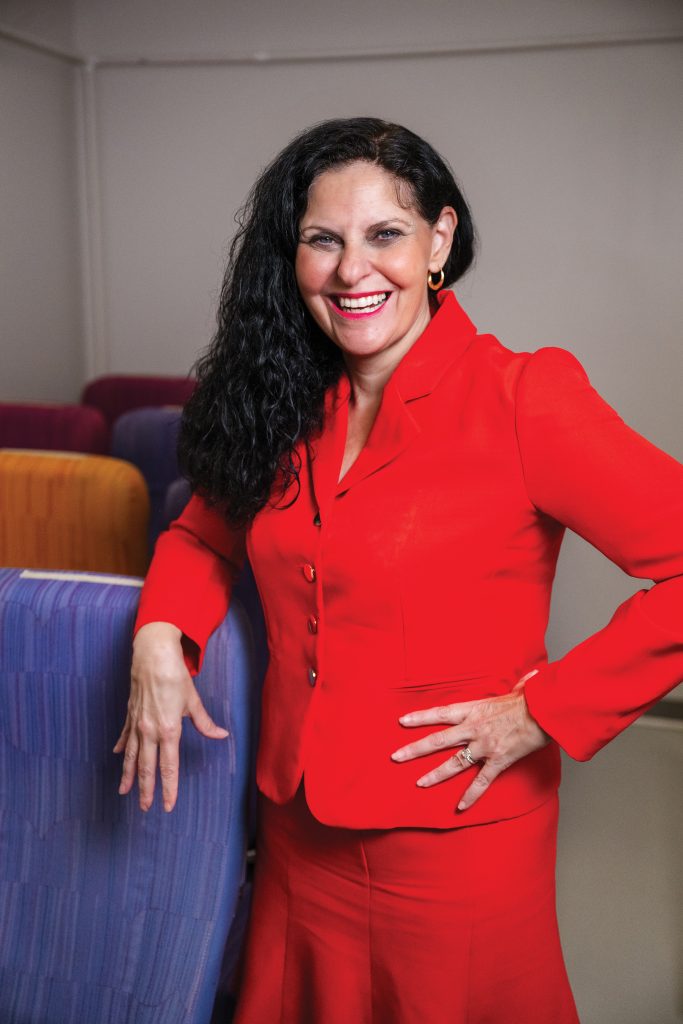
Deborah Carstens ’96 MBA has a Ph.D. in industrial engineering and is director of the Human Factors in Aeronautics, Safety, Sociability, Interfaces, Stress, and Training (HF ASSIST) Lab. Her research interests are safety and efficiency optimization of human performance, interfaces and processes.

This piece was featured in the winter 2026 edition of Florida Tech Magazine.