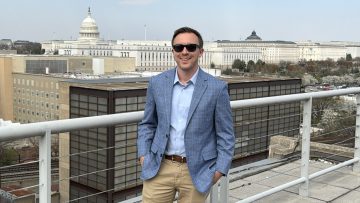
Carlos García-Galán ’97, ’97, has spent a lifetime looking toward the moon.
Today, as NASA’s program manager for Moon Base, he is leading efforts to establish a permanent human presence on the lunar surface and lay the groundwork for future space exploration.
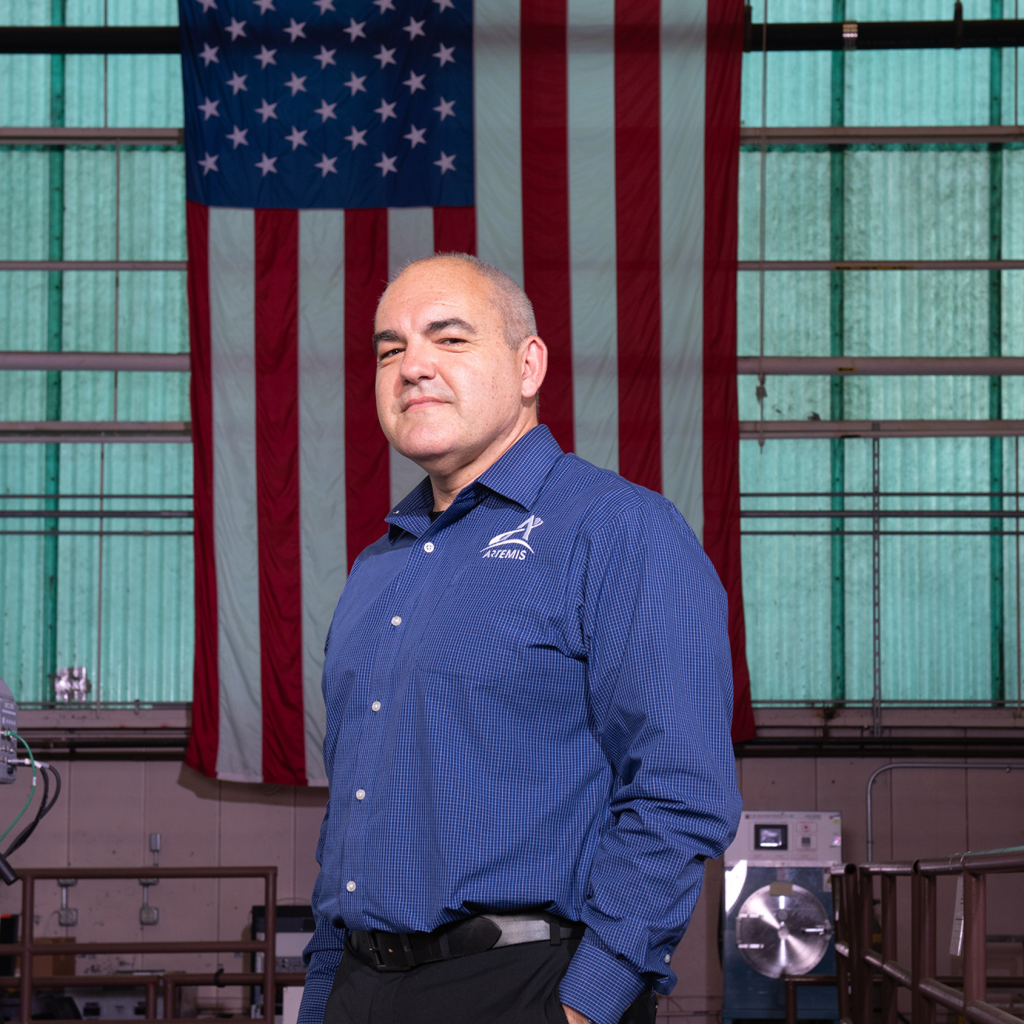
“The objective of the Moon Base program is to build humanity’s first outpost in deep space,” García-Galán says. “That starts with robotic missions and testing the technologies needed to support a permanent presence on the lunar surface.”
The initiative is focused on developing the technology and infrastructure needed to support long-duration lunar missions, with NASA working alongside industry, international space agencies and government partners to make it a reality.
“My role is to help unite those teams, build those partnerships and lead the effort from the earliest stages of discovery to the construction of permanent infrastructure and the execution of long-duration lunar missions,” García-Galán explains. “It’s an incredible responsibility to help push humanity’s capabilities forward, but one that my experiences at NASA have prepared me for.”
Those experiences began long before García-Galán joined NASA. As a Florida Tech student pursuing degrees in electrical engineering and space sciences, he immersed himself in the university’s strong connection to the space industry. Working for the student newspaper gave him a unique opportunity to witness history firsthand and further fueled his passion for space exploration.
“I was in charge of writing our space-focused articles, so I got press passes to the shuttle launches,” García-Galán recalls. “It was a dream come true as a student because I was able to interact with the press and be so close to the launches.”
After graduating, García-Galán launched a career that would span some of NASA’s most ambitious programs. Early on, he served as an International Space Station flight controller, supporting space shuttle and space station missions from mission control centers in Houston and Korolev, Russia.
“I loved being a flight controller because you had to perform under pressure and make decisions in real time,” García-Galán says. “Very quickly, I found myself in mission control, supporting critical space station assembly missions, which gave me significant responsibility early in my career.”
He later joined Honeywell Space Systems as a technical lead, helping develop technologies for human spaceflight and supporting Lockheed Martin during the early development of the Orion spacecraft.
“At Honeywell Space Systems, I worked on adapting technologies from fields like industrial automation to support human spaceflight and mission control operations,” he says. “The experience allowed me to work with senior engineers, learn new technologies and help turn innovative ideas into products that could support NASA.”
García-Galán eventually returned to NASA, where he helped lead spacecraft design, mission analysis and launch operations for the Orion program. His path to Moon Base also included leadership roles as deputy manager of the Gateway program and as head of the Orion program’s European Service Module integration effort at NASA’s Glenn Research Center.
From the International Space Station and Orion to Gateway and now Moon Base, García-Galán has spent his career helping shape the future of human space exploration—work that is bringing humanity one step closer to a permanent home beyond Earth.
“There’s never just one path to achieving a dream,” he says. “My advice is simple: Don’t be afraid to take the next step, even when the path ahead isn’t clear. That’s often where the greatest opportunities are waiting.”
Q&A
FLORIDA TECH CONNECTION: ’97 B.S. space sciences, ’97 electrical engineering
FAVORITE HOBBY: Playing and watching soccer
BUCKET LIST ITEM: Travel to Everest Base Camp
BIGGEST INSPIRATION: Gene Kranz and the teams who worked on the Apollo missions

This piece was featured in the fall 2026 edition of Florida Tech Magazine.