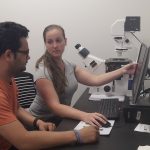
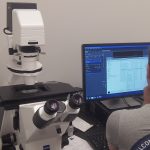
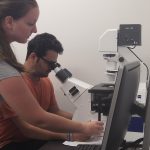
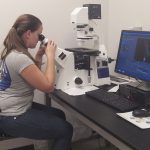
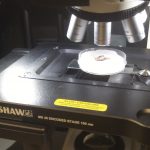
Biomedical engineering is an exciting program that combines engineering with medicine and biology to improve healthcare. The microscopy center has lots of cool microscopes that allow students to see and learn about things that could change the medical field. One of the newest microscopes our students get to use is a one-of-a-kind Renishaw Raman microscope. It works by using the inelastic scattering of monochromatic light to observe interaction between matter and radiated energy. Plotting the intensity of this “shifted” light versus frequency results in a Raman spectrum of the sample. Raman spectroscopy can be used to study solid, liquid and gaseous samples. Another example is a fluorescent microscope which uses light emission rather than regular direct light reflection. It uses chemical compounds that, once exposed to a specific wavelength, emit a longer wavelength than the one absorbed. Samples are labelled with staining dyes, proteins or particles that will bond to specific specimens such as tissues or cancer cells. These are just two examples of the microscopy available for hands-on student experience and research.
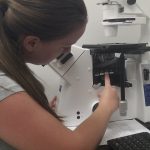
Inverted Flourescent Microscope: Changing samples also means recalibrating parameters
Inverted Flourescent Microscope: Moving on to the next sample.
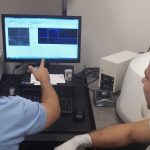
Inverted Flourescent Microscope: Explaining the different parameters to student
Inverted Flourescent Microscope: Sample images are recorded for documentation and further analysis
Inverted Flourescent Microscope: A student learns how to use the binoculars for best viewing of image
Inverted Flourescent Microscope: Using the binocular to refine the sample centering
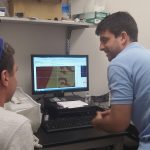
Inverted Flourescent Microscope: Using the software live display to find the sample
Inverted Flourescent Microscope: Centering a slide so it is easier to find the sample through the lens.
InVia Raman Micro-Spectrometer: Capturing information with high definition light is also possible
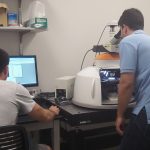
InVia Raman Micro-Spectrometer: Samples can be changed after making sure the laser and interlocks are off.
InVia Raman Micro-Spectrometer: Teaching the student what the excitation observed in the sample represents.
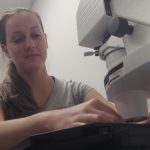
InVia Raman Micro-Spectrometer: Checking to see that the sample is centered
InVia Raman Micro-Spectrometer: Selecting the broad objective for a general view.
InVia Raman Micro-Spectrometer: A student places a sample in the dark chamber for viewing.