A nearly $500,000 grant from NASA to assistant professor of space sciences Howard Chen will fund research that could speed up humanity’s search for life by reducing false positives for habitability among exoplanets.
The grant, “Unveiling novel spin-orbit-climate dynamics on rocky exoplanets in compact multi-planet systems,” will allow Chen to study the climate effects of star-to-planet and planet-to-planet interactions in compact systems.
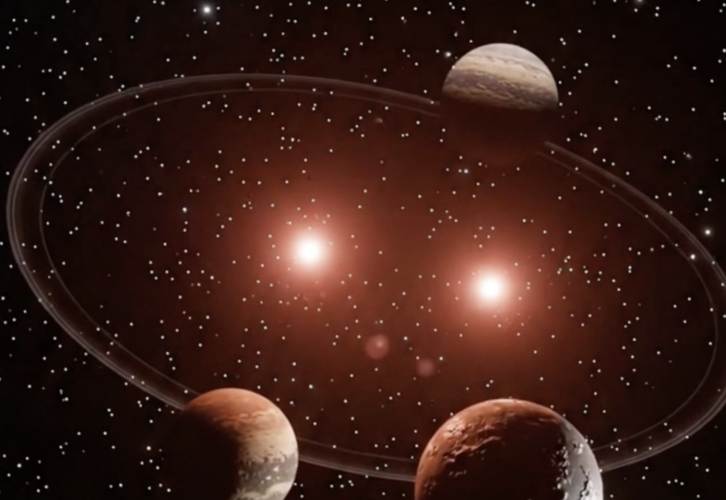
He will study multiple compact solar systems with this grant, and first up is TRAPPIST-1, which has seven planets that are so close together that they all would fit inside the orbit of Mercury, our solar system’s smallest planet.
All the planets are in the habitable zone – where the planets’ surface temperatures could have allowed liquid water at some point in their history – around the system’s star, which like our Sun serves as a gravitational anchor and source of heat in these systems. Chen’s research goal with this grant is to understand how the planets interact with each other in orbit and how those interactions affect the climate of the planets and the probability of them having contained liquid water.
The climate on planets in solar systems that are trillions of miles away like TRAPPIST-1 must be predicted using measurable information like the size of the planet and its spectra, or light information, which can be used to understand the atmospheric makeup of the planet.
Chen laid the foundation for this grant, his first as the principal investigator, through other studies he has done on exoplanets. He found certain characteristics that have changed researchers’ understanding of how planets behave in a compact system.
When planets are close enough to the host star, the star’s powerful gravity tidally locks them. This principle is why we see the same side of the moon always facing Earth.
In compact systems, Chen found that gravitational force from the host star has competition: gravitational pull from neighboring planets. These interplanetary forces are stronger the further the planets are from the host star and in some cases can be strong enough to break a star’s tidal lock on an individual planet.
“What we found was that the planet, instead of being entirely locked, actually (still) doesn’t rotate, but it wobbles,” Chen said.
That wobble changes how researchers understand the temperature on these planets.
Historically, the climate has been assumed to be constant, since there was a day side which was hot and a night side which was cold. But the random nature of the gravitational effects between planets means the climate could vary drastically, even if the planet is the same distance from the host star.
“From a simulation standpoint, you can get water, but you can also just rerun history a little bit and have a dry planet in that same region, even though the liquid water belt says we should have water,” Chen said of how interplanetary forces could affect the planet’s surface.
Chen’s research through this grant will use computer modeling to run different gravitational histories that simulate what the planet-to-planet interactions may have been in the TRAPPIST-1 system and eventually other compact systems.
Once the histories have run, the final step of the process begins: using the data from the gravitational history simulations to predict the spectra of the planet, which can be used to understand the climate.
Chen described it as a “powerful sequence,” using the single measurement of the gravitational interactions, to predict the spectra of the planets. Once researchers have a prediction for the spectra, they can use that to estimate the climate and atmospheric makeup of the planet and what those factors mean for the habitability of the planet.
This grant will support the students who work in Chen’s research group, providing them with opportunities to gain firsthand experience with physics simulators to understand the star-to-planet and planet-to-planet interactions.
“I am super grateful to be studying science and astronomy in this era in human history,” Chen said.