MELBOURNE, FLA. — Over their years in academia, Marcus Hohlmann and Souvik Das have earned many titles, from graduate assistant to doctor to postdoctoral researcher to faculty member.
Their distinguished work in high energy physics has now earned them a new title that far fewer share: Laureate.
For their contributions to “the exploration of nature at the shortest distances and most extreme conditions at CERN’s Large Hadron Collider,” as noted in the citation, they and Ph.D. candidate Erick Yanes have been recognized with the 2025 Breakthrough Prize in Fundamental Physics along with a large number of other physicists, engineers and technicians involved in the global effort.
Considered the Oscars of Science, the award was presented at a flashy, celebrity-attended gala in Los Angeles in April. It went to several groups comprising thousands of people, including many who were involved in the discovery of the Higgs boson, which is an elementary particle whose existence confirms much of the Standard Model of particle physics that governs the world around us.
First awarded 13 years ago, the Breakthrough Prize is recognized as the world’s largest science prize. It honors top scientists, handing out three prizes in Life Sciences, one in Fundamental Physics and one in Mathematics. It is overseen by the Breakthrough Prize Foundation, a charitable endeavor founded by science philanthropist and technology investor Yuri Milner and his wife Julia, that is dedicated to advancing fundamental knowledge, celebrating scientific achievement, and utilizing scientific and technological innovations to improve people’s lives and inspire future generations.
The Florida Tech team and about 4,500 others have spent years working on one of two massive particle detectors located underground at the Large Hadron Collider (LHC) particle accelerator near Geneva, Switzerland, the 15,400-ton Compact Muon Solenoid (CMS) experiment.
According to the prize’s full citation, one third of the $3 million Breakthrough Prize went to the CMS Collaboration “for detailed measurements of Higgs boson properties confirming the symmetry-breaking mechanism of mass generation, the discovery of new strongly interacting particles, the study of rare processes and matter-antimatter asymmetry, and the exploration of nature at the shortest distances and most extreme conditions at CERN’s Large Hadron Collider” using data it collected from 2015 to 2018.
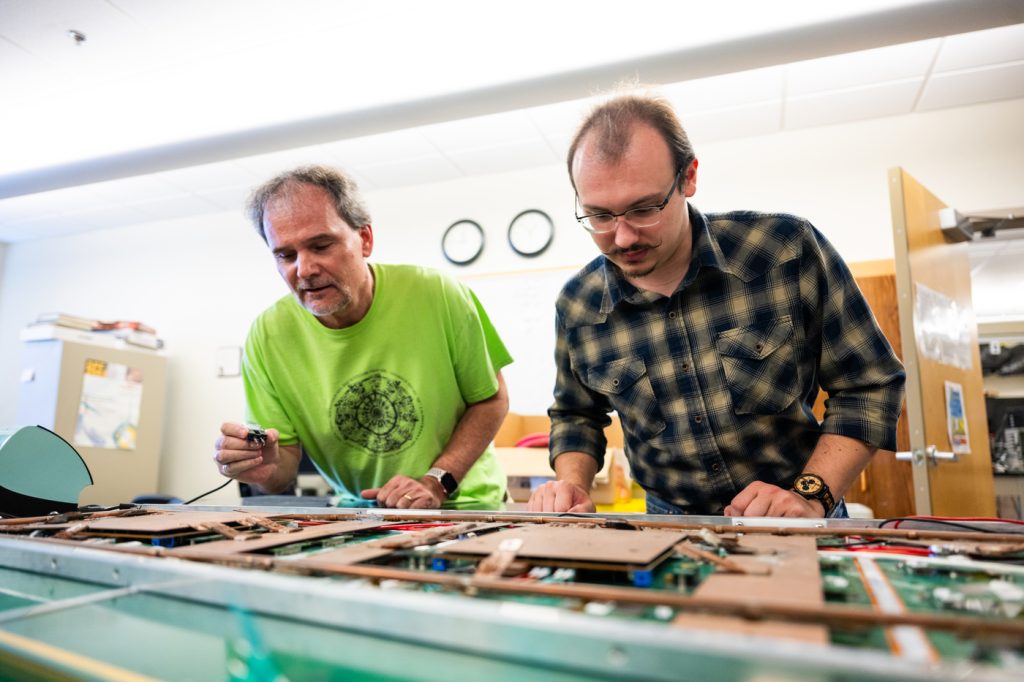
Hardware built on Florida Tech’s campus by the High Energy Particle Physics group is currently installed in the CMS experiment. These Gas Electron Multiplier (GEM) detector modules and many identical modules produced by other CMS groups in Belgium, Germany, India, Italy and at CERN, detect and precisely measure muons, an elementary particle and heavier cousin of the familiar electron. This capability is critical to the measurement that the collaboration was cited by the Breakthrough Prize Foundation.
The nearly 9,000 people behind the other three detectors, the 7,700-ton ATLAS, and the smaller ALICE and LHCb detectors, were all recognized with the Breakthrough Prize, as well. They join the CMS team as 2025 Breakthrough Prize laureates.
The prize comes with a $1 million award to CMS, which the new laureates have agreed to use to help fund graduate students at CERN.
The news was unexpected.
“I was thrilled because I did not hear that this was in the works at all before it was announced,” said Hohlmann, a particle physicist who came to Florida Tech in 2002 in part because of the pending launch of CMS-related research.
“I wanted to be on an LHC experiment as a young assistant professor,” he said. “I thought it was going to be exciting, which it was.”
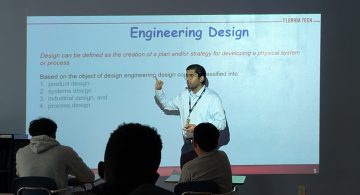
Das started on the CMS experiment in 2006 as a graduate student at Cornell University, and he worked on the Pixel Detector of the experiment at CERN in Switzerland from 2007 to 2011. The Pixel Detector was instrumental in the detection and detailed measurement of essential properties of the Higgs boson.
After earning his Ph.D., he returned to the U.S. in 2011 and took up a postdoctoral position with the University of Florida based at the Fermi National Accelerator Laboratory. There, he started searching for Higgs bosons decaying into bottom quarks in CMS data.
A year later, based on this work and the work of many others, the CMS collaboration declared discovery of the Higgs boson.
“I made small contributions to a big analysis,” Das said.
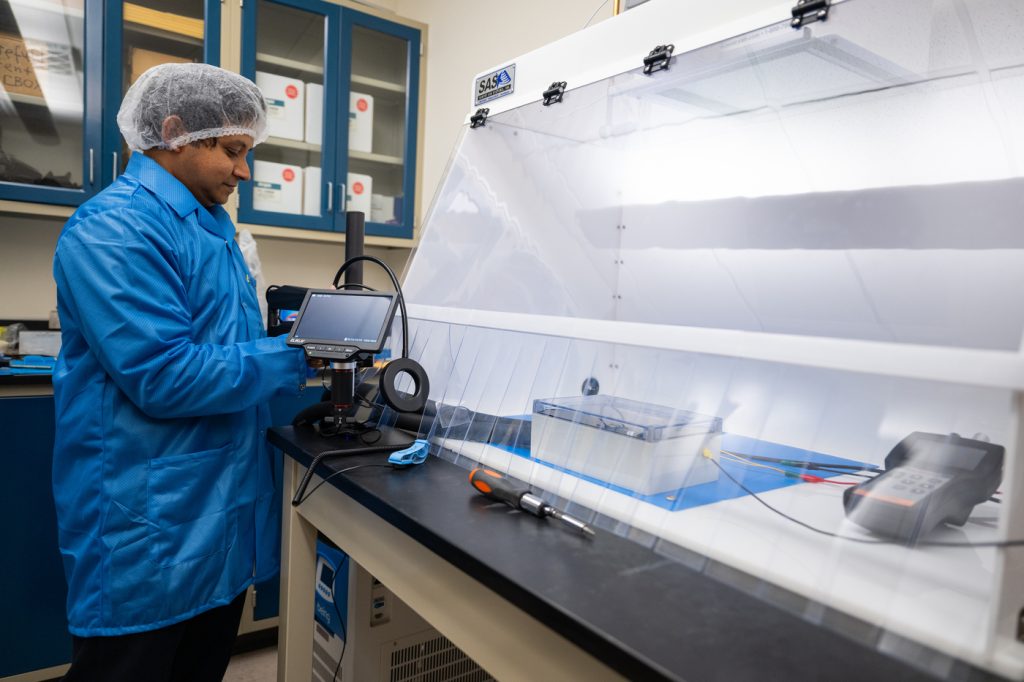
He has now established a testing and troubleshooting lab at Florida Tech for thousands of silicon detector elements that are being assembled around the world and will be used to upgrade the CMS Inner Tracker for the High-Luminosity LHC. His lab has also developed a database and grading web-application for these detector elements that is hosted at Florida Tech and is used by 23 universities and research institutes around the world.
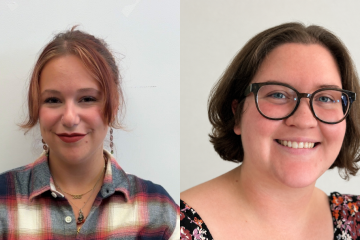
Erick Yanes, the Ph.D. candidate, said he was honored to be part of the Breakthrough Prize and proud to have helped contribute to the CMS experiment.
“Working on both the hardware side with GEM detectors and on the search for dark matter has been deeply rewarding. It’s exciting to see our efforts help push the boundaries of what we know about the universe,” he said. “I’m grateful to be part of a collaboration where progress continues to be made, step by step, through the dedication of so many.”
In addition to their work on the detectors, the team also helps operate the detector. Falling primarily to students, this duty centers on monitoring the data as they come out of the CMS detector to make sure they are accurate. That mainly means looking at many plots – graphical representations of data – to ensure there are no anomalies.
“You continuously have to do quality control, and we’re always looking for funny things,” Hohlmann said. “If it’s not an artifact or something went wrong, that’s the most exciting thing.”
And when the same anomaly is picked up by multiple detectors, that may mean it’s time to get really excited. That was the case with the Higgs boson.
“Like a crime scene with converging evidence; you’ve got to see it everywhere,” Das said.
Both men agree their part in the Higgs discovery is the pinnacle of their work so far with the Compact Muon Solenoid group. But their curiosity propels them forward, seeking more answers to these extremely complicated but fundamental questions about the world around us.
“It’s ultimately, how does the world work at the smallest distances, the most fundamental level?” Hohlmann said.