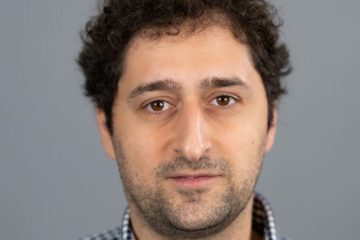
Florida Tech’s Shannon Barry is a Ph.D. student researching bull shark behavior under associate professor Toby Daly-Engel. On July 8, her research will be in the national spotlight with a feature on National Geographic’s SharkFest series, Investigation Shark Attack.
Each episode in this six-part series offers a “forensic investigation” of shark encounters by a panel of scientists. It is part of more than 25 hours of shark-oriented programming starting July 5 that also includes a look at the making of “Jaws” as that classic movie turns 50; a series centered on busy shark migration routes; and a new film from Emmy- and BAFTA-winning cinematographer Bertie Gregory as he seeks to film great white sharks – cage free – off the coast of South Africa.
This will be Barry’s second SharkFest appearance; her first was in 2021 on World’s Biggest Bull Shark, an exciting adventure around the Indian River Lagoon. Barry’s advisor, Daly-Engel, is no stranger to educating the public on shark behavior, either. She appeared in the bull shark episode and others from both National Geographic’s SharkFest and Discovery Channel’s Shark Week.
Barry’s research focuses on how climate change can impact bull sharks’ use of near-shore areas, such as the Indian River Lagoon, as nursery habitats. These habitats are essential to the sharks’ health; they are where female sharks tend to give birth and where juveniles grow up, she explained. Bull sharks are also philopatric, which means females return to the nursery where they were born to give birth later in life.
The Indian River Lagoon was once considered the northernmost nursery habitat along the U.S. Atlantic coast, but a 2018 study found that the bull sharks are establishing a new nursery in North Carolina’s Pamlico Sound. This means that the female sharks are leaving the nursery where they were born to give birth somewhere else, Barry explained.

In her dissertation, Barry hopes to explore this migration from both a genetic and environmental perspective. She is analyzing how bull sharks are related to one another in hopes of finding genetic connections between nursery habitats. She’s also looking at how the sharks adapt to nurseries and how those adaptations differ between habitats in the Atlantic Ocean and the Gulf of Mexico.
“If we can find connections between their genetics and environmental conditions like temperature and salinity, we can better predict how future climate can impact their habitat use,” Barry said.
Barry said it was Daly-Engel, an accomplished shark geneticist, who helped her get the opportunity to share her own research on national television.
“Shannon is very good at talking about her research and the science behind it to normal people, not just other scientists, which is hugely important for conservation. You can tell she really cares about what she’s doing,” Daly-Engel said.
Barry is pleased that others are interested in the topic that she’s dedicated the last seven years of her life to understanding, and she’s excited for her research to help educate the public on why changing bull shark behavior is significant.
“Like all sharks, bull sharks are long-lived…which means they don’t have the ability to rapidly adapt to climate change. So, they have to either stay and endure the changes or move to areas that better fit their needs,” Barry said. “Producing a show on this topic helps highlight a problem that not many people may realize is actually a problem.”
Barry’s episode of Investigation Shark Attack, “Gulf Trouble,” will air at 9 p.m. EST on Tuesday, July 8, on National Geographic. It can also be streamed on Disney+ and Hulu.