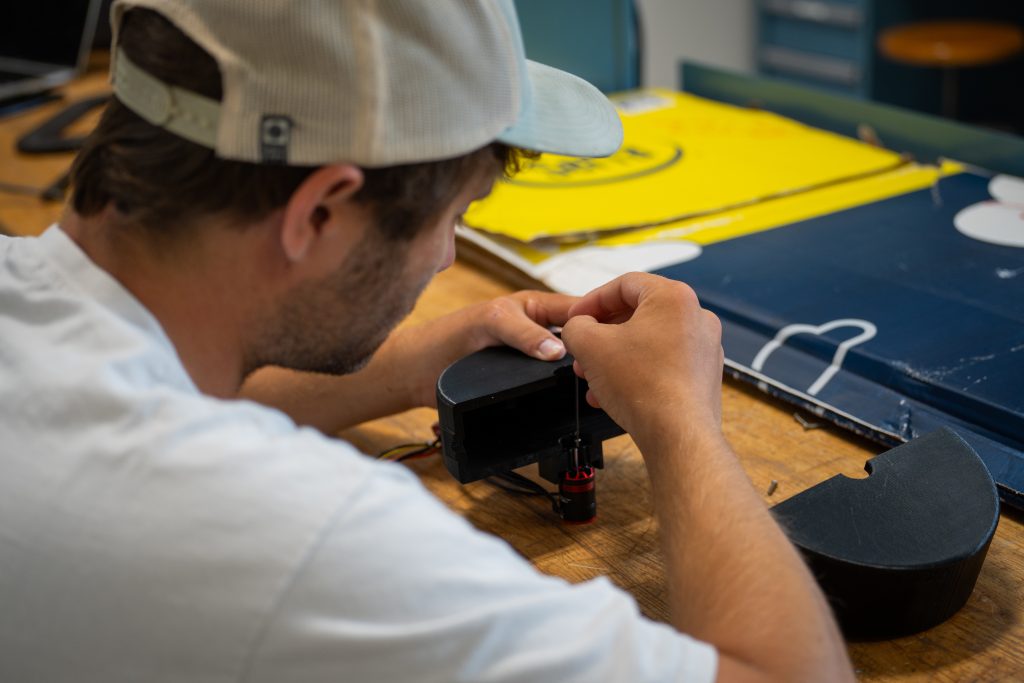
After weeks of design, testing and iteration, Florida Tech’s ocean engineering seniors unveiled prototypes in July’s student design symposium. The four student groups showcased innovation that they hope will advance naval architecture, energy capture, coral reef restoration and autonomous instrument deployment.
The groups developed and finalized their projects through the program’s Marine Field Projects course—a summertime, senior-level class where students apply classroom knowledge to solve complex coastal and ocean engineering problems. They work in teams to design, build and test their own technology, often partnering with industry professionals and researchers.
The class culminates with a symposium, where each group presents and pitches their creations to their peers. Here’s a look.
Coral Reef Block Deployment System
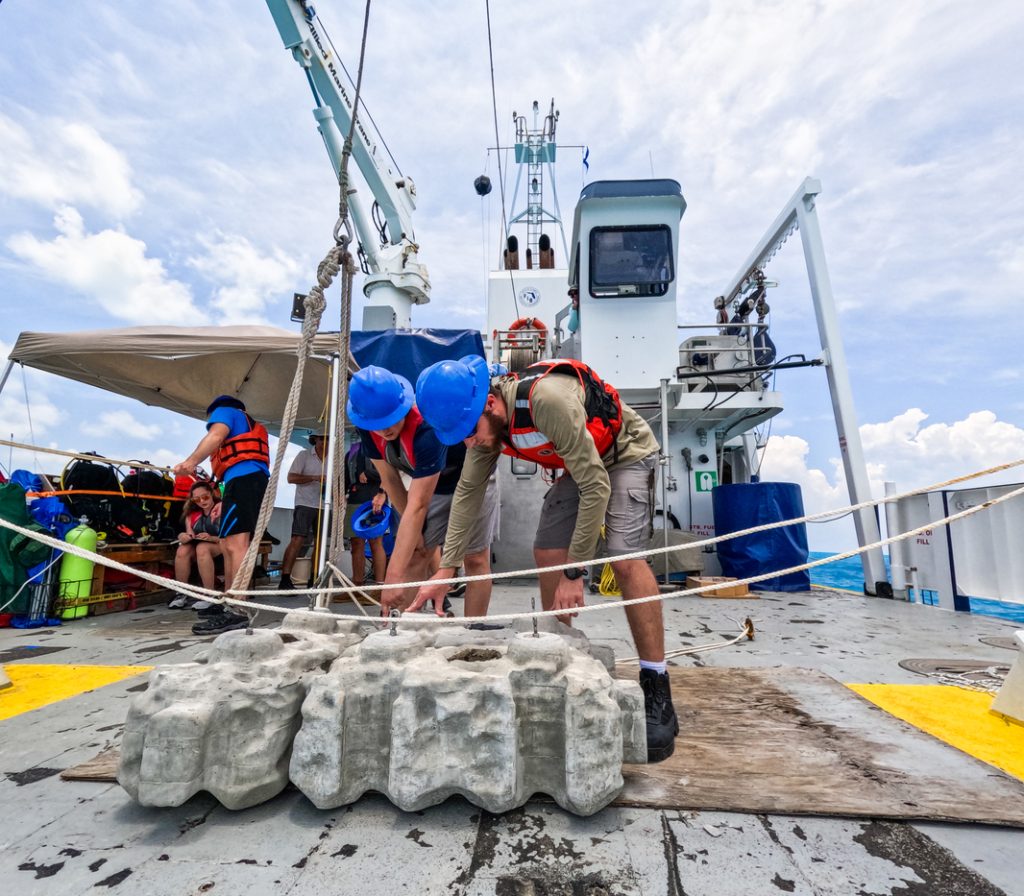
Jacob Elston, Jaidyn Lodens, Dylan Alvarez and Alexander Ketchen hope to help shape the future of coastal restoration, one reef block at a time. They created a single-point hydraulic lift system designed to safely and efficiently deploy heavy interlocking concrete blocks, whether on ground or barge. It’s designed for use in the construction of “ReefStarter,” a coastal engineering initiative being developed by associate professor Robert Weaver that uses modular blocks to build artificial coral reefs, spurs, and berms.
The lifting mechanism is built into a central cavity within the blocks, allowing the blocks to be moved securely and positioned with precision.
“That way, the blocks shouldn’t have any movement, and you should be able to get any orientation that you need to actually place them into the water,” Alvarez said.
The team is currently testing 1/3-scale versions of the blocks and plans to develop a full-scale deployment system. Their design aims to make ReefStarter’s large-scale reef restoration efforts more practical and cost-effective.
Current Capture
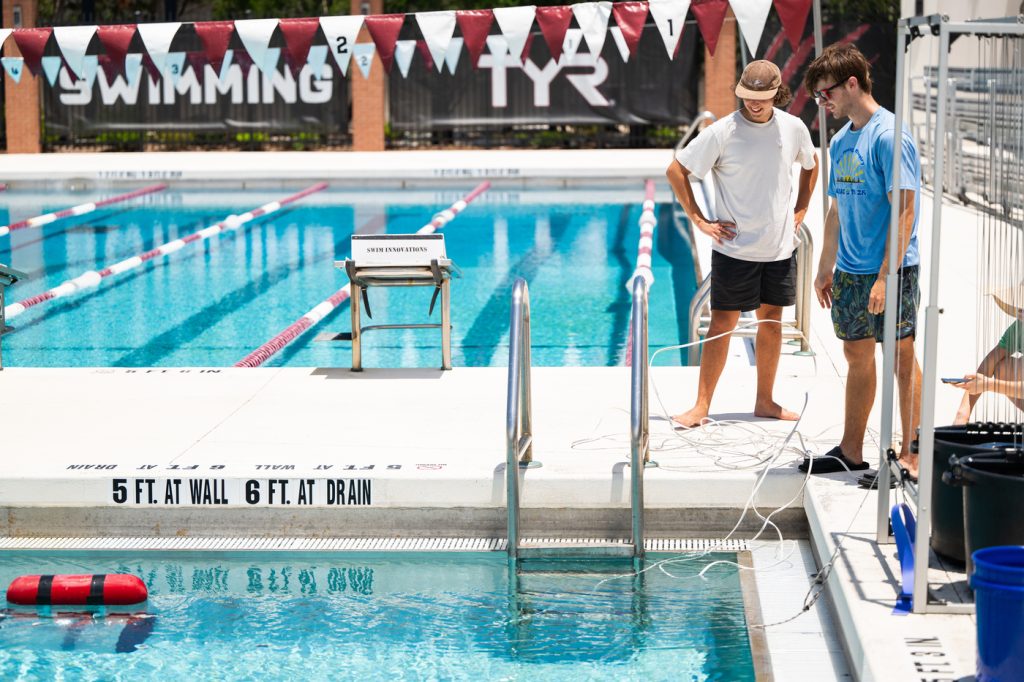
Sofia Scarpa, Maggie Palmer, Ricky Gay, Hayden Linkel and Colin Stefan are working to improve renewable ocean energy with their prototype, Current Capture. It’s a modular, deployable hydro turbine that harnesses ocean currents to generate electricity for ships.
The turbine is designed to be lowered off the stern of a vessel. The current spins the submerged turbine, producing electricity that is transmitted back to the ship.
The group is currently building a small-scale version. If the concept proves viable, they plan to scale it up for commercial applications.
“If we can prove this base concept, hopefully we can get it into the industry,” Scarpa said.
Naval Architecture

Annslee Maloy, Aidan Johnson, William Mullray and Nathan Laplaca are developing a gyroscopic stabilization system for Florida Tech’s 1/23-scale model of the U.S. Navy’s R/V Melville. The 12-foot-long, 530-pound self-propelled research vessel model was acquired by assistant professor Travis Hunsucker in August 2024 through a partnership with the Naval Surface Warfare Center Carderock Division.
Currently, the model only operates in calm conditions. The stabilization system is designed to reduce rolling and enable functionality in various sea states to more accurately simulate the conditions that full-size vessels encounter.
“Our end goal is to test it on the actual model and prove that it reduces the rolling motion of the ship model,” Maloy said.
Project Yellow Cat
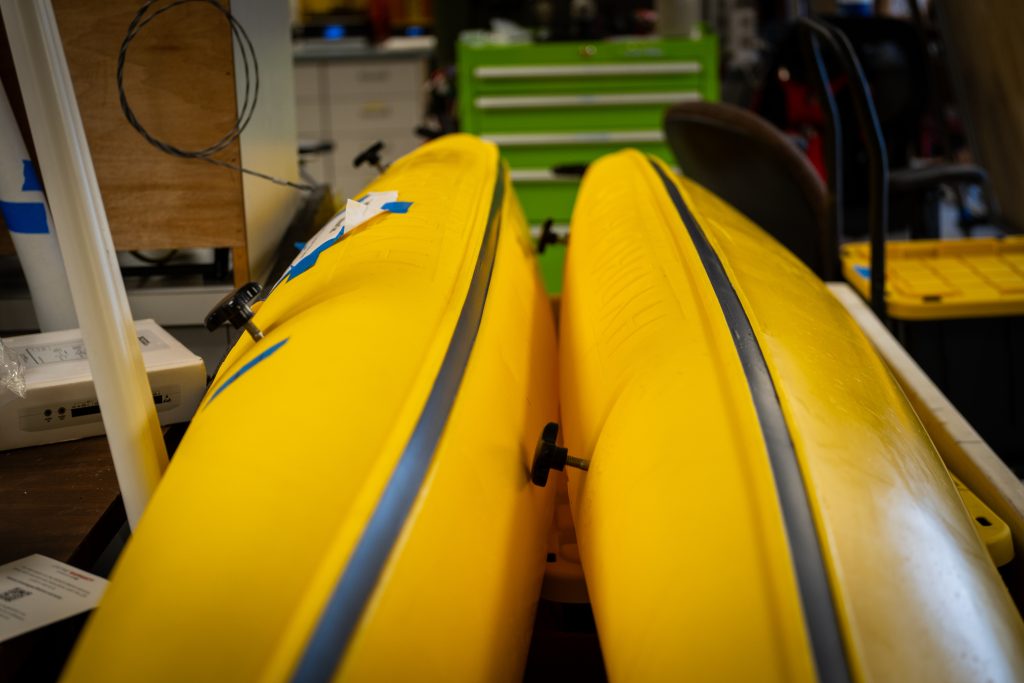
Project Yellow Cat, developed by ocean engineering students Scott Santore, Cruz Halbich and Kyle Griffis, is a proof-of-concept autonomous marine surface vehicle. It is a multipurpose instrumentation platform designed to aid in a wide variety of instrument deployments, including remotely operated vehicles.
Yellow Cat will shuttle instruments from a dock or barge to a deployment site in the water. The vessel’s modular architecture can support both student-designed and commercial underwater equipment, making it a potentially useful university tool for research demonstrations in the Indian River Lagoon and beyond.
“The end goal is to give the school a vehicle that they can take to the water and use,” Santore said. “They can pick any instrument that they want, take it to the river or some patch of water and give it a task to do.”