It was her senior year at Illinois Wesleyan University when Leslie Matuszewich met Gandalf.
Not the wizard—the rat. Specifically, a lab rat assigned to her as part of a class assignment.
She was reading The Hobbit at the time, so the name felt right. Over time, she trained Gandalf through a series of increasingly complex tasks.
The next year, Wayne Dornan, a new Wesleyan faculty member who specialized in behavioral neuroscience, joined the psychology department. It was a field Matuszewich had never heard of. Dornan’s teaching style clicked with her in a way she still finds difficult to explain.
Researching alongside Dornan, presenting their work and hearing his encouragement to apply to graduate school gave her something she hadn’t expected to find: a clear path forward.
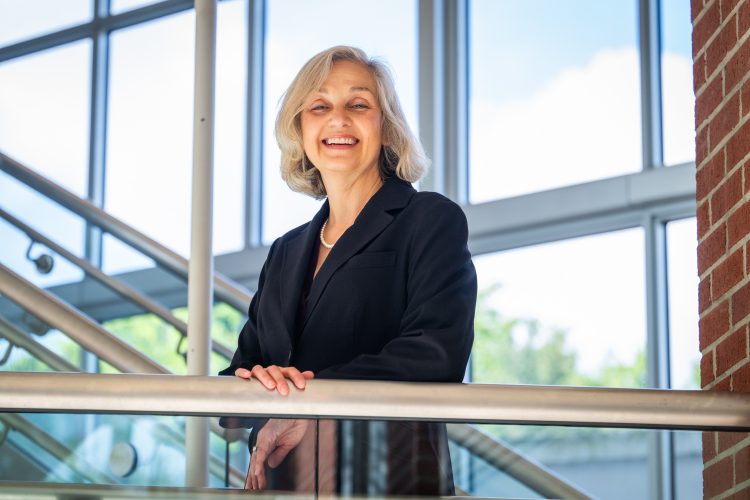
Today, Matuszewich, a behavioral neuroscientist who has spent her career studying what drives people to act, persist and succeed, is settling in as dean of Florida Tech’s College of Psychology and Liberal Arts (COPLA).
The Scientist
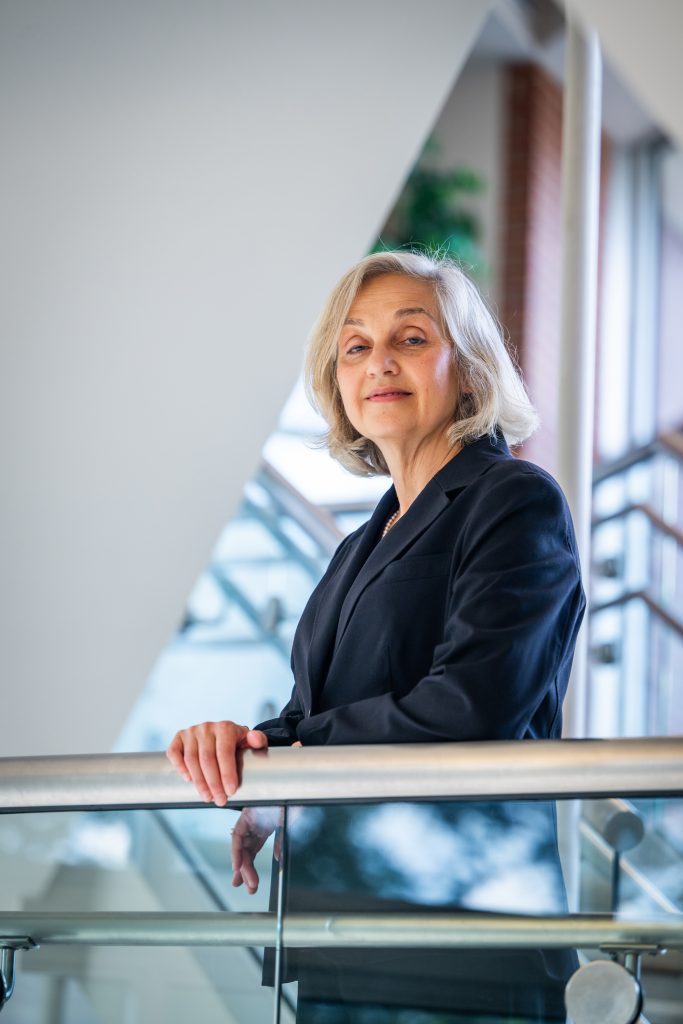
Matuszewich earned her Ph.D. in psychology from the State University of New York at Buffalo, researching dopamine—a neurotransmitter central to motivated behavior, from addiction and eating to sexual behavior.
After completing her Ph.D., Matuszewich accepted a postdoctoral position at Case Western Reserve University, where her research centered on depression and suicidal behavior. The work was important, but it was heavy on brain tissue analysis—and behavior had always been what drew her in.
Matuszewich then returned to animal behavior research as part of a research team, this time studying the vulnerability that chronic stress creates for methamphetamine addiction and its long-term neurological effects. Once she joined the faculty at Northern Illinois University (NIU), her research evolved to examine how stress alters motivated behavior more generally, such as effort to obtain food rewards.
She had spent years studying what drives rats to pursue rewards. Soon, she found herself asking the same questions about her students.
When a student came to discuss their grades, Matuszewich told them they could earn an A if they completed the remaining work. The student’s response stopped her cold.
“I’m fine with a B or C,” the student shrugged.
“I couldn’t understand it. I had always been surrounded by students who were striving for A’s,” she says. “That conversation sparked my interest in understanding why people make different choices about where to invest their time and effort.”
The Leader
At NIU, Matuszewich never stopped teaching—or climbing. She served as director of undergraduate studies and chair of the psychology department before becoming senior associate dean for research and graduate studies in the College of Liberal Arts and Sciences, a role in which she grew the college’s external research funding to more than $31 million.
She describes her leadership style as team-based and people-centered, shaped by years of learning what she didn’t know.
“When I came out of graduate school, I was certain I knew the right path forward,” she says. “Over time, I learned that isn’t true. There are always multiple perspectives to consider. I’m always better off when decisions are informed by shared governance, shared leadership and collaborative discussion.”
Her approach shows up in how she moves through a campus. She prefers to walk rather than stay behind a desk. Seeing people in their own environments helps her understand both the barriers they face and the opportunities available to them, she says.
The Vision
When the COPLA dean position opened at Florida Tech, Matuszewich wasn’t actively searching. Her youngest son had just finished high school and had started college in Colorado. She wasn’t prepared to move from Illinois yet, but the posting caught her attention immediately.
“When I saw the advertisement, I was intrigued, because it’s such a unique college,” she says. “I thought, ‘Oh, I have to apply.’”
She was drawn to Florida Tech’s commitment to student-faculty research, its balance of scale and intimacy, its identity as an R2 doctoral research institution and COPLA’s portfolio across its three schools. She sees COPLA not as a counterweight to Florida Tech’s STEM identity but as an essential component within it.
“COPLA has strengths that I don’t think will be replaced,” she says.
She points to The Scott Center for Autism Treatment, to behavior analysts and licensed counselors graduating from the behavior analysis and psychology schools, and to the growing demand for professionals who work directly with people. She also sees an opening for the School of Arts and Communication to serve the rest of Florida Tech in a new way, helping scientists and engineers translate their work for broader audiences.
“One of the growing areas in science is public-facing science communication,” Matuszewich says. “We need chemists, biologists and physicists to be able to communicate their work. That’s one of the things I find most exciting.”
Her goals for the first few years are methodical: Learn the college; amplify what is working; and build partnerships within the university and throughout the community to ensure that COPLA’s contributions are visible and understood.
The New Adventure
Matuszewich moved to Florida with her partner, Ross, and their two cats. Their sons, Michael and Peyton, are in college: Michael studies statistics at Iowa State University, and Peyton studies accounting at the University of Colorado – Colorado Springs. Matuszewich and Ross are, as she puts it, “free birds.”
She already has her eye on cultivating a garden. A devoted grower of all kinds of plants, she acknowledges she is not especially scientific about it. She just likes to try things and see what happens.
“I am looking forward to learning about new plants that thrive in Florida,” she says.
It is a small thing, perhaps. But for someone who has spent a career studying what motivates living things to grow—and who now has a college of her own to tend—it feels exactly right.
Get to Know Leslie…
HOME: “I am originally from Chicago, Illinois. I was born and raised in the city, on the North Side.”
THREE VALUES AS DEAN: Transparency, ethics, student success
STAYING MOTIVATED WHEN THINGS GET HARD: “What keeps me motivated is finding a piece of the problem that I can actually influence, making progress on it and seeing that progress lead toward a larger goal. I also eat chocolate and ice cream. A lot of ice cream.”
FAVORITE PIECE OF ADVICE: “Value the process rather than the outcome.”
FREE TIME: “I spend a lot of time walking or hiking as often as possible. I also love to cook and garden. Growing plants is one of my joys. I like trying new plants, especially flowering. I enjoy watching sports. If given the opportunity, you will find me at some Panthers sporting events.”

This piece was featured in the fall 2026 edition of Florida Tech Magazine.