Laugh, then think.
While this might be the three-word formula for living a fulfilling life, it is also the guiding philosophy behind an event celebrating achievements in science and engineering from renowned scholars…who are wearing costumes; in front of an international audience of 1,500…all of whom throw paper airplanes at the stage; and that features distinguished thinkers each offering 24/7 lectures summarizing their work…as in each one lasts 24 seconds and also must be explained in seven words.
What pray tell is this ignoble endeavor? Yes.
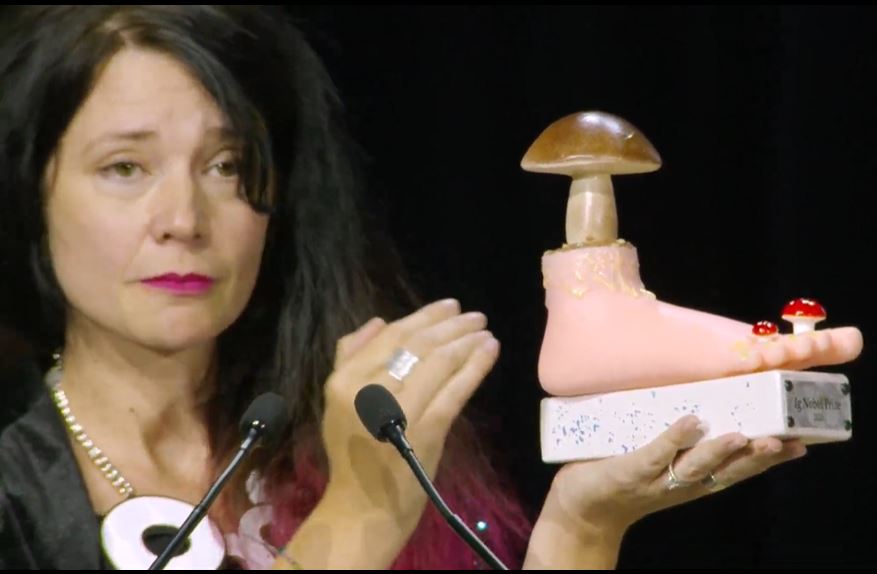
Welcome to the 36th First Annual Ig Nobel Ceremony, home to all the above and so much more, including amazing science from the world’s leading universities (Florida Tech among them), and a cadre of actual Nobel Prize laureates – Esther Duflo, Abhijit Banerjee, Michel Mayor and Tim Hunt – who hand each of 10 winning teams their award – a severed foot with mushrooms growing out of it. (The event theme was “fungi.”)
First up on the stage in Zurich, Switzerland, on Tuesday was the biomechanics prize…and two frolicking apes, their thick, hairy arms barely fitting through the Florida Tech t-shirts each donned.
Under one was associate professor Catherine Talbot from the School of Psychology (the other was her very supportive husband, Dylan Kinser), who joined lead author Matilda Brindle from the University of Oxford and co-author Stuart West, also at Oxford, in accepting the Ig Nobel for their 2025 paper, “A comparative approach to the evolution of kissing,” published in the journal Evolution and Human Behavior
“I am over the moon,” Talbot said the next day. “I think we were all a bit shocked and truly honored to share the stage with such respected scientists from around the world.”
Their paper reconstructs the evolutionary history of kissing – it was an ancient trait in large apes, they found, thus the costumed primate canoodlers on stage – and developed a definition of kissing that is a tad more technical than “lip-locking”: non-agonistic interactions involving directed, intraspecific oral-oral contact with some movement of the lips or mouth parts and no food transfer.
Talbot carried memories of her “academic” grandfather – the pioneering primatologist Frans de Waal, whose work was a huge inspiration to her – to the stage. He won an Ig Nobel in 2012 for chimpanzee research, specifically for discovering that chimpanzees can identify individual group members from photographs of their rear ends.

“I never imagined standing on that stage myself,” she said.
Other winners of the 36th Ig Nobel prizes included:
>> Economics for finding that upper-class people are more likely to swipe from a child’s stash of candy, among other unethical behavior;
>> Chemistry for discovering that milk proteins from cockroaches pack three times as much energy as milk proteins from cows;
>> Physics for theoretical and experimental attempts to design a splash-free urinal.
For the silliness and shenanigans, the Ig Nobel prizes are serious about showing how important science can come in many forms on many topics.
“The Ig Nobels are a fantastic tradition, bathed in circus, opera and comedy,” Talbot said. “Of course, it’s all very silly, but more than that, it celebrates the natural curiosity that leads to blue-sky thinking, which is fundamental to driving science forward.
“That’s really the heart of it for me: blue-sky research doesn’t always come with an obvious payoff upfront, and it doesn’t need to,” she continued. “Some of history’s most useful discoveries started with someone just being curious about something strange.”